
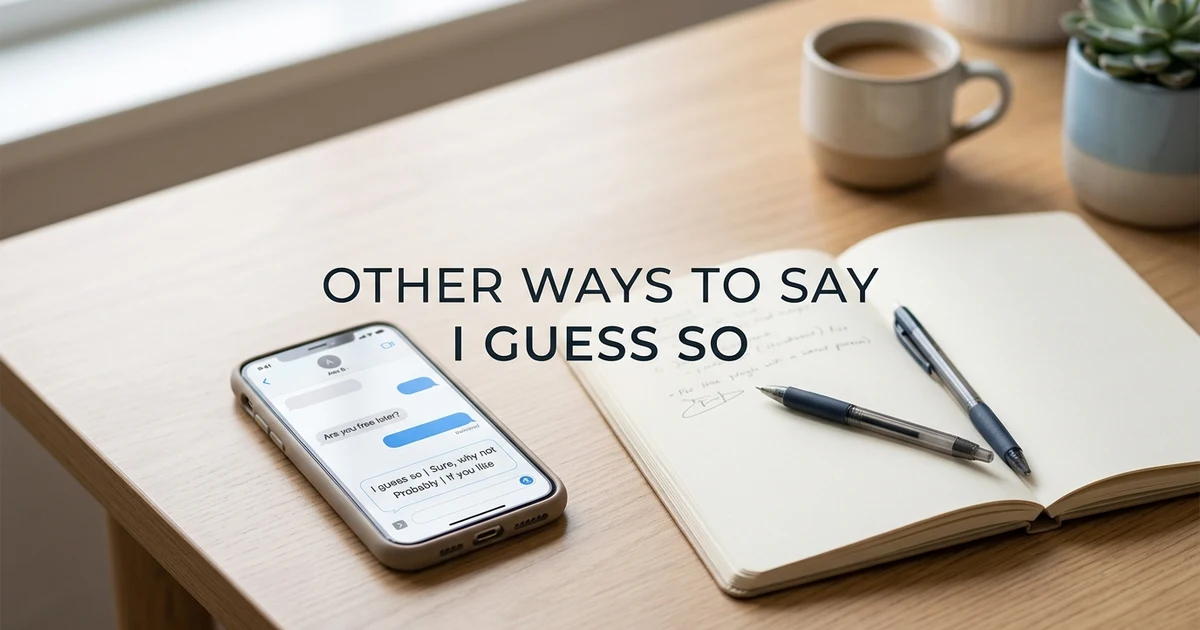
Sometimes you want to respond to a question without sounding too certain. The phrase i guess so can work in casual conversation, but it may sound hesitant, uncertain, or slightly uninterested depending on the situation. If you are looking for other ways to say respond i guess so, you may want a phrase that sounds more natural, polite, confident, friendly, or professional.
The best alternative depends on what you actually mean. You might agree with someone, accept an idea without much enthusiasm, or simply show that you are not completely sure. Choosing the right wording helps your message match your intended tone.
Quick Answer
Other ways to say i guess so include I suppose so, probably, I think so, most likely, I believe so, that sounds right, I would say so, and I think that is probably true. These alternatives can express agreement or uncertainty with slightly different levels of confidence. For professional communication, I think so or I believe so usually sounds clearer than i guess so.
TL;DR
- Meaning: A hesitant way to agree or say something is probably true.
- Tone: Casual, uncertain, sometimes indifferent.
- Common use: Texting, chats, everyday conversations, and informal replies.
- Where it appears: Messages, social media, group chats, and spoken conversation.
- Formal or informal: Mostly informal.
- Best alternatives: I suppose so, I think so, probably, most likely, or I believe so.
What Other Ways to Say I Guess So Mean
The phrase i guess so usually means yes, probably or I think that is true, but it does not express complete confidence.
For example:
- Are you coming with us?
I guess so.
This reply suggests that the person will probably come, but they do not sound completely certain or enthusiastic.
Depending on the context, the phrase can communicate:
- Uncertainty
- Mild agreement
- Reluctant agreement
- Indifference
- Lack of information
- A casual response
The alternative you choose should reflect the exact feeling you want to communicate.

Full Form or Basic Explanation
I guess so is not an abbreviation. It is a casual phrase built around the verb guess.
Here, guess does not necessarily mean making a random prediction. It often softens an answer and shows that the speaker does not feel completely certain.
Compare these responses:
- Yes, definitely. Strong confidence
- I think so. Moderate confidence
- I guess so. Some uncertainty
- Probably. Likely, but not certain
- I am not sure. Clear uncertainty
This difference matters because two phrases can have almost the same basic meaning while giving a very different impression.
How People Use It in Texting or Online Conversation
In texting, i guess so often appears as a short response to a question or statement.
For example:
- Are you free later?
I guess so. - So you agree with me?
I guess so. - You are taking the earlier train, right?
I guess so.
People often use it because it feels quick and natural. In a casual chat, it usually does not need additional explanation.
However, the phrase can sometimes sound less enthusiastic than the writer intended. If someone asks you to join a plan, for example, I guess so may sound like you do not really want to go.
For a warmer response, you could use:
- Sure, I think so.
- Probably, yes.
- I believe so.
- That sounds right.
- Yes, most likely.

Tone and Emotional Meaning
The tone depends heavily on context.
Casual
I guess so works naturally among friends, classmates, or people having an informal conversation.
Uncertain
It can show that you do not have enough information to give a definite answer.
Reluctant
Sometimes it suggests agreement without much enthusiasm.
Indifferent
A short i guess so can occasionally make the speaker sound uninterested.
Softened
It can also make an answer less blunt. Instead of saying yes with complete certainty, the speaker leaves room for doubt.
Because text does not carry facial expressions or voice tone, readers may interpret a short reply differently from what you intended.
Common Situations Where It Appears
You may see this type of response in:
- Casual text messages
- Group chats
- Conversations with friends
- Social media messages
- Informal questions
- Discussions about uncertain plans
- Everyday spoken English
- Quick replies to simple questions
It works best when the conversation already has a relaxed tone.
For more serious situations, a clearer response usually works better.
Examples in Real Conversations
Situation: Confirming a plan
Example:
Are we meeting at 6?
I think so.
Meaning:
The person believes the meeting is at 6 but does not feel completely certain.
Situation: Agreeing with an opinion
Example:
That was probably the best option.
I suppose so.
Meaning:
The speaker agrees, but in a somewhat reserved way.
Situation: Answering a casual question
Example:
Are you staying for dinner?
Probably.
Meaning:
The person expects to stay but does not want to make a definite commitment.
Situation: Confirming information
Example:
This is the right address, right?
I believe so.
Meaning:
The speaker thinks the information is correct and sounds slightly more confident than i guess so.
Situation: Showing stronger confidence
Example:
Do you think she will come?
Most likely.
Meaning:
The person expects her to come but recognizes that it is not guaranteed.
Situation: Giving a relaxed agreement
Example:
That seems like a good idea.
That sounds right.
Meaning:
The response shows agreement without sounding overly formal.
Similar Terms or Related Phrases
| Phrase | Confidence | Tone | Best Use |
|---|---|---|---|
| I guess so | Low to moderate | Casual, hesitant | Informal chats |
| I suppose so | Moderate | Reserved | Casual or semi-formal conversation |
| I think so | Moderate | Neutral | Everyday communication |
| I believe so | Moderate to high | Polite, professional | Work or formal conversations |
| Probably | Moderate | Direct | Casual or professional contexts |
| Most likely | High | Confident | When something seems very likely |
| I would say so | Moderate | Conversational | Discussions and opinions |
| That sounds right | Moderate | Friendly | Confirming information |
| I suppose you are right | Moderate | Conceding | Agreeing with someone |
| I believe that is correct | High | Formal | Professional communication |
When You Should Use It
A hesitant response works well when you genuinely do not feel completely certain.
Use it when:
- You are making a casual guess.
- You want to avoid sounding overly certain.
- You are discussing an informal plan.
- You agree but want to leave some room for doubt.
- The conversation has a relaxed tone.
- The other person already understands the context.
For example, if a friend asks whether you think a restaurant will still have tables available, I guess so can sound perfectly natural.
If you want to sound more confident, choose I think so or most likely instead.
When You Should Avoid It
Avoid i guess so when the situation requires a clear or confident answer.
It may sound inappropriate when:
- Responding to a manager or client
- Confirming important work information
- Answering a formal request
- Giving instructions
- Confirming a deadline
- Discussing an important decision
- The other person needs certainty
For example, if your manager asks whether you completed an important task, I guess so can sound careless.
A clearer response would be:
- Yes, I completed it.
- I believe it is complete.
- Yes, I have finished it.
- I will confirm and get back to you.
Is It Formal or Informal?
I guess so is informal.
It fits naturally in casual texting, conversations with friends, family discussions, and relaxed online communication.
It can work in some workplace conversations if the relationship is casual and the topic is unimportant. However, it generally does not work well in formal emails, professional reports, academic writing, or important business communication.
For professional situations, consider:
- I believe so.
- I think that is correct.
- That appears to be the case.
- Based on the information available, yes.
- I believe that is accurate.
These options make your meaning clearer and more professional.
Common Misunderstandings
The biggest issue with i guess so comes from its uncertain tone.
Someone may interpret it as simple uncertainty, while another person may hear reluctance or annoyance.
For example:
Are you coming to the party?
I guess so.
This could mean:
- I probably will come.
- I am not completely sure.
- I will come, but I am not excited about it.
- I do not really care either way.
The surrounding conversation usually determines the intended meaning.
If you want to avoid confusion, use a more specific response such as I think I can make it, I am probably coming, or I am not sure yet.
USA and Tier 1 Country Usage
I guess so is widely understandable in everyday English across the United States, Canada, the UK, Australia, and other English-speaking settings. The exact emotional impression can vary with the speaker and situation, but the basic meaning remains easy to understand.
In American texting, the phrase commonly works as a relaxed and slightly hesitant response. Similar wording also appears in British, Canadian, and Australian informal conversation.
The main difference comes from context rather than geography. A friendly conversation can make i guess so sound harmless, while a serious conversation can make the same phrase sound dismissive or uncertain.
Quick Reference Table
| Context | What It Means | Tone | Best Use | Avoid If |
|---|---|---|---|---|
| Casual texting | Probably yes | Relaxed | Friends and family | You need certainty |
| Group chat | Mild agreement | Informal | Casual discussions | Important decisions |
| Social media | Probably true | Casual | Comments and replies | Professional communication |
| Dating chat | Uncertain agreement | Reserved | Informal conversation | You want to sound enthusiastic |
| Workplace chat | Probably | Informal | Low-stakes topics | Important work matters |
| Professional email | Uncertain agreement | Too casual | Rarely appropriate | Formal communication |
| Academic writing | Probably | Informal | Generally unsuitable | Essays and reports |
| Everyday conversation | Probably yes | Neutral to hesitant | Informal speaking | Clear confirmation is needed |
Conclusion
I guess so is a casual way to express agreement while showing some uncertainty. It can mean probably yes, I think so, or I suppose so, depending on the conversation and tone. Although it works naturally in texting and everyday speech, it can sometimes sound reluctant or uninterested.
If you want a more confident response, use I think so, most likely, or I believe so. For professional communication, clearer phrases such as I believe that is correct usually work better. The best alternative depends on whether you want to sound casual, polite, confident, uncertain, or professional.
FAQs
What does i guess so mean in text?
In text, i guess so usually means probably yes or I think that is true. It can also suggest uncertainty or mild reluctance, depending on the surrounding conversation.
What does i guess so mean in texting?
In texting, the phrase gives a casual and slightly uncertain response. It often means the person agrees but does not feel completely confident or enthusiastic.
Is i guess so rude?
Not usually. However, a very short reply can sound dismissive or uninterested, especially when someone expects an enthusiastic or definite answer.
Can I use i guess so in a professional message?
You can, but it usually sounds too casual or uncertain for formal communication. I believe so or I think that is correct generally works better.
What is a better way to say i guess so?
Good alternatives include I think so, I suppose so, probably, most likely, I believe so, and that sounds right. Choose one based on the level of confidence you want to express.
Is I suppose so more polite than I guess so?
Often, yes. I suppose so can sound slightly more measured and polite, while i guess so tends to feel more casual and conversational.
What is the difference between I think so and I guess so?
I think so usually sounds more confident. I guess so suggests greater uncertainty and may sometimes sound reluctant or indifferent.