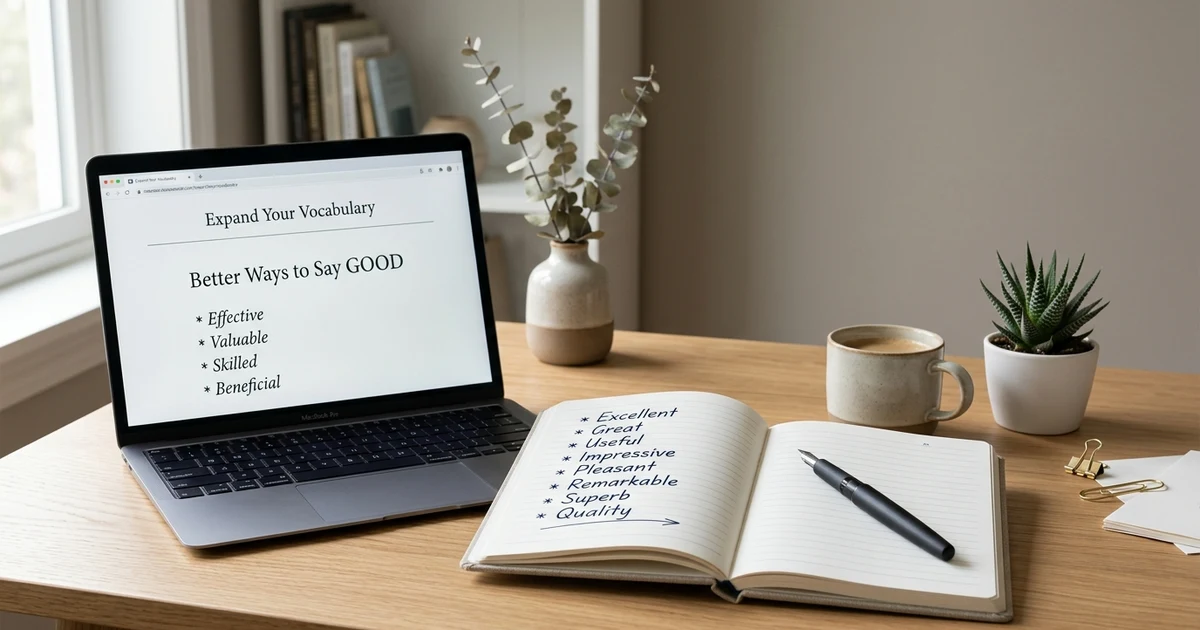
Finding other ways to say good can make your writing and conversations sound more natural, specific, and engaging. The word good works in many situations, but it can feel too general when you want to describe quality, performance, feelings, food, appearance, or someone’s character.
The best alternative depends on the context. Excellent may fit a professional compliment, while great sounds natural in everyday conversation. Pleasant works well for experiences, impressive suits achievements, and kind describes someone’s character. Choosing the right word helps your message sound more precise without making it overly formal.
Quick Answer
Other ways to say good include excellent, great, wonderful, positive, impressive, solid, useful, enjoyable, pleasant, effective, and admirable. The best choice depends on what you are describing and how formal you want to sound.
TL;DR
- Meaning: Good usually describes something positive, satisfactory, useful, or pleasing.
- Tone: It sounds neutral, friendly, and widely acceptable.
- Common use: People use it for work, food, experiences, results, behavior, and general opinions.
- Where it appears: Everyday conversation, texts, emails, reviews, school writing, and workplace communication.
- Formal or informal: Good works in both settings, but more precise alternatives can make professional or academic writing stronger.
What Other Ways to Say Good Means
The phrase refers to alternative words and expressions that communicate a positive idea without repeatedly using good.
The right replacement depends on the exact meaning. For example:
- Good work can become excellent work or impressive work.
- Good food can become delicious food or flavorful food.
- Good idea can become smart idea or practical idea.
- Good person can become kind person or trustworthy person.
- Good result can become strong result or successful outcome.
- Good experience can become enjoyable experience or memorable experience.
This distinction matters because good has several meanings. Replacing it with a random synonym can change the message.

Basic Explanation and Useful Alternatives
Here are some common alternatives and the situations where they fit best:
| Alternative | Best for | Tone |
|---|---|---|
| Excellent | Quality, work, performance | Strong and professional |
| Great | General praise | Friendly and natural |
| Wonderful | Experiences, events, feelings | Warm |
| Excellent | Results and achievements | Professional |
| Impressive | Skills and accomplishments | Positive and specific |
| Positive | Results, attitudes, feedback | Neutral |
| Pleasant | Experiences, weather, interactions | Polite |
| Enjoyable | Activities and experiences | Casual |
| Effective | Methods, plans, solutions | Professional |
| Useful | Tools, advice, information | Practical |
| Solid | Work, choices, performance | Casual and confident |
| Admirable | Character and behavior | Respectful |
| Remarkable | Unusual achievements or qualities | Strong |
| Satisfying | Results and experiences | Reflective |
| Favorable | Conditions, outcomes, opinions | Formal |

How People Use These Alternatives in Texting or Online Conversation
In casual texting, people usually prefer short and familiar words. Great, awesome, nice, amazing, solid, and fantastic can work naturally depending on the situation.
For example:
- That sounds great.
- Nice work on the project.
- That was amazing.
- The plan looks solid.
- I had a really enjoyable weekend.
Social media comments often use stronger words because a simple good can sound less expressive.
A comment such as impressive work, beautiful photo, or amazing result gives the reader more information than simply saying good.
In professional messages, choose words that match the situation rather than trying to sound overly enthusiastic. Strong, effective, excellent, helpful, and successful often work well.
Tone and Emotional Meaning
The alternative you choose can change the emotional tone of your sentence.
Great feels friendly and conversational. It works well in texts and everyday speech.
Excellent sounds stronger and more professional. Teachers, managers, and colleagues may use it when praising quality or performance.
Wonderful adds warmth and often describes experiences or personal moments.
Impressive suggests that something exceeded expectations or deserves recognition.
Pleasant sounds calm and polite. It works well for conversations, visits, weather, or experiences.
Solid sounds relaxed and confident. It often means something is reliable or reasonably strong rather than extraordinary.
Admirable focuses more on a person’s behavior, effort, or values.
Common Situations Where You Can Replace Good
Describing Work
Instead of good work, try:
- Excellent work
- Strong work
- Impressive work
- High-quality work
- Well-done work
For a professional setting, excellent work or strong work often sounds more specific than good work.
Describing Food
Instead of good food, consider:
- Delicious food
- Flavorful food
- Tasty food
- Enjoyable meal
- Well-prepared meal
Choose a word that describes the actual quality you noticed.
Describing a Person
Instead of good person, you might say:
- Kind person
- Caring person
- Honest person
- Reliable person
- Thoughtful person
- Trustworthy person
A specific quality usually communicates more than a broad compliment.
Describing an Idea
Instead of good idea, try:
- Great idea
- Smart idea
- Practical idea
- Useful suggestion
- Strong proposal
- Promising idea
Describing a Result
Instead of good result, try:
- Strong result
- Positive outcome
- Successful result
- Favorable outcome
- Impressive result
Examples in Real Conversations
Situation: Praising Someone’s Work
Example: You did an excellent job on the presentation.
Meaning: You are giving clear and strong praise for the person’s performance.
Situation: Responding to a Friend
Example: That sounds great. I would be happy to join.
Meaning: You are showing friendly approval.
Situation: Discussing a Restaurant
Example: The food was delicious, especially the pasta.
Meaning: You are giving a more specific compliment about the food.
Situation: Workplace Feedback
Example: This is a strong proposal with a clear structure.
Meaning: You are giving positive but professional feedback.
Situation: Describing an Experience
Example: We had a really pleasant afternoon.
Meaning: The experience felt enjoyable and comfortable.
Situation: Complimenting an Achievement
Example: That was an impressive result considering the short deadline.
Meaning: You recognize the quality of the achievement and its difficulty.
Situation: Describing a Helpful Resource
Example: This guide is useful for anyone learning the basics.
Meaning: You are focusing on practical value rather than general quality.
Similar Terms and Related Phrases
Some alternatives appear similar but carry slightly different meanings.
Good vs Great
Good usually expresses general approval. Great sounds stronger and more enthusiastic.
Good: The movie was good.
Great: The movie was great.
Good vs Excellent
Excellent represents a higher level of praise and often sounds more professional.
Good: You did good work.
Excellent: You did excellent work.
Good vs Nice
Nice often describes something pleasant, attractive, kind, or enjoyable.
Good: We had a good evening.
Nice: We had a nice evening.
Good vs Positive
Positive works especially well for results, feedback, attitudes, changes, and outcomes.
Good: We received good feedback.
Positive: We received positive feedback.
Good vs Effective
Effective means something successfully produces the intended result.
Good: This is a good method.
Effective: This is an effective method.
The second version tells the reader why the method deserves praise.
When You Should Use These Alternatives
Choose a replacement when the word good feels too broad or repetitive.
Useful choices include:
- Excellent for strong professional praise
- Great for casual approval
- Impressive for achievements
- Pleasant for experiences
- Delicious for food
- Effective for methods and solutions
- Useful for resources and advice
- Kind for personal character
- Successful for results
- Promising for ideas or future possibilities
Specific language usually makes your writing clearer.
When You Should Avoid Replacing Good
You do not need to replace good every time you use it. Good remains one of the most natural and flexible words in English.
Avoid forcing a stronger synonym when:
- You only want to give simple approval.
- The stronger word would exaggerate your opinion.
- The conversation is casual and a simple response sounds more natural.
- You are describing something that is satisfactory but not exceptional.
- The alternative changes the original meaning.
For example, calling an ordinary meal excellent may sound exaggerated if you only thought it was satisfactory.
Is It Formal or Informal?
Good itself works in almost every level of communication. You can use it in casual texts, workplace messages, emails, school writing, and everyday speech.
Some alternatives fit particular contexts better.
| Setting | Natural choices |
|---|---|
| Casual texting | Great, nice, awesome, solid |
| Friendly conversation | Great, wonderful, nice |
| Workplace email | Excellent, strong, effective, positive |
| Academic writing | Effective, beneficial, positive, valuable |
| Reviews | Enjoyable, impressive, satisfying, well-made |
| Performance feedback | Strong, impressive, excellent |
| Personal compliments | Kind, thoughtful, admirable |
In formal writing, specific words often communicate more clearly than repeatedly using good.
Common Misunderstandings
One common mistake involves treating every synonym as interchangeable. English alternatives often carry different levels of emotion and precision.
For example, useful does not simply mean good. It means something provides practical value.
Likewise, pleasant does not necessarily mean excellent. It usually describes something comfortable or enjoyable.
The word impressive suggests that something deserves attention or admiration. That makes it stronger than a neutral positive description.
Context also affects tone. A short response such as good can sound perfectly friendly in one conversation but slightly dismissive in another, especially if someone expected a more detailed reaction.
USA and Tier 1 Country Usage
Good remains extremely common in everyday English across the United States, Canada, the UK, Australia, and New Zealand.
The alternatives are also widely understood across these varieties of English. Words such as great, excellent, nice, impressive, useful, effective, and wonderful generally work without requiring regional explanation.
The main difference comes from context rather than geography. A workplace email may favor strong or excellent, while a text to a friend may naturally use great or nice.
Regional vocabulary can vary slightly in casual speech, but standard alternatives remain broadly understandable across English-speaking countries.
Quick Reference Table
| Context | What It Means | Tone | Best Use | Avoid If |
|---|---|---|---|---|
| Excellent | Very high quality | Professional | Work and achievements | The quality is only average |
| Great | Strong approval | Friendly | Texts and conversation | You need very precise wording |
| Wonderful | Very enjoyable or pleasing | Warm | Experiences and events | You want a neutral tone |
| Impressive | Deserves admiration | Positive | Achievements and skills | Nothing stands out |
| Pleasant | Comfortable or enjoyable | Polite | Experiences and interactions | You mean exceptional quality |
| Effective | Produces the intended result | Professional | Methods and solutions | You only mean enjoyable |
| Useful | Provides practical value | Neutral | Information and resources | You mean emotionally positive |
| Solid | Reliable or reasonably strong | Casual | Work and decisions | You need formal academic language |
| Admirable | Deserving respect | Respectful | Character and actions | You only mean satisfactory |
| Positive | Favorable or beneficial | Neutral | Feedback and outcomes | You mean excellent quality |
Conclusion
There are many natural ways to express the idea behind good, but the best choice depends on what you actually want to communicate. Great works well in casual conversation, excellent suits stronger professional praise, and words such as effective, useful, pleasant, impressive, or kind provide more specific meaning.
Using a more precise word can make a message sound clearer without making it complicated. At the same time, there is nothing wrong with using good when simple approval is all you need. The goal is not to replace it everywhere, but to choose a word that matches the situation, tone, and exact meaning.
FAQs
What are the best alternatives to good?
Common alternatives include great, excellent, wonderful, impressive, positive, pleasant, effective, useful, solid, and admirable. The best option depends on what you are describing.
What is a professional way to say good?
Excellent, strong, effective, positive, valuable, and impressive can work well in professional communication. Choose the word that describes the specific quality you want to highlight.
What is another way to say good in text?
Great, nice, solid, awesome, excellent, and impressive can work in casual texts. Great and nice are especially natural for everyday conversations.
Is good too informal for a professional message?
No. Good is completely acceptable in professional communication. However, a more specific word such as effective, strong, or excellent can make workplace feedback more informative.
What is another way to say good job?
You can say excellent work, great work, impressive work, strong work, well done, or you handled that well. The best option depends on how formal and enthusiastic you want to sound.
What is a stronger word than good?
Excellent, outstanding, exceptional, remarkable, and impressive are stronger than good. Use them only when the situation genuinely deserves stronger praise.
How can I avoid repeating good in my writing?
First identify what you mean by good. If you mean useful, say useful.you mean successful, say successful. If you mean enjoyable, say enjoyable. Specific words make writing more precise and reduce repetition.