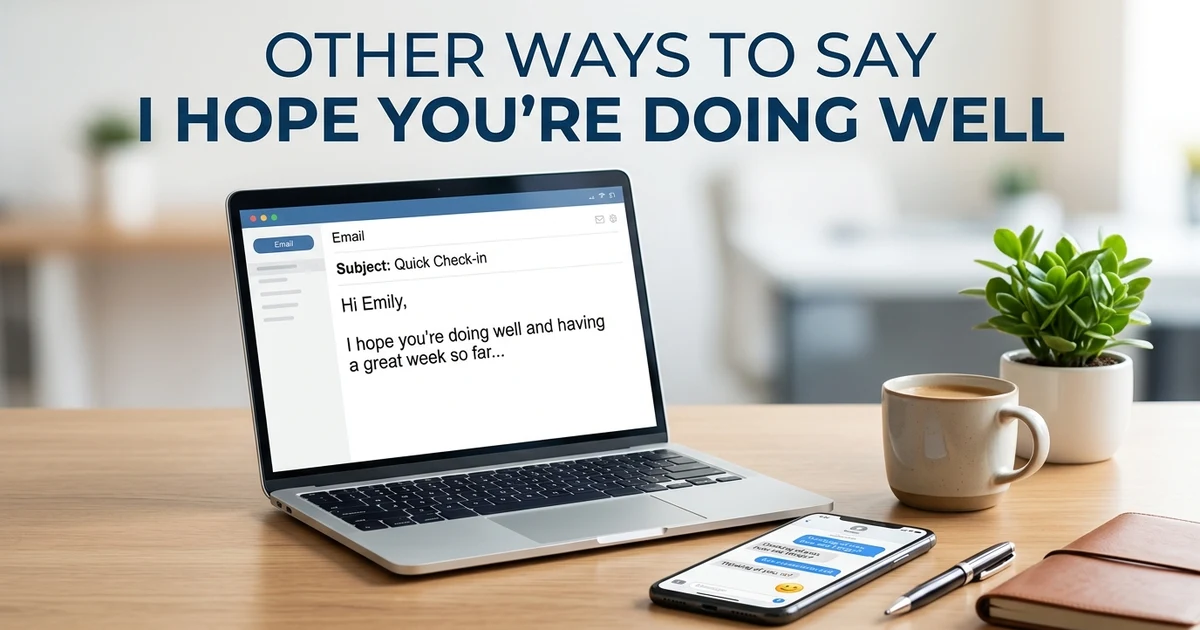
Finding other ways to say I hope youre doing well can help you make a message sound warmer, more professional, more personal, or simply less repetitive. The phrase works well in emails, texts, LinkedIn messages, follow-ups, and everyday conversations, but the best alternative depends on who you are contacting and why.
A thoughtful opening can make a message feel natural without sounding overly formal. You might want a professional alternative for a coworker, a friendly version for an old friend, or a short option for someone you have not spoken to recently.
Quick Answer
Good alternatives include I hope youre doing well, I hope things are going well for you, I hope youre having a good week, I hope all is well with you, and I hope youre doing great. For professional messages, I hope things are going well and I hope your week is going smoothly sound natural. For friends, How have you been and Hope things have been good are more conversational.
TL;DR
- Meaning: You are checking in and expressing a positive wish about someones situation.
- Tone: Usually polite, friendly, warm, and respectful.
- Common use: Emails, follow-ups, texts, professional communication, and personal messages.
- Where it appears: Work emails, LinkedIn, social media messages, casual texts, and conversations.
- Formal or informal: The original phrase works in both settings, but some alternatives fit specific situations better.
- Best approach: Choose an alternative based on your relationship with the person and the purpose of your message.
What I Hope Youre Doing Well Means
The phrase I hope youre doing well expresses a simple wish that the other person is feeling good and that things are going positively in their life.
It often appears at the beginning of a message, especially when you have not spoken to someone recently. It can also serve as a polite transition before getting to the main reason for contacting them.
For example:
- I hope youre doing well. I wanted to follow up about our meeting.
- I hope youre doing well. How has your new role been going?
- I hope youre doing well. I wanted to check whether you received my email.
The phrase does not necessarily suggest that you know anything specific about the persons situation. It simply communicates goodwill.
That makes it flexible, but it can also feel routine if you use it in every email. Choosing a more specific alternative can make your message sound more personal.

Full Form or Basic Explanation
I hope youre doing well is not an abbreviation or slang expression. It is a complete conversational phrase.
The meaning can be understood in three parts:
- I hope: You are expressing a positive wish.
- Youre: Short for you are.
- Doing well: You are generally okay, healthy, happy, or having things go reasonably well.
In simple words, the phrase means that you wish the other person is okay and that life is going well for them.
The exact meaning can change slightly according to context. In a workplace email, it may simply be a polite greeting. In a message to someone you care about, it can communicate genuine concern or warmth.

How People Use It in Texting or Online Conversation
People commonly use this expression as an opening line before moving into the main point of a message.
In texting, people often shorten the idea and use more conversational alternatives:
- Hope youre doing well.
- Hope all is good.
- How have you been?
- Hope things are going well.
- How are things with you?
- Hope youre having a good week.
On social media, the wording often becomes even more relaxed. Someone reconnecting with an old friend might write Hope youve been well or How have you been lately?
In professional online communication, the full phrase remains common because it sounds polite without being excessively formal.
For example:
I hope youre doing well. I wanted to ask about the project timeline.
A LinkedIn message might use:
Hope things are going well with you. I noticed your recent career update and wanted to reach out.
The context determines whether the wording feels natural or overly formal.
Tone and Emotional Meaning
The phrase generally carries a friendly and considerate tone.
It can communicate:
- Politeness
- Warmth
- Respect
- General concern
- Goodwill
- A desire to reconnect
It usually does not sound rude. However, the phrase can feel somewhat generic when someone uses it automatically at the beginning of every email.
The emotional meaning also depends on the relationship.
In professional communication
It sounds courteous and appropriate.
Example:
I hope things are going well. I wanted to follow up on the proposal we discussed.
With a friend
It can sound slightly formal, especially if you normally text casually.
A more natural option might be:
How have you been?
With someone you have not contacted for a long time
It works well because it acknowledges the gap without making the message uncomfortable.
Example:
I hope youve been well. Its been a while since we last caught up.
In a sensitive situation
A more specific expression may show greater care.
Example:
I hope youre getting some time to rest after everything that happened.
That sounds more personal than a generic greeting.
Common Situations Where It Appears
You can use this type of greeting in many everyday situations.
- Professional emails: Opening a request, follow-up, or update.
- Job networking: Reconnecting with a former coworker or professional contact.
- School communication: Contacting a teacher, professor, advisor, or classmate.
- Client communication: Starting a polite business conversation.
- Personal texts: Checking in with a friend or relative.
- LinkedIn messages: Reaching out to a professional contact.
- After a long gap: Restarting communication with someone.
- Follow-up emails: Returning to a previous conversation.
- Holiday messages: Checking in after a break.
- General correspondence: Starting a polite message before discussing another subject.
Examples in Real Conversations
Situation: Professional follow-up
Example:
I hope things are going well. I wanted to follow up on the documents I sent last week.
Meaning:
You are politely checking on a previous matter.
Situation: Reconnecting with a friend
Example:
Hope youve been well. How have things been since we last talked?
Meaning:
You are showing friendly interest after some time apart.
Situation: Contacting a former coworker
Example:
I hope your new role is going well. It would be great to catch up sometime.
Meaning:
You are combining a positive wish with a personal invitation to reconnect.
Situation: Starting a client email
Example:
I hope your week is going smoothly. I wanted to share the updated proposal with you.
Meaning:
You are keeping the opening professional and pleasant.
Situation: Checking on someone
Example:
I hope things have been good on your end. Let me know how youve been.
Meaning:
You are inviting the person to share an update.
Situation: After a long period without contact
Example:
I hope all has been well with you. Its been quite some time since we last spoke.
Meaning:
You are politely acknowledging the time between conversations.
Situation: Casual text
Example:
Hope youre doing good. What have you been up to lately?
Meaning:
You are checking in casually and opening the door to conversation.
Similar Terms or Related Phrases
Several alternatives have almost the same meaning, but their tone can differ.
| Phrase | Tone | Best Use |
|---|---|---|
| I hope youre doing well | Polite and neutral | General emails and messages |
| I hope things are going well | Friendly and professional | Work and personal communication |
| I hope all is well | Polite and slightly formal | Emails and professional contacts |
| I hope youve been well | Warm and personal | Reconnecting after time apart |
| I hope youre having a good week | Friendly and current | Emails and casual messages |
| How have you been? | Casual and personal | Friends and familiar contacts |
| How are things with you? | Conversational | Friends, coworkers, and acquaintances |
| Hope all is good | Casual | Texting and informal messages |
| I hope everything is going smoothly | Professional | Work situations and projects |
| Its good to hear from you | Warm and welcoming | Replies and reconnecting |
The best choice depends on the relationship rather than the phrase alone.
When You Should Use It
This type of greeting works especially well when you want to sound polite without becoming overly formal.
Use it when:
- You are contacting someone after some time apart.
- You want a courteous email opening.
- You are following up on an earlier conversation.
- You are contacting a former coworker.
- You want to check in before asking a question.
- You are writing to a client or professional contact.
- You want a neutral phrase that works for many situations.
You can also make the message more personal by connecting the greeting to something you know about the person.
For example:
I hope your conference went well.
I hope your move went well.
These alternatives feel more genuine because they relate directly to the persons situation.
When You Should Avoid It
The phrase itself is not inappropriate, but certain situations call for something more specific.
Avoid relying on it when:
- You need to address an urgent issue immediately.
- You have a very formal business message that requires a direct opening.
- The recipient has recently experienced a difficult situation and a generic greeting may feel insensitive.
- You communicate with the person frequently and the phrase has become repetitive.
- The message needs to be extremely concise.
For example, if you are writing about an overdue document, starting with several lines of small talk may delay the main point.
A direct opening can work better:
I am following up on the invoice we discussed last week.
You can still be polite without adding a routine greeting every time.
Is It Formal or Informal?
I hope youre doing well works in both formal and informal communication.
Its flexibility makes it popular in professional emails, but the phrase does not sound especially formal. It sits somewhere between professional and conversational.
Professional
I hope youre doing well. I am writing to follow up on our previous conversation.
Neutral
I hope youre doing well. I wanted to ask about your availability next week.
Casual
Hope youre doing well. What have you been up to?
For a formal workplace email, alternatives such as I hope your week is going well or I hope all is well can work nicely.
For close friends, How have you been? usually sounds more natural.
Common Misunderstandings
The phrase rarely causes serious confusion, but people can interpret its tone differently.
It may sound automatic
Some readers see it as a standard email greeting rather than a personal expression of concern.
That does not make it bad. It simply means the phrase may not carry much emotional weight by itself.
It can sound formal in a casual relationship
If you normally text someone with short, relaxed messages, a full professional-style opening might feel unusual.
It does not necessarily ask for a detailed update
I hope youre doing well is usually a polite wish, not a direct question. If you genuinely want to know how someone is doing, ask:
How have you been?
How have things been lately?
The surrounding message matters
The same phrase can sound warm in one message and routine in another. The rest of the wording, relationship, and reason for contacting someone all influence the message tone.
USA and Tier 1 Country Usage
English speakers in the United States, Canada, the United Kingdom, Australia, and New Zealand generally understand this phrase easily.
It works across different varieties of standard English because the wording uses common everyday language.
There can still be differences in preferred tone. In professional communication, the phrase remains widely understandable across these countries. In casual texting, shorter versions such as Hope youre well or How have you been may feel more natural.
Regional communication habits can also depend on age, workplace culture, relationship, and personal writing style. There is no single version that every English speaker prefers.
For international readers, the safest approach is to choose wording that clearly matches the relationship and situation.
Better Alternatives Based on Your Situation
Instead of using the same greeting every time, choose an alternative that gives the message a specific purpose.
For a professional email
- I hope your week is going well.
- I hope things are going smoothly.
- I hope all is well on your end.
- I hope youre having a productive week.
- I trust things are going well.
a coworker
- Hope your week is going well.
- How are things going?
- Hope everything is going smoothly.
- How have things been?
- I hope the project is going well.
a friend
- How have you been?
- Hope youve been good.
- How are things with you?
- What have you been up to?
- Hope all is good with you.
someone you have not spoken to recently
- I hope youve been well.
- I hope life has been treating you well.
- How have you been lately?
- I hope everything has been going well for you.
- Its been a while. How have you been?
For a warm personal message
- I hope life is treating you kindly.
- I hope youve been doing well lately.
- I hope things have been good on your end.
- I hope youve had a good week.
- I hope everything has been going smoothly for you.
How to Make the Greeting Sound More Natural
A simple way to improve this type of opening is to connect it to the actual person or situation.
Instead of:
I hope youre doing well. I wanted to ask about the meeting.
Try:
I hope your week is going well. I wanted to ask about the meeting.
Or:
I hope the project is going smoothly. I had a quick question about the next step.
This approach avoids a generic opening and gives the reader a reason to feel that the message was written specifically for them.
Another useful option involves asking a direct question:
How have you been? I wanted to reach out about the project we discussed.
That style works particularly well with people you already know.
Quick Reference Table
| Context | What It Means | Tone | Best Use | Avoid If |
|---|---|---|---|---|
| Work email | Positive wish for the recipient | Professional and friendly | General correspondence | You need an urgent direct opening |
| Client message | Polite check-in | Respectful | Client relationships | The message requires immediate action |
| Friend text | Friendly check-in | Casual | Reconnecting | You normally use very informal language |
| Former coworker | Goodwill after time apart | Warm and professional | Networking | You need to keep the message extremely short |
| LinkedIn message | Courteous opening | Professional | Networking | A direct introduction would work better |
| Follow-up email | Pleasant transition | Neutral | Checking on previous communication | The issue is urgent |
| Personal message | General concern | Warm | Checking in | The person needs a more specific response |
| Social media DM | Friendly greeting | Casual to neutral | Reconnecting | The platform conversation is very informal |
Conclusion
There are plenty of natural alternatives to I hope youre doing well, and the best choice depends on your relationship with the reader and the purpose of your message. I hope things are going well works well in professional settings, while How have you been? feels more natural with friends and familiar contacts.
The original phrase remains polite, flexible, and widely understood across English-speaking countries. It is not rude, and it can work in both casual and professional communication. Still, a more specific greeting can make your message feel less routine.
When possible, connect your opening to the persons situation. A simple line such as I hope your new role is going well can sound more thoughtful than a generic greeting while keeping the message natural and concise.
FAQs
What does I hope youre doing well mean in text?
It means you are expressing a positive wish that the other person is okay and that things are going well for them. In texting, it can work as a friendly or polite way to start a conversation.
What does I hope youre doing well mean in texting?
In texting, the phrase usually means you are checking in or showing general goodwill. A shorter version such as Hope youre doing well can sound more casual and natural in everyday messages.
Is I hope youre doing well rude?
No. The phrase is generally polite and friendly. It may feel slightly generic if you use it repeatedly, but the wording itself does not normally sound rude.
Can I use I hope youre doing well in a professional message?
Yes. It works well in professional emails, workplace communication, networking messages, and client correspondence. You can make it more specific by mentioning the persons work, project, or recent situation.
Is I hope youre doing well formal or informal?
It is neutral enough for both formal and informal communication. It sounds appropriate in professional emails but can also work in personal messages. More casual options include How have you been? and Hope all is good.
What is a better professional alternative to I hope youre doing well?
I hope your week is going well, I hope things are going smoothly, and I hope all is well on your end are useful professional alternatives. The best option depends on the context and your relationship with the recipient.
What can I say instead of I hope youre doing well to a friend?
You can use How have you been?, How are things with you?, Hope youve been good, or What have you been up to? These options usually sound more conversational than a standard email greeting.