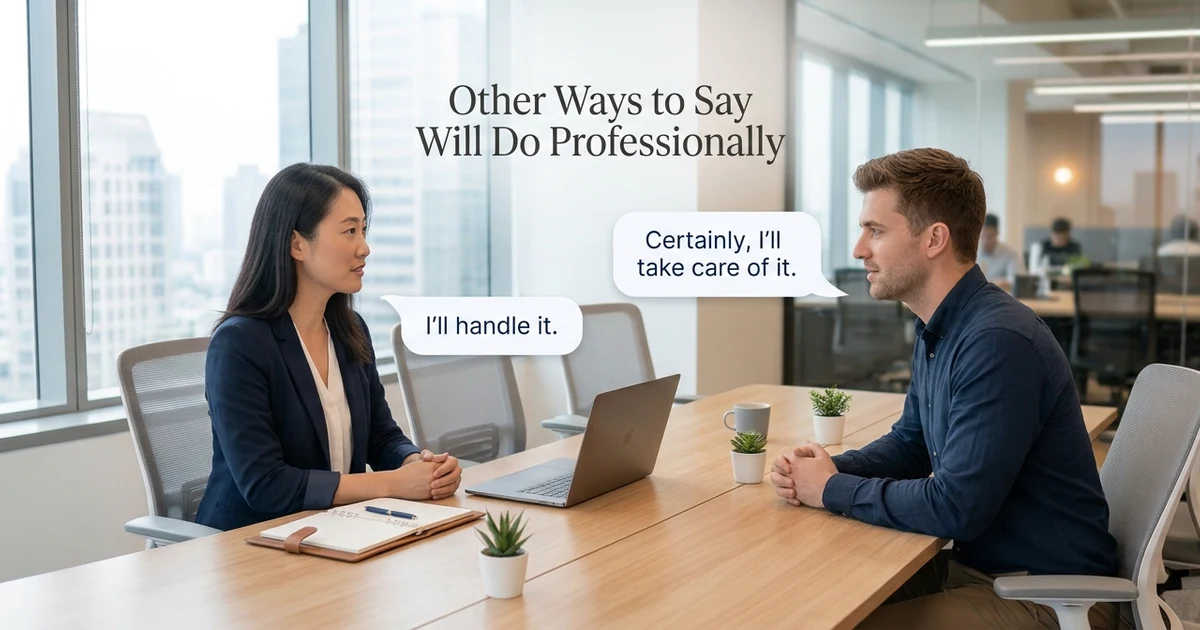
If you often reply with will do at work, you may wonder if there is a more polished way to respond. While this simple phrase works well in many situations, there are times when a more professional reply leaves a better impression. Choosing the right words can make your emails, workplace chats, and business conversations sound more confident, respectful, and clear.
This guide covers professional alternatives, when to use them, and how each option fits different workplace situations.
Quick Answer
Instead of saying will do professionally, you can use replies such as Certainly, I will take care of it, Absolutely, Consider it done, I’ll handle that, or I’ll get started right away. The best choice depends on how formal the conversation is and how quickly you plan to complete the task.
TL;DR
- Meaning: A professional way to confirm you will complete a task.
- Tone: Helpful, cooperative, and respectful.
- Common use: Emails, workplace chat, meetings, and customer service.
- Best for: Acknowledging requests or assignments.
- Formality: Usually professional, with some alternatives sounding more formal than others.
What Will Do Means
Will do is a short reply that tells someone you understand their request and intend to complete it.
It works as a quick confirmation and often replaces longer responses like:
- I will take care of it.
- I’ll complete that.
- I’ll get it done.
Although it is common in workplace communication, it can sound a little casual in formal business settings. Many professionals prefer slightly more polished alternatives, especially when speaking with clients, senior managers, or new business contacts.
Why Use a More Professional Alternative
A thoughtful reply can improve communication without making it sound stiff.
Professional alternatives help you:
- Show respect for the other person.
- Confirm you understood the request.
- Build trust.
- Sound more confident.
- Match the tone of formal business communication.
25 Other Ways to Say Will Do Professionally
| Alternative | Best Used For | Tone |
|---|---|---|
| Certainly | Formal emails | Professional |
| Absolutely | Friendly workplaces | Positive |
| I’d be happy to | Customer service | Warm |
| I’ll take care of it | General business | Professional |
| I’ll handle it | Team communication | Confident |
| Consider it done | Internal teams | Confident |
| I’ll get right on it | Urgent requests | Responsive |
| I’ll start working on it | Project updates | Professional |
| I’ll complete it | Task confirmation | Direct |
| I’ll make it a priority | High-priority work | Professional |
| I’ll ensure it’s done | Client communication | Reassuring |
| You can count on me | Team collaboration | Supportive |
| I’ll see to it | Formal communication | Polite |
| I’ll follow through | Commitments | Professional |
| I’ll address it | Problem solving | Professional |
| I’ll get this taken care of | Customer support | Friendly |
| Happy to help | Service roles | Warm |
| I’ll review it today | Review requests | Specific |
| I’ll send it shortly | Deliverables | Professional |
| I’ll have it ready | Deadlines | Reliable |
| Thanks, I’ll handle it | Workplace chat | Friendly |
| I’ll move this forward | Project management | Professional |
| I’ll work on that next | Task planning | Organized |
| I’ll take care of this immediately | Urgent matters | Formal |
| I’ll make sure it’s completed | Important assignments | Reassuring |
Best Professional Alternatives Explained
Certainly
This works well when speaking with clients, executives, or anyone in a formal setting.
Example
Manager: Please update the report before noon.
Reply: Certainly. I’ll send the revised version before the deadline.
I’ll Take Care of It
This phrase sounds professional without feeling overly formal. It fits almost every workplace.
Example
Client: Could you update the invoice?
Reply: I’ll take care of it this afternoon.
I’ll Handle It
This response shows confidence and ownership.
Example
Team member: Can someone contact the supplier?
Reply: I’ll handle it.
Absolutely
Absolutely sounds positive and enthusiastic while remaining professional in most workplaces.
Example
Supervisor: Can you join tomorrow’s meeting?
Reply: Absolutely. I’ll be there.
I’ll Get Right On It
Use this when you want to show urgency.
Example
Manager: We need this fixed quickly.
Reply: I’ll get right on it.
I’ll Make It a Priority
This tells the other person their request matters.
Example
Customer: Could this be finished today?
Reply: I’ll make it a priority and keep you updated.
I’ll Ensure It’s Done
This phrase adds reassurance and accountability.
Example
Director: Please verify the figures before sending them.
Reply: I’ll ensure it’s done before the report goes out.
I’ll See to It
This is slightly formal and often appears in professional emails.
Example
Client: Please confirm the reservation.
Reply: I’ll see to it and send you the confirmation shortly.
How People Use These Replies in Professional Messages
Instead of replying with only two words, many professionals include a little more information.
For example:
Thanks for letting me know. I’ll take care of it and update you by tomorrow afternoon.
Microsoft Teams
Absolutely. I’ll handle this after my current meeting.
Slack
Got it. I’ll review everything and send feedback today.
Customer Support
Certainly. I’ll investigate the issue and keep you informed of our progress.
Tone and Emotional Meaning
Different replies create different impressions.
| Phrase | Tone |
|---|---|
| Certainly | Formal and respectful |
| Absolutely | Positive and energetic |
| I’ll handle it | Confident |
| I’ll take care of it | Reliable |
| Happy to help | Friendly |
| Consider it done | Confident but slightly casual |
| I’ll ensure it’s done | Reassuring |
| I’ll see to it | Polite and professional |
Common Situations Where These Alternatives Work
You can use these responses in many professional situations.
- Replying to your manager.
- Answering a client’s request.
- Confirming project tasks.
- Responding during virtual meetings.
- Workplace chat platforms.
- Customer support conversations.
- Team collaboration.
- Following up after meetings.
- Confirming deadlines.
- Handling service requests.
Examples in Real Conversations
Situation
Your manager asks for an updated presentation.
Example
I’ll have the revised presentation ready before lunch.
Meaning
You accepted the task and gave a clear timeline.
Situation
A customer requests additional information.
Example
Certainly. I’ll email the details within the next hour.
Meaning
You confirmed the request politely and professionally.
Situation
A teammate needs assistance.
Example
I’ll handle that while you finish the client meeting.
Meaning
You offered support and accepted responsibility.
Situation
Your supervisor requests a report.
Example
I’ll make it a priority and send it this afternoon.
Meaning
You showed commitment and urgency.
Similar Terms and Related Phrases
Many expressions can replace will do, but they do not all carry the same tone. Some sound more formal, while others fit casual workplace chats.
| Phrase | Meaning | Best For | Formality |
|---|---|---|---|
| Will do | I will complete the task | Internal teams | Medium |
| I’ll take care of it | I will handle the task | Emails and chat | High |
| I’ll handle it | I accept responsibility | Team communication | Medium to High |
| Certainly | Yes, I will | Clients and managers | High |
| Absolutely | Yes, with enthusiasm | Modern workplaces | Medium |
| Consider it done | I am confident it will be completed | Internal teams | Medium |
| Happy to help | I am glad to assist | Customer service | Medium |
| I’ll see to it | I will make sure it happens | Formal communication | High |
| I’ll address it | I will deal with the issue | Business communication | High |
| You can count on me | You can trust me | Teamwork | Medium |
How to Choose the Right Alternative
The best response depends on who you are talking to.
For your manager
Choose replies that sound respectful and dependable.
Good options:
- Certainly.
- I’ll take care of it.
- I’ll ensure it’s done.
- I’ll have it ready by tomorrow.
For a client
Keep your response polite and reassuring.
Good options:
- Certainly.
- I’d be happy to help.
- I’ll look into this right away.
- I’ll make sure it’s completed.
For coworkers
You can sound a little more relaxed while staying professional.
Good options:
- I’ll handle it.
- Happy to help.
- I’ll get started.
- I’ll work on it next.
For urgent requests
Show that you understand the priority.
Good options:
- I’ll get right on it.
- I’ll make it a priority.
- I’ll address this immediately.
- I’ll take care of it now.
When You Should Use These Phrases
Professional alternatives work well when someone asks you to complete a task or take responsibility.
Use them when:
- Confirming a request in an email.
- Replying during Microsoft Teams or Slack conversations.
- Speaking with customers.
- Answering your manager.
- Following up after meetings.
- Accepting new assignments.
- Confirming deadlines.
- Responding to service requests.
Adding a short timeline makes your reply even stronger.
For example:
- I’ll have it finished by 3 p.m.
- I’ll send the report this afternoon.
- I’ll review it before tomorrow’s meeting.
When You Should Avoid Them
Even professional replies have limits.
Avoid short confirmations if:
- You do not fully understand the request.
- You cannot meet the deadline.
- You need more information.
- The task depends on someone else first.
Instead, ask for clarification.
Examples:
- Could you clarify which document you need?
- I can do that after I receive the updated files.
- I’ll begin as soon as I have the final details.
Is Will Do Formal or Informal?
Will do sits somewhere in the middle.
It is polite enough for many workplace chats but slightly casual for highly formal communication.
Formal situations
Instead of saying:
Will do.
Try:
- Certainly.
- I’ll take care of it.
- I’ll ensure this is completed.
- I’ll address this today.
Informal workplace conversations
Will do still sounds natural among teammates, especially in quick messaging platforms.
Common Mistakes
A few small mistakes can make your reply sound less professional.
Giving no timeline
Instead of:
Will do.
Say:
I’ll complete it by the end of the day.
Using overly casual language
Instead of:
Yep.
Say:
Certainly, I’ll handle that.
Promising too much
Avoid agreeing to impossible deadlines.
A better response is:
I’ll do my best to complete it by Friday and will keep you updated.
Replying without reading carefully
Always make sure you understand the request before confirming it.
USA and Tier 1 Country Usage
People across the United States, Canada, the United Kingdom, Australia, and New Zealand commonly use will do in everyday workplace communication.
In many offices, especially on Slack, Microsoft Teams, or internal chat systems, the phrase sounds natural and friendly.
For more formal communication, professionals often choose longer responses such as:
- Certainly.
- I’ll take care of it.
- I’ll handle that.
- I’ll ensure it’s completed.
These alternatives are common in business emails, customer support, consulting, healthcare, education, and corporate environments.
Quick Reference Table
| Context | What It Means | Tone | Best Use | Avoid If |
|---|---|---|---|---|
| Email to manager | Task accepted | Professional | Business emails | You need clarification |
| Client email | Request accepted | Polite | Customer communication | You cannot meet the deadline |
| Team chat | I’ll handle it | Friendly | Internal messaging | Formal legal communication |
| Project meeting | Responsibility accepted | Professional | Team discussions | You are unsure about the task |
| Customer support | I will resolve this | Reassuring | Service communication | The issue requires more information |
| Workplace messaging | I’ll complete the task | Casual-professional | Slack and Teams | Highly formal correspondence |
Conclusion
Using a professional alternative to will do helps you sound more confident, reliable, and thoughtful. While the original phrase works well in many everyday conversations, a slightly more polished response often creates a better impression in emails, meetings, and client communication.
Choose your reply based on the situation. A simple response like I’ll take care of it or Certainly can communicate the same commitment while matching the tone of professional business communication. The most effective replies are clear, polite, and, whenever possible, include a realistic timeline.
FAQs
What are the best other ways to say will do professionally?
Some of the best options include Certainly, I’ll take care of it, I’ll handle it, Absolutely, I’ll ensure it’s done, and I’ll get started right away.
Is will do professional?
Yes, it is generally professional for internal workplace communication. For formal emails or client conversations, a longer response often sounds more polished.
Can I use will do in a business email?
You can, but many professionals prefer replies such as I’ll take care of it or Certainly because they sound more formal and complete.
What is a formal replacement for will do?
Good formal alternatives include Certainly, I’ll see to it, I’ll ensure it’s completed, and I’ll address it promptly.
Is consider it done more professional than will do?
Consider it done sounds confident but is slightly more casual. It works well with colleagues but may not suit every client or executive email.
What should I say instead of will do to my boss?
Good choices include I’ll take care of it, Certainly, I’ll have it completed by the deadline, or I’ll make it a priority.
What is the difference between will do and I’ll handle it?
Will do simply confirms you will complete the task. I’ll handle it also suggests that you are taking ownership and responsibility for managing the work.