You have probably used according to many times while writing emails, essays, articles, reports, or even casual messages. It is a useful phrase, but repeating it too often can make your writing feel dull or repetitive.
That is why many people search for other ways to say according to. Sometimes you need a more formal option, sometimes a casual alternative, and other times you simply want your writing to sound smoother and more natural.
This guide covers simple alternatives, when to use them, examples, tone differences, and how native English speakers in the USA and other English-speaking countries use them in everyday writing.
Quick Answer
If you want another way to say according to, you can use phrases like based on, as stated by, as reported by, in the opinion of, under, following, or in the words of.
The best alternative depends on context. Some work better in formal writing, while others sound more natural in everyday conversation.
TL;DR
Here is the short version.
- According to means based on information from someone or something
- It usually shows a source of information
- Common alternatives include based on, as reported by, and as stated by
- It appears in essays, news articles, research papers, and daily conversation
- Most alternatives work in formal writing
- Casual conversation often uses simpler replacements
What Other Ways to Say According To Means
People look for alternatives because according to often appears repeatedly in writing.
The phrase generally means:
- Based on information provided by someone
- Referring to a source
- Following someone’s opinion or statement
- Using information from a report, study, or authority
Example:
According to the weather report, rain is expected tomorrow.
This tells the reader that the weather report is the source of information.

Basic Explanation of the Phrase
Unlike internet abbreviations or texting slang, according to is a standard English phrase.
Writers use it when they want to:
- Credit a source
- Present evidence
- Reference research
- Mention what someone said
- Support an argument with outside information
It helps readers understand where the information came from.
Other Ways to Say According To
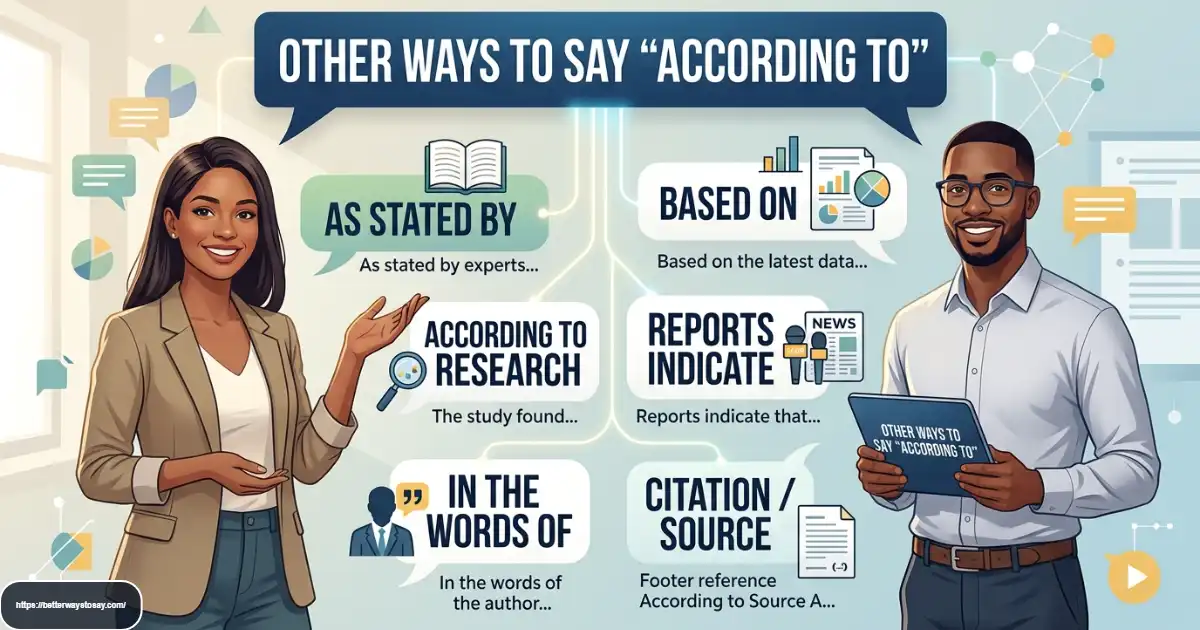
Other ways to say according to can help you make your writing and conversations sound more natural and varied. The best alternative depends on what you mean and the context. Common options include as stated by, based on, as reported by, in the words of, as noted by, and in line with.
How People Use It in Writing and Online Conversation
People use this phrase in both professional and casual communication.
In formal writing:
- Academic essays
- News articles
- Research papers
- Business reports
In online conversation:
- Social media discussions
- Reddit comments
- Group chats
- Blog posts
- Forum discussions
Examples:
Based on recent reviews, this laptop performs well.
As reported by several users, the app keeps crashing.
Following the latest update, battery life improved.

Tone and Emotional Meaning
The phrase itself sounds neutral.
Its alternatives can change the tone slightly depending on what you choose.
Formal tone
Best for work, academics, journalism
- As stated by
- As reported by
- Based on findings from
Casual tone
Best for everyday conversation
- From what I heard
- Going by
- Based on
Opinion-based tone
Best when discussing personal views
- In the opinion of
- In the words of
- From someone’s perspective
Common Situations Where It Appears
You will usually see this phrase in situations like these.
School assignments
Students cite books or research.
Workplace communication
Teams refer to reports and data.
News reporting
Journalists reference official sources.
Social media discussions
People share information they found online.
Professional writing
Businesses cite surveys or studies.
These alternatives work well in essays, reports, articles, emails, and everyday communication. For example, you might use as stated by when referring to a source, based on when explaining information or evidence, or as reported by when discussing news or research. Choosing the right phrase can make your writing clearer and help you avoid repeating according to.
Examples in Real Conversations
Here are practical examples.
Situation: Office meeting
Example: Based on last quarter’s report, sales increased.
Meaning: The report provides the information.
Situation: News article
Example: As reported by local authorities, the highway will close tonight.
Meaning: Authorities are the source.
Situation: Casual chat
Example: From what I heard, they are moving next month.
Meaning: Information came through conversation.
Situation: Academic paper
Example: As stated by recent research, exercise improves concentration.
Meaning: Research supports the claim.
When using these alternatives, pay attention to the relationship between the source and the information. Some phrases directly introduce a person’s opinion or statement, while others describe information that comes from research, evidence, rules, or data. Matching the phrase to the context makes your sentence sound more precise and professional.
Situation: Social media comment
Example: Going by recent updates, the game launches next week.
Meaning: Information comes from recent announcements.
Similar Terms or Related Phrases
Here are common replacements.
| Phrase | Best Used For | Tone |
|---|---|---|
| Based on | General writing | Neutral |
| As stated by | Formal writing | Professional |
| As reported by | News writing | Formal |
| In the opinion of | Opinions | Neutral |
| Following | Instructions or rules | Formal |
| Going by | Casual conversation | Informal |
| In the words of | Quoting people | Neutral |
| Under | Rules or systems | Formal |
| Per | Business communication | Professional |
| From what I heard | Casual speech | Informal |
When You Should Use It
Use alternatives when you want to improve writing variety.
Good situations include:
- Academic essays
- Research papers
- Journalism
- Workplace communication
- Blog writing
- Professional emails
- Social media discussions
- Formal reports
Using different phrases makes writing sound more polished.
When You Should Avoid It
Some alternatives can create confusion.
Avoid casual replacements in serious writing.
Examples:
Do not use in formal reports
From what I heard
Too informal.
Do not use in academic writing
Going by
Feels conversational.
Avoid in legal writing
I heard that
Not credible enough.
Always match the phrase with the situation.
Is It Formal or Informal
The phrase according to itself works in both formal and informal English.
Formal environments
- University assignments
- Research papers
- Professional reports
- Journalism
- Corporate communication
Informal environments
- Text messages
- Social media comments
- Casual discussion
- Group chats
- Online forums
The alternatives determine how formal your sentence sounds.
Common Misunderstandings
Some people misuse alternatives without checking context.
A few common mistakes:
Using informal phrases in professional writing
Bad example:
Going by the annual report, profits increased.
Better:
Based on the annual report, profits increased.
Using opinion phrases for factual statements
Bad example:
In the opinion of NASA, Earth orbits the sun.
Better:
According to NASA, Earth orbits the sun.
Context matters.
USA and Tier 1 Country Usage
In countries like the United States, Canada, the UK, and Australia, people commonly use different alternatives depending on communication style.
Common in professional writing
- Based on
- As stated by
- Per
- As reported by
casual American English
- From what I heard
- Going by
- Based on
journalism
- According to sources
- As confirmed by
- As reported by
Native speakers switch naturally depending on situation.
Quick Reference Table
| Context | What It Means | Tone | Best Use | Avoid If |
|---|---|---|---|---|
| Based on | Information source | Neutral | General writing | Rarely |
| As stated by | Someone said it | Formal | Business, academics | Casual texting |
| As reported by | News source | Formal | Journalism | Personal chat |
| Going by | Using available info | Informal | Casual conversation | Professional writing |
| Per | Following instructions | Professional | Workplace communication | Casual speech |
| From what I heard | Heard from others | Informal | Friendly conversation | Academic work |
| In the opinion of | Personal viewpoint | Neutral | Opinion writing | Objective reporting |
Best Alternatives You Can Use Instead
Here are some strong replacements you can use regularly.
- Based on
- As stated by
- As reported by
- In the words of
- Per
- Following
- In the opinion of
- Under
- Going by
- From what I heard
- Based on evidence from
- As confirmed by
- As noted by
- Referring to
- As mentioned by
Choosing the right option improves writing quality and prevents repetition.
Conclusion
Searching for other ways to say according to usually means you want better writing variety without changing meaning.
The phrase simply points to a source of information, but repeating it too often can make writing feel repetitive. Alternatives like based on, as stated by, as reported by, and per can make sentences sound more natural depending on context.
The best choice depends on where you are writing, who will read it, and whether you need a formal or casual tone.
FAQs
What does other ways to say according to mean?
It refers to alternative phrases that carry the same meaning as according to while fitting different contexts.
What can I use instead of according to?
You can use based on, as stated by, as reported by, per, or in the opinion of.
Is according to formal or informal?
It works in both formal and informal English, depending on context.
Can I use according to in professional writing?
Yes. It is common in business reports, academic writing, journalism, and research papers.
What is the best formal replacement for according to?
The strongest formal alternatives are as stated by, as reported by, and based on.
What is a casual replacement for according to?
Common casual options include going by and from what I heard.
Is according to common in American English?
Yes. People in the USA use it regularly in professional writing, conversation, and media reporting.