Many people use well noted to acknowledge a message, especially in emails, workplace chats, and customer service conversations. While the phrase is polite, it can sound stiff, repetitive, or overly formal if you use it too often.
If you want to sound more natural, professional, or friendly, there are many better alternatives. The best choice depends on who you are talking to and the situation.
Quick Answer
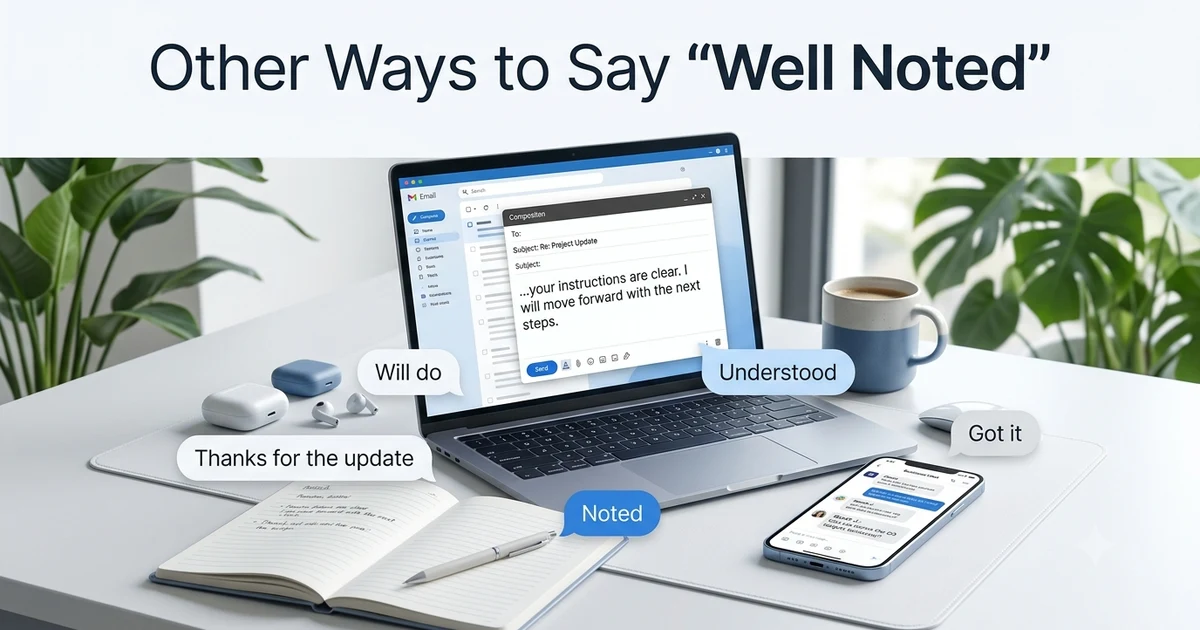
Other ways to say well noted include noted, understood, got it, thanks for letting me know, acknowledged, received, I’ll keep that in mind, and message received. Some options work best in professional emails, while others fit casual chats and team messaging platforms.
TL;DR
- Meaning: A polite way to acknowledge that you received and understood a message.
- Tone: Usually professional, respectful, and neutral.
- Common use: Emails, workplace chats, customer support, and business communication.
- Where it appears: Outlook, Gmail, Slack, Microsoft Teams, and other online conversations.
- Formal or informal: Mostly formal, but many natural alternatives fit both formal and casual situations.
What Well Noted Means
Well noted means that you have received information and understand it. It tells the other person that you acknowledge their message and will remember or act on it if needed.
People often use it after receiving instructions, updates, corrections, or important details.
For example:
Manager: Please submit the report before Friday.
Employee: Well noted. I’ll have it ready by Thursday.
The reply confirms that the message has been understood without requiring a long response.
Basic Explanation
The phrase combines two simple ideas:
- Well suggests that something has been understood properly.
- Noted means the information has been recorded or acknowledged.
Together, they communicate that you have received the information and taken note of it.
Although many people use this phrase in business communication, native English speakers often prefer more natural alternatives because well noted can sound overly formal or slightly unnatural in everyday English.
Why People Look for Other Ways to Say Well Noted
Using the same response repeatedly can make emails and chats sound repetitive.
Choosing different expressions helps you:
- Sound more natural.
- Match the level of formality.
- Build friendlier workplace communication.
- Avoid sounding cold or robotic.
- Respond appropriately in different situations.
Best Alternatives to Well Noted
Here are some of the most natural alternatives.
| Alternative | Best For | Tone |
|---|---|---|
| Noted | Professional emails | Neutral |
| Understood | Instructions | Professional |
| Got it | Team chats | Casual |
| Thanks for letting me know | Updates | Friendly |
| Acknowledged | Formal communication | Formal |
| Received | Confirming documents | Professional |
| I’ll keep that in mind | Suggestions | Friendly |
| I’ll take care of it | Action items | Professional |
| Thanks, I understand | General replies | Warm |
| Message received | Casual workplace chats | Friendly |
| Sounds good | Team collaboration | Casual |
| Will do | Accepting a task | Casual and positive |
| Thanks for the update | Status reports | Professional |
| I’ll follow up | Next steps | Professional |
| Consider it done | Assigned tasks | Friendly and confident |
How People Use It in Texting and Online Conversations
Outside business emails, people usually choose shorter and friendlier replies.
In workplace chat
Manager: The meeting starts at 10.
Reply:
Got it.
Manager: Please update the spreadsheet today.
Reply:
Will do.
In text messages
Friend: I’ll be there around 7.
Reply:
Sounds good.
Friend: Don’t forget your jacket.
Reply:
Thanks for the reminder.
In group chats
Team member: We moved the deadline to Monday.
Reply:
Thanks for the update.
In online communities
Moderator: Please follow the posting rules.
Reply:
Understood.
Using shorter acknowledgments makes conversations feel more natural than repeating well noted every time.
Tone and Emotional Meaning
The phrase itself is polite and neutral. It rarely expresses emotion.
Depending on the context, however, it may sound:
- Professional during business communication.
- Respectful when acknowledging instructions.
- Cold if used without any friendly wording.
- Distant in casual conversations.
- Slightly outdated in modern workplace communication.
Adding a few extra words often creates a warmer impression.
Instead of:
Well noted.
Try:
Thanks for letting me know.
Or:
Understood. I’ll handle it today.
These responses acknowledge the message while sounding more personal.
Common Situations Where It Appears
People commonly use this phrase or its alternatives in situations like these:
- Responding to work instructions.
- Confirming meeting changes.
- Acknowledging project updates.
- Replying to customer emails.
- Accepting feedback.
- Confirming appointment details.
- Receiving delivery information.
- Answering school or university messages.
- Acknowledging policy updates.
- Confirming travel plans.
Examples in Real Conversations
Situation
Your manager changes a deadline.
Example
Manager: The presentation is due Thursday instead of Friday.
You: Understood. I’ll finish it by Thursday morning.
Meaning
You acknowledge the change and confirm your plan.
Situation
A coworker shares an update.
Example
Coworker: The client approved the proposal.
You: Thanks for the update.
Meaning
You recognize the information in a friendly way.
Situation
A customer sends additional information.
Example
Customer: I have attached the missing invoice.
Support agent: Received. I’ll review it shortly.
Meaning
You confirm receipt of the document.
Situation
A friend changes dinner plans.
Example
Friend: Let’s meet at 6 instead of 7.
You: Sounds good.
Meaning
You accept the change naturally.
Situation
Your teacher posts new instructions.
Example
Teacher: Please submit your assignment as a PDF.
Student: Understood. I’ll upload it this evening.
Meaning
You confirm that you understand the requirement.
Situation
Your team lead assigns a task.
Example
Team lead: Please contact the client after lunch.
You: Will do.
Meaning
You accept responsibility for completing the task.
In most everyday conversations, simple responses like understood, got it, thanks for the update, or will do sound more natural than well noted while still showing respect.
Similar Terms and Related Phrases
Many expressions share the same purpose as well noted, but each has a slightly different tone. Choosing the right one helps your message sound more natural.
| Phrase | Meaning | Best Used When | Tone |
|---|---|---|---|
| Noted | I have received and understood your message. | Professional emails | Neutral |
| Understood | I understand your instructions. | Work and school | Professional |
| Acknowledged | I confirm receipt of your message. | Formal business communication | Formal |
| Received | I have received the file or information. | Documents and attachments | Professional |
| Got it | I understand. | Team chats and texting | Casual |
| Will do | I will complete the task. | Accepting assignments | Friendly |
| Thanks for the update | Thank you for informing me. | Project updates | Friendly and professional |
| I’ll keep that in mind | I will remember your advice. | Suggestions or recommendations | Warm |
| Sounds good | I agree with the plan. | Casual conversations | Casual |
| Message received | I got your message. | Informal workplace chats | Casual |
Which Alternative Should You Choose?
- Use Noted for short professional replies.
- Use Understood when someone gives instructions.
- Use Received after getting a file or document.
- Use Thanks for the update when someone shares new information.
- Use Got it in casual workplace chats.
- Use Will do when accepting a task.
- Use I’ll keep that in mind for advice or suggestions.
When You Should Use It
Acknowledging a message keeps communication clear. You do not need a long reply every time. A short response often works best.
Good situations include:
- Confirming you received important information.
- Replying to workplace instructions.
- Acknowledging schedule changes.
- Confirming meeting details.
- Responding to customer requests.
- Accepting project assignments.
- Confirming receipt of documents.
- Letting someone know you understand their feedback.
For example:
Manager: Please update the budget before noon.
Reply:
Understood. I’ll finish it before lunch.
This sounds clear, polite, and professional.
When You Should Avoid It
Although well noted is polite, it is not always the best choice.
Avoid it when:
- Talking with close friends.
- Sending warm personal messages.
- Responding to emotional conversations.
- Writing marketing or customer-facing content.
- You want to sound conversational.
For example, if a friend says:
I’m feeling much better today.
Instead of replying:
Well noted.
A better response would be:
I’m glad to hear that.
Or:
That’s great news.
Similarly, if a customer reports a problem, replying with only well noted may sound cold. A better reply is:
Thanks for letting us know. We’ll look into this right away.
Is It Formal or Informal?
The phrase sits on the formal side of English.
Professional emails
It works, but many native English speakers prefer more natural alternatives.
Examples:
- Noted.
- Understood.
- Thanks for the update.
- Received.
- I’ll take care of it.
Workplace chats
Short replies feel more conversational.
Examples:
- Got it.
- Sounds good.
- Will do.
Personal messages
Most people rarely use well noted with family or friends because it sounds distant.
Natural alternatives include:
- Okay.
- Got it.
- Thanks.
- No problem.
- Sounds good.
Customer communication
Customer service representatives often choose warmer responses.
Examples:
- Thanks for reaching out.
- Thanks for letting us know.
- We appreciate the update.
- We’ll review this and get back to you.
Common Misunderstandings
Even though the phrase is simple, people sometimes interpret it differently.
It can sound cold
A one-word acknowledgment may seem unfriendly, especially if someone expected a thoughtful reply.
It does not promise action
Saying well noted only confirms understanding. It does not mean you will complete a task unless you say so.
Instead of:
Noted.
You can write:
Understood. I’ll finish it today.
It is not always natural
Many learners believe it is the standard reply in English. In reality, native speakers often choose shorter or warmer alternatives depending on the situation.
Context changes the tone
The same phrase may sound perfectly polite in an email but awkward in a casual text message.
How People Use It in the USA and Other Tier 1 Countries
People in the United States, Canada, the United Kingdom, Australia, and New Zealand understand the phrase well noted, especially in business settings.
However, everyday workplace communication often sounds more conversational.
Instead of writing:
Well noted.
You may see replies such as:
- Got it.
- Understood.
- Thanks for the heads-up.
- Thanks for the update.
- Will do.
- Sounds good.
- I’ll take care of it.
These alternatives feel more natural while remaining polite.
In large companies, especially those using Slack, Microsoft Teams, or Google Chat, employees often prefer short acknowledgments that keep conversations moving.
Email communication may still include more formal responses, particularly when dealing with clients, executives, legal matters, or official documentation.
Quick Reference Table
| Context | What It Means | Tone | Best Use | Avoid If |
|---|---|---|---|---|
| Business email | I received and understood your message. | Professional | Client communication | Friendly personal chats |
| Team chat | I understand. | Casual | Internal communication | Formal legal emails |
| Customer support | We acknowledge your message. | Professional | Service responses | Emotional conversations |
| Text message | I got your message. | Casual | Friends and family | Formal reports |
| School or university | I understand the instructions. | Respectful | Teachers and classmates | Casual jokes |
| Project management | Task acknowledged. | Professional | Team assignments | Personal discussions |
| Social media messages | I understand what you said. | Friendly | Direct messages | Sensitive topics |
The best alternative depends on your audience. A quick reply like got it works well in casual chats, while understood or thanks for the update often sounds more polished in professional communication.
Conclusion
Knowing other ways to say well noted helps you communicate more naturally in different situations. While the phrase is polite and professional, it can feel formal or repetitive if you use it too often. Choosing an alternative such as understood, got it, thanks for the update, or will do lets you match the tone of your conversation and connect better with the person you are replying to.
Think about your audience before you respond. Formal emails usually benefit from professional acknowledgments, while casual chats often sound better with shorter, friendlier replies. A simple change in wording can make your messages clearer, warmer, and more natural.
FAQs
What are the best other ways to say well noted?
Some of the best alternatives include noted, understood, got it, acknowledged, received, thanks for the update, will do, sounds good, and I’ll keep that in mind. The best choice depends on whether your conversation is formal or casual.
Is well noted rude?
No. Well noted is generally polite and respectful. However, it may sound cold or overly formal in casual conversations. Adding a friendly phrase such as thanks for letting me know can make your response feel warmer.
Can I use well noted in a professional email?
Yes. It is acceptable in professional emails, especially when acknowledging instructions or updates. Even so, many professionals prefer more natural replies like understood, noted, or thanks for the update.
What is the difference between well noted and noted?
Both phrases acknowledge that you received and understood information. Noted is shorter and more common in modern business communication, while well noted sounds slightly more formal and traditional.
What does well noted mean in text?
In text messages, well noted means you have read and understood the message. Most people, however, choose simpler replies such as got it, okay, or sounds good because they feel more conversational.
Is well noted formal or informal?
The phrase is mostly formal. It fits business emails, workplace communication, and official messages. For texting, social media, or conversations with friends, casual alternatives usually sound more natural.
What should I say instead of well noted?
You can choose an alternative based on the situation:
- Professional: Understood, Noted, Received, Acknowledged
- Friendly: Thanks for the update, I’ll take care of it, I’ll keep that in mind
- Casual: Got it, Sounds good, Will do, Okay