
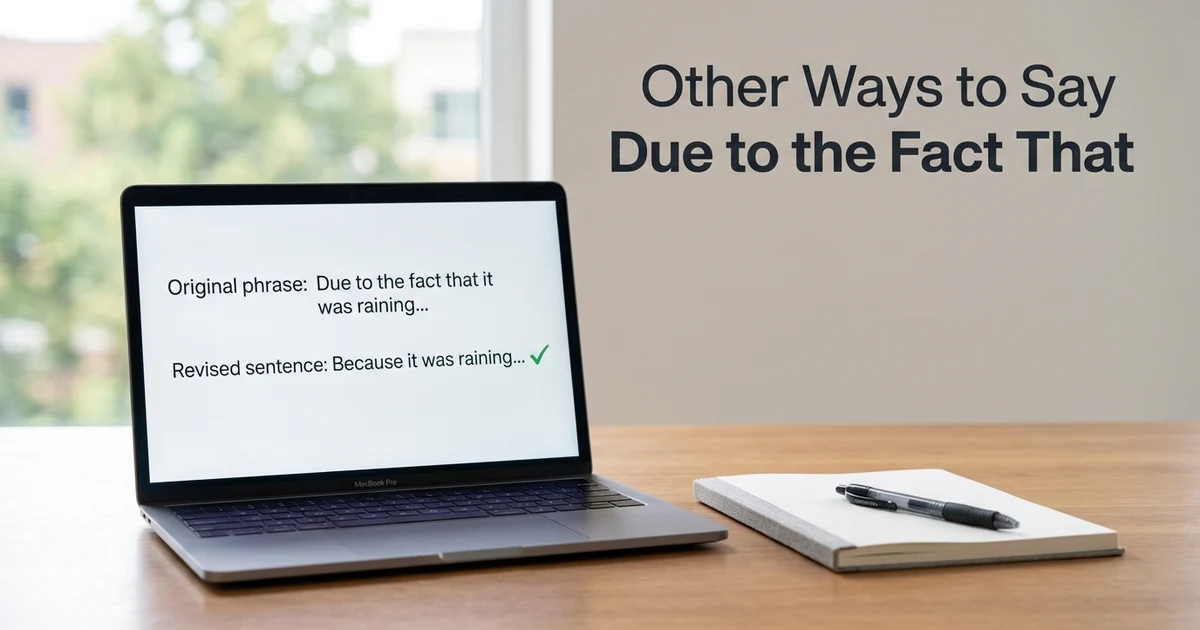
There are many situations where other ways to say due to the fact that can make your writing shorter, clearer, and more natural. The phrase is grammatically correct, but it often sounds wordy because a simpler expression such as because or since can communicate the same idea.
The best alternative depends on your audience and tone. A casual email may need a simple phrase, while an academic paper or formal report may call for a more polished option. Below, you will find practical alternatives, examples, tone differences, and guidance on which expression works best in different situations.
Quick Answer
The most natural alternatives to due to the fact that include because, since, as, given that, owing to the fact that, and considering that. In most everyday writing, because is the clearest choice. For formal writing, given that or considering that can work well when the context supports them.
TL;DR
- Meaning: It introduces a reason or explains why something happened.
- Tone: Formal and somewhat wordy.
- Common use: Formal writing, reports, explanations, and professional communication.
- Best simple alternative: Because.
- Best formal alternatives: Given that, considering that, and owing to the fact that.
- In casual writing: Because or since usually sounds more natural.
What Other Ways to Say Due to the Fact That Mean
The phrase due to the fact that means because something is true or because something happened. It introduces a reason for an action, event, decision, or situation.
For example:
- The event was canceled due to the fact that the venue had a safety issue.
- The event was canceled because the venue had a safety issue.
Both sentences communicate the same basic idea. The second version sounds more direct and natural.
The main issue with due to the fact that is not correctness. The problem is usually wordiness. Writers often use several words where one word can do the same job.
Common alternatives
| Alternative | General tone | Best for |
|---|---|---|
| Because | Neutral | Everyday and professional writing |
| Since | Neutral | Explanations and general writing |
| As | Neutral to formal | Written explanations |
| Given that | Formal | Reports and professional writing |
| Considering that | Neutral to formal | Reasoned explanations |
| Owing to the fact that | Formal | Formal documents |
| In light of the fact that | Formal | Official or analytical writing |
| On account of the fact that | Formal | Formal explanations |
| Because of | Neutral | Noun phrases rather than clauses |
| As a result of | Neutral | Explaining an outcome |

The Best Simple Alternative: Because
In most cases, because is the strongest replacement.
It is short, clear, and familiar to readers. It also works in professional writing, academic writing, emails, reports, and everyday communication.
Instead of:
The meeting was postponed due to the fact that several team members were unavailable.
Write:
The meeting was postponed because several team members were unavailable.
The second sentence gets to the point faster without changing the meaning.
More examples
- We stayed inside because it was raining.
- The project was delayed because the supplier missed the deadline.
- She changed her schedule because the original appointment conflicted with another commitment.
- The company changed its policy because customer needs had shifted.
For most readers, this is the easiest and most natural choice.

Formal Alternatives to Due to the Fact That
Sometimes you may want a more formal expression without using the long original phrase. Several options can work well.
Given that
Given that introduces a fact that provides a reason or context for something.
Example:
Given that the deadline is tomorrow, we should complete the review today.
This sounds professional without becoming unnecessarily complicated.
Considering that
Considering that works when the reason involves a fact that someone should take into account.
Example:
Considering that the budget has been reduced, the revised proposal is reasonable.
It often sounds natural in analytical or explanatory writing.
In light of the fact that
This phrase emphasizes that a decision or conclusion follows from a particular fact.
Example:
In light of the fact that demand has declined, the company decided to reduce production.
It has a formal tone and fits reports, business writing, and official explanations.
Owing to the fact that
Owing to the fact that has a formal tone and closely matches the original phrase.
Example:
The flight was delayed owing to the fact that severe weather affected the airport.
However, because remains more concise:
The flight was delayed because severe weather affected the airport.
How to Use These Alternatives in Everyday Writing
Most everyday writing does not need a complicated replacement. If you are writing a text message, email, school assignment, social media post, or ordinary explanation, choose the simplest phrase that expresses your meaning.
Casual messages
Use because or since.
- I left early because I had another appointment.
- Since you were busy, I sent the information by email.
Professional emails
Because, since, and given that can all work.
- We need to move the meeting because two team members are unavailable.
- Given that the deadline has changed, I have updated the schedule.
Academic writing
Because and since remain acceptable, but given that, considering that, and in light of can sometimes fit a more analytical style.
- The results changed because the sample size increased.
- Given that the sample size increased, the results require further analysis.
Reports
Formal alternatives can be useful when you want to connect evidence with a conclusion.
- Given that operating costs have increased, the current budget requires revision.
- In light of the fact that demand has fallen, the forecast should be adjusted.
Common Situations Where These Alternatives Appear
You can replace the original phrase in many types of writing.
Common situations include:
- Explaining a decision
- Giving a reason for a delay
- Explaining a change in plans
- Writing business emails
- Preparing reports
- Writing academic assignments
- Explaining a recommendation
- Describing a cause and effect relationship
- Writing formal notices
- Giving background information
- Explaining why an event happened
- Justifying a particular action
The important question is not whether one alternative always works. Instead, consider how formal the writing needs to sound and how direct you want to be.
Examples in Real Conversations
Situation: Explaining a late arrival
Example: I was late because traffic was heavier than expected.
Meaning: Traffic caused the delay.
Situation: Professional email
Example: Given that the client requested additional revisions, we will need another two days.
Meaning: The client request creates a need for more time.
Situation: School assignment
Example: Since the temperature dropped overnight, the water froze.
Meaning: The lower temperature explains the result.
Situation: Business report
Example: In light of the fact that sales declined during the quarter, management reviewed the pricing strategy.
Meaning: The decline in sales led to the review.
Situation: Casual conversation
Example: We stayed home because the weather was terrible.
Meaning: The weather was the reason for staying home.
Situation: Explaining a decision
Example: Considering that the original plan was too expensive, we chose a simpler option.
Meaning: The high cost influenced the decision.
Similar Terms and Related Phrases
Several expressions can communicate a similar idea, but they do not always work in exactly the same grammatical structure.
Because vs because of
Because normally introduces a clause containing a subject and verb.
- We canceled the trip because the weather was bad.
Because of normally comes before a noun or noun phrase.
- We canceled the trip because of the bad weather.
This distinction matters because you cannot always replace one with the other without changing the sentence structure.
Since vs because
Since can introduce a reason, but it can also refer to time.
- Since the office was closed, we worked from home.
- I have worked here since 2022.
When since means because, the context usually makes the intended meaning clear.
As vs because
As can introduce a reason, but it may sound slightly more formal or written.
- As the store was closed, we returned the next morning.
Because usually sounds more direct:
- We returned the next morning because the store was closed.
Given that vs because
Given that often emphasizes an existing fact or circumstance.
- Given that the deadline is approaching, we need to act quickly.
Because simply states the reason:
- We need to act quickly because the deadline is approaching.
Considering that vs because
Considering that can suggest that someone is taking a fact into account.
- Considering that the project is already over budget, we should reconsider the plan.
Because gives a straightforward reason:
- We should reconsider the plan because the project is already over budget.
When You Should Use a Simpler Alternative
A simpler alternative usually works better when clarity matters more than formality.
Choose because when:
- You want direct communication.
- You are writing an ordinary email.
- You are explaining something to a general audience.
- The reason is straightforward.
- You want the sentence to sound natural.
- The original phrase makes the sentence unnecessarily long.
Choose since or as when the reason is secondary information and the sentence flows naturally with either word.
Choose given that when you want to highlight a known fact that affects a decision.
Choose considering that when the reader should take a particular circumstance into account.
When You Should Avoid Due to the Fact That
The phrase is not incorrect, but there are several situations where it can make your writing less effective.
Avoid it when a shorter word works
Instead of:
The match was canceled due to the fact that it was raining.
Use:
The match was canceled because it was raining.
The second sentence sounds cleaner.
Avoid it in short messages
In texting or casual online conversation, the phrase can sound unnecessarily formal.
Instead of:
I could not attend due to the fact that I was working.
A natural message would be:
I could not attend because I was working.
Avoid repeated use
Using the same formal phrase several times in a paragraph can make the writing feel heavy.
Vary your structure with because, since, as, given that, or a different sentence construction.
Avoid it when the sentence becomes difficult to read
Long sentences already contain enough information for the reader to process. Adding a wordy cause-and-effect phrase can make the sentence harder to follow.
Is Due to the Fact That Formal or Informal?
Due to the fact that generally sounds formal and somewhat wordy.
It can appear in:
- Formal reports
- Business documents
- Official correspondence
- Academic writing
- Legal or administrative writing
However, formal does not automatically mean better.
In professional writing, clarity usually matters more than using a complicated expression. A sentence with because can sound more polished than one filled with unnecessary formal wording.
For example:
The application was rejected because it did not meet the requirements.
This sounds professional and clear.
The application was rejected due to the fact that it did not meet the requirements.
This sounds more bureaucratic and takes longer to read.
Common Misunderstandings
It does not mean something different from because
The two expressions can introduce the same basic reason.
The main difference involves style and sentence structure rather than core meaning.
Formal does not always mean more professional
Some writers assume longer expressions sound more intelligent. In practice, unnecessary wording can make professional communication less effective.
A concise sentence often makes a stronger impression.
Due to and due to the fact that are not always interchangeable
Due to commonly works before a noun phrase.
- The delay was due to heavy traffic.
Due to the fact that introduces a clause.
- The delay occurred due to the fact that traffic was unusually heavy.
Because can often make the second sentence more natural:
- The delay occurred because traffic was unusually heavy.
Since can have two meanings
Since can refer to time or provide a reason.
- I have lived here since 2020.
- Since the store was closed, we went home.
Readers usually understand the intended meaning from context, but because can remove any possible ambiguity.
USA and Tier 1 Country Usage
English speakers in the United States, Canada, the UK, Australia, and New Zealand generally understand due to the fact that without difficulty. The phrase is not restricted to one country.
The main difference comes from writing style rather than meaning. Everyday communication tends to favor shorter expressions such as because and since. Formal documents may use more elaborate alternatives.
For an international audience, because is often the safest choice because it is familiar, direct, and easy for English learners to understand.
Professional readers also tend to appreciate concise communication, especially in emails, reports, instructions, and workplace messages.
Quick Reference Table
| Context | What It Means | Tone | Best Use | Avoid If |
|---|---|---|---|---|
| Because | Gives a direct reason | Neutral | Almost any context | You specifically need a more formal structure |
| Since | Gives a reason | Neutral | General explanations | The time meaning could cause confusion |
| As | Gives a reason | Neutral to formal | Written explanations | The sentence becomes unclear |
| Given that | Refers to an important fact | Formal | Reports and decisions | The situation is very casual |
| Considering that | Takes a circumstance into account | Neutral to formal | Explanations and analysis | A very direct reason is enough |
| In light of the fact that | Connects a fact to a decision | Formal | Reports and official writing | Simple communication is preferred |
| Owing to the fact that | Gives a formal reason | Formal | Formal documents | You want concise everyday language |
| Because of | Gives a reason before a noun | Neutral | Emails and general writing | A full clause follows |
| Due to the fact that | Gives a reason | Formal and wordy | Formal explanations | A shorter alternative works |
How to Choose the Right Alternative
Think about three things before replacing the phrase.
1. Consider your audience
A text to a friend does not need the same wording as a business report.
For casual communication, choose because or since.
For formal documents, given that or in light of the fact that may fit better.
2. Consider the sentence structure
Check what comes after the expression.
Use because before a clause:
- We left because the store closed.
Use because of before a noun phrase:
- We left because of the store closure.
3. Consider whether the extra formality adds value
If it does not, simplify the sentence.
Good writing does not require complicated wording. The best expression is usually the one that communicates the reason clearly without making the reader work harder.
Better Replacements for Different Writing Situations
Here is a quick practical guide.
For casual texting:
Because, since
For a friendly email:
Because, since, as
For a professional email:
Because, given that, considering that
For an academic paper:
Because, since, given that, considering that
For a business report:
Given that, considering that, in light of the fact that
For an official document:
In light of the fact that, owing to the fact that
For simple English:
Because
Conclusion
The best other ways to say due to the fact that usually depend on the level of formality and the sentence structure. Although the original phrase is grammatically acceptable, it often adds unnecessary words to a sentence.
For most situations, because offers the clearest and most natural replacement. Since and as also work well for general explanations, while given that and considering that can suit professional or analytical writing. More formal options such as in light of the fact that and owing to the fact that have their place, but they should not replace simpler wording without a reason.
When choosing an alternative, focus on clarity, audience, and context. A shorter expression is often the stronger choice.
FAQs
What does due to the fact that mean?
Due to the fact that means because. It introduces a reason or explains why something happened. The phrase has a formal tone but can sound wordy in everyday writing.
What is the best alternative to due to the fact that?
Because is usually the best alternative. It has the same basic meaning, requires fewer words, and works in casual, professional, and academic writing.
Is due to the fact that formal or informal?
Due to the fact that sounds formal and somewhat wordy. It may appear in reports, official documents, and formal writing, but because often sounds clearer and more natural.
Can I use because instead of due to the fact that?
Yes. In many sentences, you can replace the longer phrase with because without changing the basic meaning. You may need to adjust the sentence slightly to maintain natural grammar.
What is the difference between because and because of?
Because normally introduces a clause containing a subject and verb. Because of normally comes before a noun or noun phrase. For example, we left because it rained uses a clause, while we left because of the rain uses a noun phrase.
Is due to the fact that bad writing?
It is not grammatically wrong, but it can be unnecessarily wordy. If a shorter expression communicates the same idea clearly, using because or another concise alternative often improves the sentence.
Can I use due to the fact that in a professional email?
Yes, but you usually do not need to. Because, since, or given that can make a professional email sound clearer and more direct.