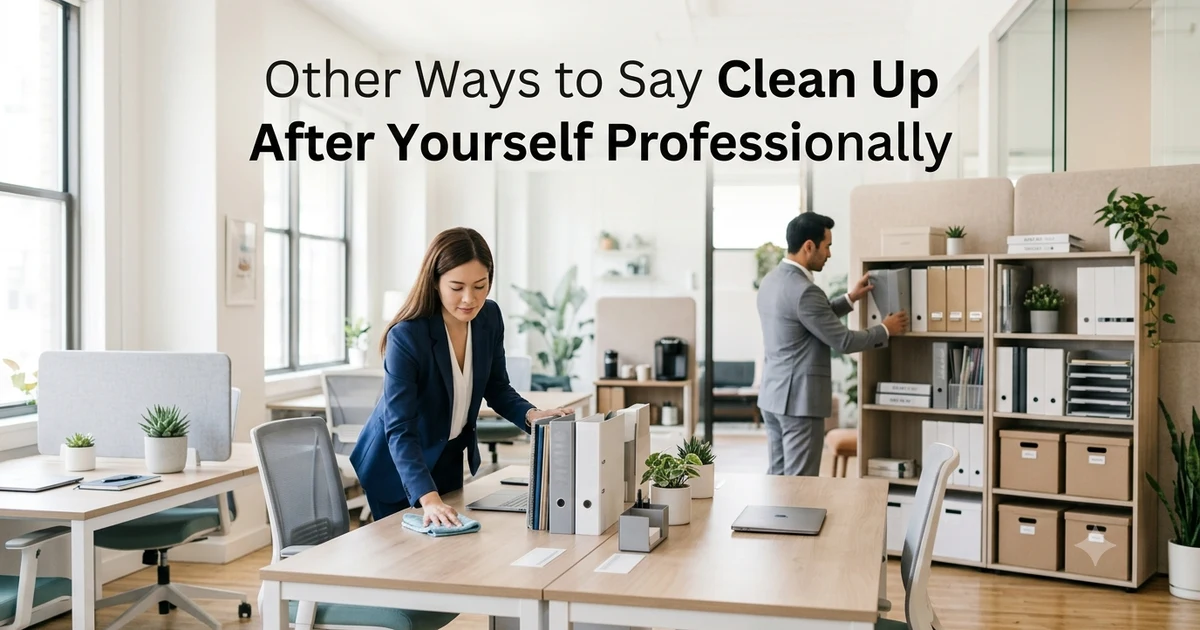
Telling someone to clean up after themselves can feel awkward, especially at work. You want to address the issue without sounding rude, bossy, or disrespectful. The right wording helps you maintain a professional tone while still making your expectations clear.
If you are looking for other ways to say clean up after yourself professionally, this guide offers polite alternatives, explains when to use each one, and provides practical workplace examples. Whether you are writing an email, speaking to a coworker, or managing a team, these phrases can help you communicate with confidence.
Quick Answer
Instead of saying clean up after yourself, you can use more professional phrases such as please leave the workspace tidy, please return the area to its original condition, please dispose of any waste before leaving, or please ensure the space is ready for the next person. These alternatives sound respectful while clearly communicating your expectations.
TL;DR
- Meaning: Asking someone to leave a shared space clean and organized.
- Tone: Polite, respectful, and professional when phrased carefully.
- Common use: Offices, break rooms, meeting rooms, warehouses, classrooms, and shared workspaces.
- Best place to use it: Workplace conversations, emails, notices, and team reminders.
- Formal or informal: Professional alternatives work well in formal and business settings.
What It Means
The phrase clean up after yourself means taking responsibility for any mess you create before leaving a space. This may include throwing away trash, wiping down surfaces, putting equipment back where it belongs, or organizing materials for the next person.
Although the meaning is simple, the phrase itself can sound direct. In many workplaces, especially when speaking with colleagues, clients, or employees, a softer approach often creates a better response.
Professional communication focuses on cooperation rather than commands. Instead of telling someone what they did wrong, it encourages shared responsibility and respect.
A Professional Explanation
In professional settings, the goal is not only to keep work areas clean but also to maintain positive relationships. Choosing respectful language helps prevent misunderstandings and reduces the chance that someone will feel criticized.
For example, compare these two requests.
Less professional:
- Clean up after yourself before you leave.
More professional:
- Please leave the workspace tidy for the next person.
- Please return any shared equipment after use.
- Please dispose of any waste before leaving the area.
The second approach sounds courteous while delivering the same message.
Tone and Workplace Meaning
The tone of your request matters just as much as the words you choose.
A professional alternative should sound:
- Respectful
- Clear
- Cooperative
- Helpful
- Neutral rather than personal
Avoid wording that sounds like you are speaking to children or assigning blame. Instead, focus on shared workplace standards and teamwork.
For example, saying please help keep our shared workspace organized feels much more collaborative than saying clean up your mess.
30 Professional Alternatives to Clean Up After Yourself
1. Please leave the workspace tidy
Best for offices, shared desks, and meeting rooms.
Example:
Please leave the workspace tidy before the next team arrives.
2. Please return the area to its original condition
Ideal after meetings, training sessions, or events.
Example:
Please return the area to its original condition when you finish.
3. Please clean your work area before leaving
Clear, polite, and easy to understand.
Example:
Please clean your work area before leaving for the day.
4. Please dispose of any waste before you leave
Works well in kitchens, break rooms, and production areas.
Example:
Please dispose of any waste before you leave the room.
5. Please keep shared spaces clean
A good reminder without pointing at anyone.
Example:
Please keep shared spaces clean so everyone can enjoy them.
6. Please help maintain a clean workspace
Encourages teamwork.
Example:
Please help maintain a clean workspace throughout the day.
7. Please put items back when you are finished
Useful when tools or supplies are shared.
Example:
Please put all supplies back when you are finished using them.
8. Please return equipment after use
Best for offices, workshops, and warehouses.
Example:
Please return equipment after use so others can access it.
9. Please organize your materials before leaving
Suitable for classrooms and creative workspaces.
Example:
Please organize your materials before leaving for the day.
10. Please prepare the space for the next user
A polite way to encourage responsibility.
Example:
Please prepare the space for the next user before you leave.
11. Please leave the room ready for the next meeting
Perfect for conference rooms.
Example:
Please leave the room ready for the next meeting.
12. Please remove your personal belongings
Useful in shared environments.
Example:
Please remove your personal belongings before leaving the room.
13. Please help keep this area organized
Creates a sense of teamwork.
Example:
Please help keep this area organized throughout the week.
14. Please reset the workspace after use
Common in offices and laboratories.
Example:
Please reset the workspace after use.
15. Please leave everything as you found it
Simple, polite, and widely understood.
Example:
Please leave everything as you found it when your shift ends.
16. Please keep your workstation organized
Ideal for manufacturing and office settings.
Example:
Please keep your workstation organized during your shift.
17. Please clear your materials before leaving
Works well after meetings or workshops.
Example:
Please clear your materials before leaving the conference room.
18. Please ensure the area is ready for the next person
Professional and customer focused.
Example:
Please ensure the area is ready for the next person before you leave.
19. Please leave shared areas in good condition
A respectful reminder for common spaces.
Example:
Please leave shared areas in good condition after use.
20. Please take responsibility for your workspace
Suitable for workplace policies.
Example:
Please take responsibility for your workspace throughout the day.
21. Please keep your area neat and organized
Friendly and encouraging.
Example:
Please keep your area neat and organized at all times.
22. Please remove any trash before leaving
Direct but polite.
Example:
Please remove any trash before leaving the break room.
23. Please return supplies to their proper place
Best for shared storage areas.
Example:
Please return supplies to their proper place after use.
24. Please leave the station clean
Often used in kitchens, healthcare, and production environments.
Example:
Please leave the station clean for the next shift.
25. Please tidy the area after use
Simple and professional.
Example:
Please tidy the area after use.
26. Please maintain housekeeping standards
Common in manufacturing, healthcare, and industrial workplaces.
Example:
Please maintain housekeeping standards throughout your shift.
27. Please leave the area clean and organized
Suitable for nearly every workplace.
Example:
Please leave the area clean and organized before you leave.
28. Please respect our shared workspace
Focuses on teamwork instead of correction.
Example:
Please respect our shared workspace by returning items to their proper locations.
29. Please help us keep this space presentable
Works well in customer-facing environments.
Example:
Please help us keep this space presentable for visitors and staff.
30. Please make sure everything is in order before leaving
A polished choice for emails and notices.
Example:
Please make sure everything is in order before leaving the workspace.
Choosing the Right Alternative
Not every phrase fits every workplace. The best choice depends on your relationship with the other person, your company culture, and the situation.
As a general guide:
- Use Please leave the workspace tidy for everyday office communication.
- Use Please return the area to its original condition after meetings, events, or training sessions.
- Use Please dispose of any waste before leaving for kitchens, break rooms, or shared facilities.
- Use Please ensure the area is ready for the next person when multiple employees share the same workspace.
- Use Please help maintain a clean workspace when you want to encourage teamwork rather than give a direct instruction.
In professional communication, respectful wording often leads to better cooperation than direct commands. Choosing a phrase that focuses on shared responsibility helps create a positive workplace culture while keeping expectations clear.
How to Use These Alternatives Professionally
The best replacement depends on where you are communicating and who you are addressing. A reminder to a coworker should sound different from a company-wide email or a notice in a shared space.
Here are some common situations.
In an Email
Email gives you room to explain the reason behind the request. Keep your message polite and focus on teamwork instead of individual behavior.
Example 1
Hello Team,
As a reminder, please leave the workspace tidy at the end of each day. Returning supplies to their proper place and disposing of any waste helps everyone start the next day smoothly.
Thank you for your cooperation.
Example 2
Good afternoon,
Please ensure meeting rooms are ready for the next group after each session. This includes clearing personal items, wiping the table if needed, and returning chairs to their original positions.
Thank you.
In a Team Chat
Chat messages should stay short and friendly.
Example
Good morning, everyone. Please remember to leave shared spaces clean and organized after use. Thanks for helping keep the office running smoothly.
On a Workplace Sign
Signs should be brief, positive, and easy to read.
Examples
- Please leave this area tidy for the next person.
- Thank you for returning supplies after use.
- Help us keep this workspace clean and organized.
- Please dispose of trash before leaving.
- Your cooperation helps everyone.
During a Conversation
If you need to remind someone in person, speak respectfully and avoid making it sound like a personal criticism.
Example
Would you mind making sure the workspace is ready for the next person before you head out?
Another example:
Could you please return the equipment after you’re finished using it? I appreciate it.
Common Workplace Situations
These alternatives fit many different environments.
Office
- Leave your desk organized before going home.
- Return office supplies to the storage area.
- Clean meeting rooms after presentations.
Break Room
- Throw away food containers.
- Wipe down the counter after preparing lunch.
- Empty coffee cups before leaving.
Warehouse
- Return tools to their storage location.
- Remove packaging materials.
- Keep walkways clear.
Healthcare
- Sanitize workstations.
- Return medical equipment.
- Prepare treatment rooms for the next patient.
Classroom or Training Room
- Collect training materials.
- Push chairs back into place.
- Leave the room ready for the next class.
Real Conversation Examples
Situation: Shared Office Kitchen
Example
Employee: I finished using the microwave.
Manager: Thanks. Please dispose of any waste before you leave so the kitchen stays clean.
Meaning
A polite reminder that focuses on maintaining a shared space.
Situation: Conference Room
Example
Team Lead: Before everyone heads out, please return the room to its original condition.
Meaning
A professional request to reset the meeting room.
Situation: Shared Desk
Example
Supervisor: Please leave the workspace tidy for whoever uses it next.
Meaning
The supervisor encourages courtesy without sounding demanding.
Situation: Warehouse
Example
Shift Manager: Please return all equipment after use and leave the station clean.
Meaning
A clear instruction that supports safety and efficiency.
Situation: Company-Wide Reminder
Example
Facilities Team: Please help maintain a clean workspace by returning supplies and removing personal items at the end of each day.
Meaning
A friendly reminder directed at everyone instead of one individual.
Similar Professional Phrases
Some alternatives have slightly different meanings. Choosing the right one makes your message more effective.
| Phrase | Best Used When | Main Focus |
|---|---|---|
| Please leave the workspace tidy | Everyday office use | General cleanliness |
| Please return items after use | Shared equipment | Organization |
| Please dispose of any waste | Kitchens and break rooms | Trash removal |
| Please prepare the area for the next person | Shared workstations | Consideration for others |
| Please reset the workspace | Hot desks, labs, studios | Returning everything to normal |
| Please keep shared spaces clean | Company reminders | Team responsibility |
| Please maintain housekeeping standards | Industrial workplaces | Safety and cleanliness |
| Please leave everything as you found it | Shared facilities | Respect for property |
When You Should Use These Alternatives
Professional alternatives work best when you want to encourage cooperation instead of creating conflict.
Good situations include:
- Office reminders
- Team meetings
- Employee handbooks
- Workplace emails
- Shared kitchens
- Conference rooms
- Schools
- Healthcare facilities
- Retail stores
- Manufacturing plants
These phrases also work well for customer-facing businesses where polite communication reflects the company’s culture.
When You Should Avoid Certain Phrases
Some expressions can sound too harsh, even if you do not mean them that way.
Avoid phrases like:
- Clean up your mess.
- Stop leaving things everywhere.
- Pick up after yourself.
- Someone has to clean up after you.
- Don’t leave a mess.
These statements often sound personal and may make the listener feel embarrassed or defensive.
Instead, focus on the shared expectation.
For example:
Please help keep this area organized for everyone.
This wording addresses the behavior without criticizing the person.
Is It Formal or Informal?
The original phrase clean up after yourself is generally neutral but can sound informal or parental in the workplace.
Professional alternatives sound more appropriate in business settings because they focus on workplace standards instead of personal behavior.
Appropriate for Formal Communication
- Please return the area to its original condition.
- Please ensure the workspace is ready for the next user.
- Please leave shared areas in good condition.
- Please maintain housekeeping standards.
Appropriate for Casual Workplace Conversations
- Please leave the workspace tidy.
- Please put everything back when you’re finished.
- Please return supplies after use.
- Please keep shared spaces clean.
In most offices, the casual professional options sound warm and natural without feeling overly formal.
Common Misunderstandings
People sometimes assume that asking someone to clean up after themselves is always rude. In reality, the wording and context make the biggest difference.
Here are a few common misunderstandings.
It sounds like you are talking to a child
The original phrase can remind people of something a parent or teacher might say. That is why it may feel disrespectful in a professional setting.
A better choice is:
- Please leave the workspace tidy.
- Please return the area to its original condition.
It feels like a personal criticism
If only one person receives the message, they may think they are being singled out.
Instead, frame the request as a shared expectation.
For example:
Please help keep our shared spaces clean so everyone has a comfortable work environment.
It only refers to cleaning
Many people think the phrase only means picking up trash. In the workplace, it often includes:
- Returning tools
- Organizing supplies
- Wiping work surfaces
- Removing personal belongings
- Preparing the area for the next person
USA and Tier 1 Country Usage
Professional alternatives to clean up after yourself are common across English-speaking workplaces in the United States, Canada, the United Kingdom, Australia, and New Zealand.
While the wording varies slightly, the goal remains the same: encourage responsibility without sounding confrontational.
Here are some common preferences.
United States
American workplaces often use friendly, team-focused language.
Examples include:
- Please leave the workspace tidy.
- Please return supplies after use.
- Help keep our shared spaces clean.
Canada
Canadian workplaces often prefer polite and cooperative wording.
Common examples include:
- Please help keep this area organized.
- Please leave the room ready for the next group.
United Kingdom
British workplaces often use indirect and courteous language.
Examples include:
- Please leave the area as you found it.
- Please return the room to its original condition.
Australia and New Zealand
Workplaces in Australia and New Zealand usually favor clear, practical communication.
Examples include:
- Please leave the station clean.
- Please return equipment after use.
- Please keep shared areas tidy.
Although the wording changes slightly from country to country, respectful language works well across all Tier 1 English-speaking workplaces.
Quick Reference Table
| Context | What It Means | Tone | Best Use | Avoid If |
|---|---|---|---|---|
| Office email | Leave your workspace organized | Professional | Team reminders | You need to address one person’s repeated behavior privately |
| Meeting room | Reset the room after use | Polite | Conference rooms | Immediate safety issue requires direct instruction |
| Break room | Throw away trash and wipe surfaces | Friendly | Shared kitchens | The issue involves damaged property |
| Shared workstation | Prepare the space for the next user | Respectful | Hot desks and shared equipment | Someone needs individual coaching |
| Warehouse | Return tools and clean the area | Clear | Industrial settings | Emergency situations |
| Classroom | Organize materials before leaving | Helpful | Schools and training rooms | Serious policy violations |
Conclusion
Finding other ways to say clean up after yourself professionally helps you communicate expectations without creating unnecessary tension. A respectful request encourages cooperation, supports a positive workplace culture, and keeps shared spaces organized.
Phrases such as please leave the workspace tidy, please return the area to its original condition, and please ensure the space is ready for the next person sound courteous while delivering a clear message. Choosing the right wording depends on your audience, the setting, and the level of formality you need. In most professional environments, focusing on teamwork and shared responsibility leads to better results than giving direct commands.
FAQs
What are other ways to say clean up after yourself professionally?
Some of the best alternatives include please leave the workspace tidy, please return the area to its original condition, please dispose of any waste before leaving, and please ensure the space is ready for the next person.
Is clean up after yourself rude?
Not necessarily. The phrase is clear, but it can sound direct or parental in a workplace. Using a more professional alternative often creates a friendlier tone.
Can I use clean up after yourself in a professional email?
You can, but a softer alternative usually works better. Professional emails often use phrases that focus on teamwork and shared responsibility rather than direct commands.
What is the most polite way to remind employees to clean up?
A good option is: Please help keep our shared workspace clean and organized. This wording sounds respectful and encourages cooperation.
How do I ask coworkers to leave the office clean?
You could say: Please leave the workspace tidy before you leave for the day, or Please return supplies to their proper place after use. Both sound professional and courteous.
What is a professional way to ask someone to put things back?
Try phrases such as Please return items after use, Please return supplies to their designated location, or Please reset the workspace before leaving.
Which alternative works best for workplace signs?
Short reminders are usually the most effective. Examples include Please leave this area tidy, Please return equipment after use, or Help keep our shared workspace organized.