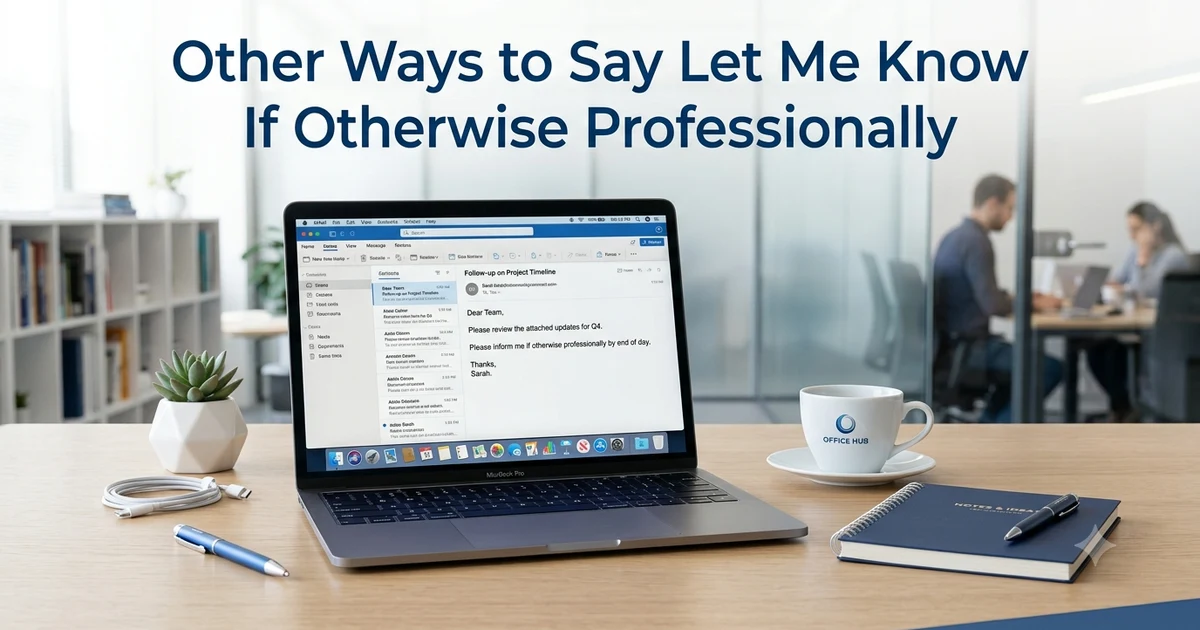
If you often write emails at work, you have probably used the phrase let me know if otherwise. While it is polite, it can sound repetitive or slightly awkward in some situations. Choosing a better alternative can make your message clearer and more professional.
Whether you are emailing a client, coworker, manager, or business partner, there are many natural ways to express the same idea. The right phrase depends on the tone you want and the level of formality.
Quick Answer
Instead of saying let me know if otherwise professionally, you can use alternatives such as please let me know if you have any concerns, feel free to correct me if needed, let me know if this does not work for you, or please advise if any changes are required. These options sound more natural and fit professional business communication.
TL;DR
- Meaning: Asking someone to tell you if your assumption is incorrect.
- Tone: Polite and professional.
- Common use: Business emails and workplace communication.
- Best for: Confirming information or proposed plans.
- Formality: Suitable for professional settings, though better alternatives often sound more natural.
What Let Me Know If Otherwise Means
This phrase tells the other person to respond only if something is different from what you expect.
People often use it after explaining a plan, confirming details, or making an assumption.
For example:
I plan to submit the report by Friday. Let me know if otherwise.
The writer expects Friday to be correct unless the recipient says something different.
Although the meaning is clear, many native English speakers prefer smoother alternatives because this wording sounds slightly incomplete.
Why People Look for Better Alternatives
Many professionals want their emails to sound clear, confident, and natural.
Replacing this phrase can help you:
- Improve email readability.
- Sound more polished.
- Avoid repetitive wording.
- Match modern business communication.
- Reduce confusion.
20 Professional Alternatives
| Alternative | Best Used For | Tone |
|---|---|---|
| Please let me know if I have misunderstood | Confirming details | Professional |
| Please advise if this is incorrect | Formal business emails | Formal |
| Feel free to correct me if needed | Collaborative conversations | Friendly |
| Let me know if any changes are required | Project updates | Professional |
| Please let me know if this does not work for you | Scheduling | Polite |
| Kindly let me know if anything needs adjustment | Client communication | Formal |
| Please let me know if you see anything differently | Team discussions | Professional |
| Let me know if there are any concerns | General workplace emails | Neutral |
| Please advise if revisions are necessary | Documents and reports | Formal |
| Let me know if you would prefer another approach | Proposals | Professional |
| Please tell me if my understanding is incorrect | Clarifying information | Formal |
| Let me know if this needs further changes | Draft reviews | Professional |
| Please let me know if anything should be updated | Status updates | Neutral |
| If this is not accurate, please let me know | Confirming facts | Professional |
| Please let me know if you have another preference | Planning | Friendly |
| Let me know if there is a better option | Collaboration | Friendly |
| Please advise if you would like anything changed | Customer service | Formal |
| Let me know if I should make any adjustments | Ongoing projects | Professional |
| Please let me know if this differs from your expectations | Client work | Professional |
| Feel free to let me know if something needs correction | General communication | Warm |
Which Alternative Sounds Most Natural?
These options are the most common in modern workplace communication.
Please let me know if I have misunderstood
Best when confirming information after a meeting or discussion.
Example:
Based on our meeting, I understand the presentation will be delivered next Tuesday. Please let me know if I have misunderstood.
Please advise if this is incorrect
Works well in formal business communication.
Example:
I believe the contract begins on August 1. Please advise if this is incorrect.
Let me know if any changes are required
Perfect for documents, proposals, or reports.
Example:
I have attached the final draft. Let me know if any changes are required.
Please let me know if this does not work for you
Useful when arranging meetings or deadlines.
Example:
I am available Thursday afternoon. Please let me know if this does not work for you.
Feel free to correct me if needed
Creates a friendly and collaborative tone.
Example:
I understand we will review the budget next week. Feel free to correct me if needed.
Tone and Meaning
These alternatives generally communicate:
- Respect
- Openness to feedback
- Professional confidence
- Willingness to collaborate
- Flexibility
Instead of sounding uncertain, they invite clarification in a polite way.
Common Workplace Situations
Use these expressions when you are:
- Confirming meeting times.
- Checking project requirements.
- Summarizing discussions.
- Sending drafts for review.
- Confirming deadlines.
- Clarifying client requests.
- Discussing schedules.
- Verifying assumptions.
Real Conversation Examples
Situation
Confirming a meeting.
Example
I have scheduled the meeting for Wednesday at 10:00 a.m. Please let me know if this does not work for you.
Meaning
The sender expects the meeting time to be acceptable unless informed otherwise.
Situation
Sending a document.
Example
I attached the updated proposal. Let me know if any changes are required.
Meaning
The sender welcomes revisions.
Situation
Following up after a meeting.
Example
My understanding is that we will move forward with Option B. Please let me know if I have misunderstood.
Meaning
The sender wants to confirm the decision.
Situation
Planning a deadline.
Example
I expect to complete the task by Friday. Please advise if this timeline needs adjustment.
Meaning
The writer asks for corrections if necessary.
Similar Professional Phrases
| Phrase | Difference |
|---|---|
| Please advise | More direct and formal |
| Let me know if you have questions | Invites questions instead of corrections |
| Kindly confirm | Requests confirmation |
| Please review | Asks for feedback |
| Let me know your thoughts | Requests opinions |
| Please confirm | Asks for approval |
| Feel free to reach out | Invites future communication |
When You Should Use These Alternatives
These phrases work well when:
- Confirming information.
- Sending updates.
- Sharing proposals.
- Coordinating projects.
- Scheduling meetings.
- Clarifying expectations.
- Communicating with clients.
- Writing professional emails.
When You Should Avoid Them
Avoid these phrases if:
- You already know the information is incorrect.
- Immediate action is required.
- The message needs a direct request instead of optional feedback.
- A simple confirmation request would be clearer.
Are These Alternatives Formal or Informal?
Most alternatives fit professional communication.
Highly formal options include:
- Please advise if this is incorrect.
- Please let me know if I have misunderstood.
- Please advise if revisions are necessary.
Moderately formal options include:
- Let me know if any changes are required.
- Please let me know if this does not work for you.
- Feel free to correct me if needed.
These phrases are common in emails, Microsoft Teams, Slack, and workplace messaging.
Common Mistakes
Before using one of these alternatives, keep these tips in mind.
- Do not use overly complicated wording.
- Avoid repeating the same phrase in every email.
- Match the level of formality to your audience.
- Keep your request specific whenever possible.
- Choose clear language instead of overly formal expressions.
USA and Tier 1 Country Usage
Professionals in the United States, Canada, the United Kingdom, Australia, and New Zealand generally prefer clear and direct business writing.
Rather than saying let me know if otherwise, many people naturally write:
- Please let me know if this is incorrect.
- Let me know if any changes are needed.
- Please advise if anything should be revised.
- Let me know if this works for you.
These versions sound smoother and appear more often in modern workplace communication.
Quick Reference Table
| Context | What It Means | Tone | Best Use | Avoid If |
|---|---|---|---|---|
| Confirming information | Correct me if needed | Professional | Email summaries | Information is already confirmed |
| Scheduling | Suggest another time | Polite | Meetings | Time cannot change |
| Reports | Request revisions | Professional | Drafts | Final approved documents |
| Client emails | Invite corrections | Formal | Business communication | Urgent requests |
| Team collaboration | Welcome feedback | Friendly | Internal discussions | Emergency situations |
Conclusion
Finding better ways to say let me know if otherwise professionally helps your emails sound more natural and confident. Instead of relying on one phrase, choose an alternative that matches your situation. Whether you are confirming details, sharing a document, or scheduling a meeting, expressions such as please let me know if I have misunderstood, let me know if any changes are required, or please advise if this is incorrect make your communication clearer and easier to understand.
FAQs
What does let me know if otherwise mean?
It asks someone to tell you if your understanding or assumption is incorrect.
Is let me know if otherwise professional?
Yes, but many native English speakers prefer smoother alternatives that sound more natural in business emails.
What is the best professional alternative?
Please let me know if I have misunderstood is one of the clearest and most professional options.
Can I use this phrase in an email?
Yes. However, alternatives like let me know if any changes are required or please advise if this is incorrect usually sound more polished.
Is this phrase formal or informal?
It is generally professional but slightly uncommon in modern business writing.
What should I say instead when confirming information?
You can say please let me know if this is incorrect, please advise if I have misunderstood, or feel free to correct me if needed.