
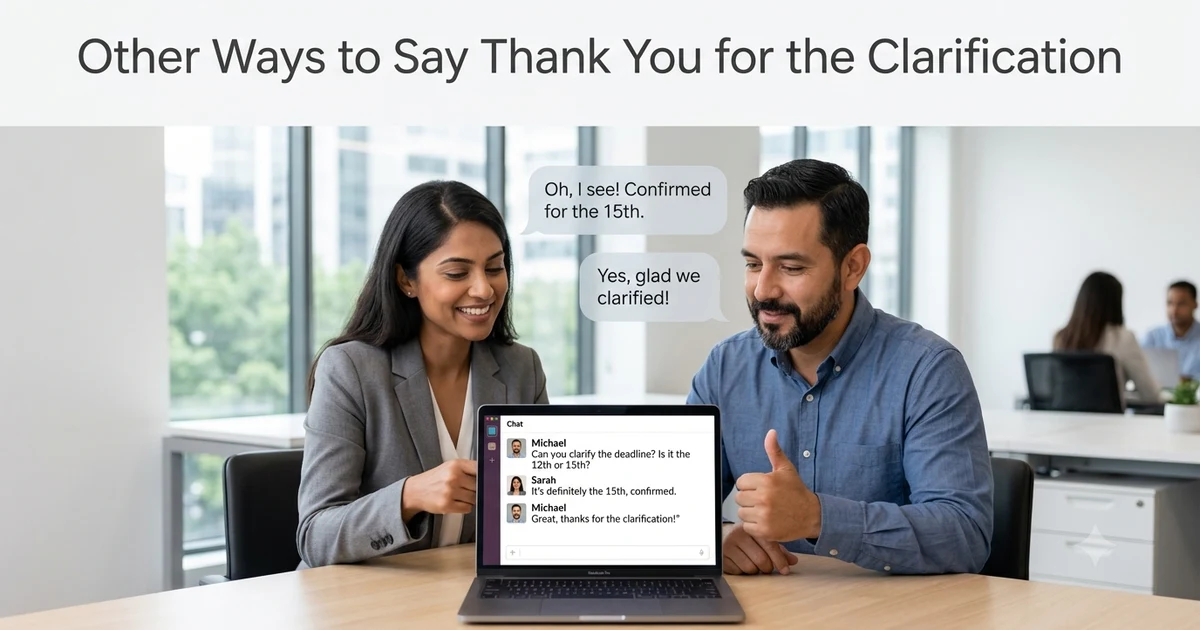
Finding other ways to say thank you for the clarification can help you sound more natural, professional, or friendly depending on the situation. The phrase itself is polite and useful, especially when someone explains something that was unclear.
You might want a warmer option for a casual message, a polished version for a work email, or a simple response for a quick chat. The best choice depends on your relationship with the person and how formal the conversation is.
Quick Answer
Other ways to say thank you for the clarification include Thanks for clearing that up, I appreciate the clarification, Thanks for explaining, That makes sense now, and Thanks for helping me understand.
For professional emails, I appreciate the clarification and thank you for clearing that up work well. For casual conversations, thanks for explaining or that makes sense now sounds more natural.
TL;DR
- Meaning: You are thanking someone for making something clearer.
- Tone: Usually polite, appreciative, and neutral.
- Common use: Emails, workplace chats, customer service, school, and everyday conversations.
- Casual option: Thanks for clearing that up.
- Professional option: I appreciate the clarification.
- Best approach: Match the wording to the relationship and situation.
What Does Thank You for the Clarification Mean?
The phrase means that you appreciate someone taking the time to explain something that was confusing, incomplete, or open to interpretation.
For example, if a coworker explains which deadline applies to a project, you might respond with:
I appreciate the clarification.
The message shows that you now understand the situation and recognize the other person’s effort.
It can also acknowledge a correction. If someone points out that you misunderstood an instruction, thanking them for the clarification keeps the conversation polite instead of making the correction feel uncomfortable.
The phrase does not usually carry a strong emotional meaning. It simply communicates appreciation and understanding.
Other Ways to Say Thank You for the Clarification
Here are some useful alternatives, ranging from casual to professional:
- Thanks for clearing that up.
- I appreciate the clarification.
- Thanks for explaining.
- Thanks for making that clear.
- That clears things up, thank you.
- Thanks for helping me understand.
- I appreciate you explaining that.
- Thanks for providing more context.
- Thanks for explaining that in more detail.
- That makes sense now, thank you.
- I appreciate the additional information.
- Thanks for clearing up the confusion.
- Thank you for explaining the situation.
- I appreciate you taking the time to clarify.
- Thanks for confirming that.
- Thanks for the additional context.
- I understand now, thank you.
- That helps a lot, thanks.
- Thanks for making that easier to understand.
- I appreciate the explanation.
The best choice depends on whether you want to sound formal, friendly, concise, or conversational.
Full Form or Basic Explanation
Thank you for the clarification is not an abbreviation or slang expression. It is a complete polite phrase.
The key word is clarification, which refers to an explanation that makes something easier to understand.
For example:
The original instruction was unclear.
The person explains what they meant.
You respond:
Thank you for the clarification.
In simple words, you are saying:
Thanks for explaining what you meant.
The phrase works particularly well when the explanation resolves uncertainty or corrects a misunderstanding.
How People Use It in Texting or Online Conversation
People use this phrase in many types of digital communication, including emails, workplace messaging apps, group chats, and direct messages.
In casual texting, the full phrase can sound slightly formal. A shorter version often feels more natural:
Thanks for clearing that up.
Thanks for explaining.
That makes sense now.
In professional online conversations, the original phrase fits comfortably:
Thank you for the clarification. I understand the next steps now.
In social media conversations, people generally choose shorter wording because the interaction tends to be less formal.
For example:
Thanks for clearing that up. I misunderstood the post.
The phrase can also work in group chats when someone resolves confusion about plans, schedules, assignments, or responsibilities.
Tone and Emotional Meaning
The phrase normally sounds polite, respectful, and appreciative.
It does not automatically sound warm or emotional. Its tone depends heavily on the surrounding message.
Polite
I appreciate the clarification. I understand what you meant now.
This sounds respectful and professional.
Friendly
Thanks for clearing that up. That makes much more sense now.
This feels relaxed and conversational.
Formal
Thank you for providing clarification regarding the updated requirements.
This suits professional or administrative communication.
Neutral
Thanks for explaining.
This works in many everyday situations.
Slightly distant
Thank you for the clarification.
When used by itself in a tense conversation, the phrase can sometimes sound formal or restrained. That does not make it rude, but the surrounding context matters.
Common Situations Where It Appears
You can use these expressions in many everyday situations.
At work
A manager explains a project requirement that seemed confusing.
I appreciate the clarification. I will update the document accordingly.
In customer service
A representative explains why a charge appeared on an account.
Thank you for explaining the charge.
At school
A teacher explains an assignment requirement.
Thanks for clearing that up. I understand what the assignment requires now.
In a group chat
Friends clarify the meeting time.
Thanks for clearing that up. I thought we were meeting later.
During a disagreement
Someone explains what they intended to say.
Thanks for explaining. I understand your point now.
In an email
A colleague provides additional information.
Thank you for the clarification. This helps me move forward with the project.
Examples in Real Conversations
Situation: Workplace email
Example
I appreciate the clarification. I will make the requested changes and send the revised version this afternoon.
Meaning
You acknowledge the explanation and confirm that you understand what you need to do.
Situation: Casual text
Example
Thanks for clearing that up. I had the wrong date.
Meaning
You are casually acknowledging that someone corrected your misunderstanding.
Situation: Customer support
Example
Thank you for explaining the policy. I understand why the request could not be processed.
Meaning
You recognize the explanation and show that you now understand the situation.
Situation: School conversation
Example
Thanks for explaining the instructions. I know what I need to include now.
Meaning
The person helped remove confusion about an assignment.
Situation: Team chat
Example
Thanks for the clarification. I will handle the second part of the task.
Meaning
You understand your responsibility after receiving additional information.
Situation: Friendly conversation
Example
That makes sense now, thanks for explaining.
Meaning
You are responding warmly without sounding overly formal.
Situation: Professional disagreement
Example
I appreciate you explaining your reasoning. That gives me a better understanding of the decision.
Meaning
You remain respectful even if you do not necessarily agree.
Similar Terms and Related Phrases
Several expressions have a similar meaning, but they are not interchangeable in every situation.
| Phrase | Tone | Best Use |
|---|---|---|
| Thanks for clearing that up | Casual and friendly | Texts, chats, everyday conversations |
| I appreciate the clarification | Professional and polite | Work emails and business messages |
| Thanks for explaining | Neutral and natural | Casual and professional settings |
| That makes sense now | Friendly and conversational | Informal conversations |
| Thank you for the additional information | Formal and neutral | Emails and professional communication |
| Thanks for confirming | Direct and practical | Schedules, details, plans |
| I understand now | Simple and direct | Everyday conversations |
| Thanks for the context | Modern and conversational | Work chats and online discussions |
| I appreciate the explanation | Polite and respectful | Professional or serious discussions |
| Thanks for helping me understand | Warm and appreciative | Personal or educational situations |
The main difference comes from what the other person actually provided.
If they explained something confusing, use thanks for explaining.
If they provided background information, thanks for the context can sound more natural.
When You Should Use These Alternatives
Choose an alternative when you want your response to sound more natural or better suited to the situation.
Use a professional option when:
- You are replying to a manager or client.
- You are writing a formal email.
- You are discussing project requirements.
- Someone has resolved an important misunderstanding.
- You want to maintain a respectful workplace tone.
Good choices include:
I appreciate the clarification.
Thank you for explaining the situation.
Thank you for providing the additional information.
Use a casual option when:
- You are texting a friend.
- You are chatting with a classmate.
- You are responding in a group chat.
- The conversation already has a relaxed tone.
Good choices include:
Thanks for explaining.
Thanks for clearing that up.
That makes sense now.
When You Should Avoid It
The phrase itself is not inappropriate, but some alternatives may sound awkward in certain situations.
Avoid overly formal wording with close friends
Saying I appreciate the clarification during a very casual conversation can sound more formal than necessary.
A friend may respond more naturally to:
Oh, got it. Thanks for explaining.
Avoid vague wording when you need to acknowledge a specific correction
If someone confirms an appointment time, saying thanks for confirming gives the response more precision.
Avoid sarcasm
The phrase can sound sarcastic if the conversation already contains frustration or disagreement.
For example, a short thank you for the clarification after an argument could be interpreted differently depending on the surrounding messages.
If you genuinely appreciate the explanation, adding a clear acknowledgment can help:
Thanks for explaining. I understand what you meant now.
Is It Formal or Informal?
Thank you for the clarification sits closer to formal and professional English, although people can use it in ordinary conversations too.
It works well in:
- Professional emails
- Workplace communication
- Business correspondence
- Customer service
- Academic communication
- Administrative messages
- Formal online conversations
For casual texting, shorter alternatives often sound more natural.
| Setting | Recommended wording |
|---|---|
| Formal email | I appreciate the clarification |
| Workplace chat | Thanks for clarifying |
| Customer service | Thank you for explaining |
| Friend | Thanks for clearing that up |
| Classmate | Thanks for explaining |
| Teacher | Thank you for clarifying |
| Manager | I appreciate the clarification |
| Group chat | Got it, thanks for explaining |
Common Misunderstandings
One common misunderstanding is thinking that clarification always means someone made a mistake. It does not.
You can ask for clarification simply because you need more information.
For example:
Could you clarify which version we should submit?
After receiving the answer, you might say:
Thanks for clarifying.
Another misunderstanding involves tone. The phrase does not automatically mean that you are annoyed or disappointed. Most of the time, it simply shows appreciation.
However, a very short response can sometimes feel distant in a tense conversation. Adding a sentence about what you now understand can make your intention clearer.
For example:
Thanks for clarifying. I understand why the schedule changed now.
This sounds more genuine than a short response with no context.
USA and Tier 1 Country Usage
Thank you for the clarification is widely understandable in standard English and works well across professional and educational settings in countries such as the United States, Canada, the United Kingdom, Australia, and New Zealand.
The main difference usually comes from context rather than country.
Professional communication tends to favor polite and direct wording:
I appreciate the clarification.
Casual communication often uses shorter expressions:
Thanks for clearing that up.
Thanks for explaining.
That makes sense now.
You do not need to change the phrase simply because the person lives in a different English-speaking country. Focus more on the relationship, setting, and level of formality.
Quick Reference Table
| Context | What It Means | Tone | Best Use | Avoid If |
|---|---|---|---|---|
| Work email | You appreciate an explanation | Professional | Managers, clients, coworkers | The message is extremely casual |
| Workplace chat | You now understand something | Polite | Team conversations | You want a very relaxed tone |
| Casual text | Someone cleared up confusion | Friendly | Friends and classmates | The setting requires formal language |
| Customer service | You understand the explanation | Respectful | Support conversations | You want to challenge the explanation |
| School | Instructions became clearer | Neutral | Teachers and classmates | A simple thanks works better |
| Social media | Someone explained their point | Conversational | Comments and replies | The discussion is hostile |
| Group chat | Confusion has been resolved | Casual | Plans and scheduling | A formal response feels unnatural |
| Professional disagreement | You acknowledge their explanation | Respectful | Difficult conversations | You want to imply sarcasm |
Conclusion
Knowing other ways to say thank you for the clarification helps you choose wording that fits the conversation instead of using the same phrase every time. The original expression sounds polite and professional, while options such as thanks for explaining and thanks for clearing that up feel more natural in casual communication.
For workplace emails, I appreciate the clarification remains a strong choice because it is concise and respectful. In everyday texting, that makes sense now or thanks for explaining usually sounds more relaxed.
The most important factor is context. Think about who you are speaking with, how formal the conversation is, and whether you want to sound professional, friendly, or simply direct. A small change in wording can make your message feel much more natural.
FAQs
What does thank you for the clarification mean in text?
It means you appreciate someone explaining something that was unclear or confusing. In texting, it can sound polite and slightly formal. Casual alternatives include thanks for explaining, thanks for clearing that up, and that makes sense now.
Is thank you for the clarification rude?
No. The phrase is generally polite and respectful. However, a very short response can sound distant in a tense conversation. Adding a sentence that shows what you understand can make the message feel warmer and more sincere.
Can I use it in a professional message?
Yes. Thank you for the clarification works well in professional emails, workplace chats, customer service conversations, and academic communication. I appreciate the clarification also provides a polished professional alternative.
What is a casual way to say thank you for the clarification?
Thanks for clearing that up and thanks for explaining are natural casual alternatives. You can also say that makes sense now or I understand now, depending on the situation.
What is a professional way to say thank you for clarifying?
I appreciate the clarification is a polished professional option. You can also use thank you for providing the additional information or thank you for explaining the situation.
What is the difference between thanks for clarifying and thanks for explaining?
Thanks for clarifying usually suggests that someone removed confusion or uncertainty. Thanks for explaining focuses more on the explanation itself. Both sound natural, but clarifying often fits professional communication particularly well.
Is thank you for the clarification formal or informal?
It is generally more formal than casual. It works especially well in professional and academic settings, while thanks for explaining or thanks for clearing that up may sound more natural in everyday conversation.