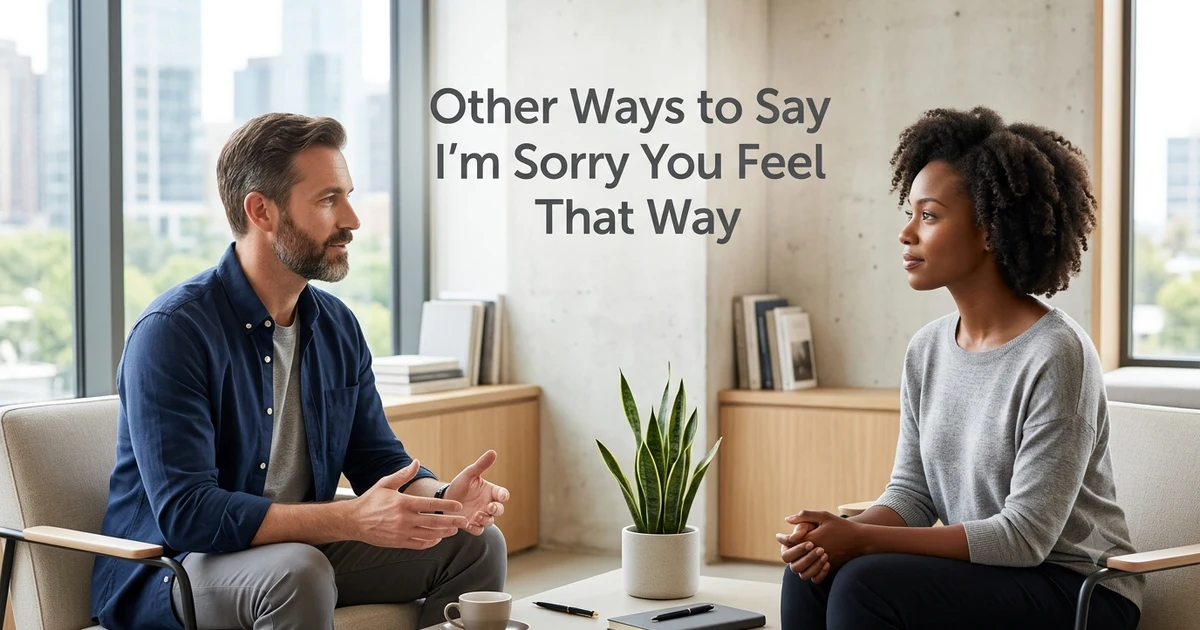
Finding other ways to say im sorry you feel that way can help you respond with more care, especially when someone is upset, hurt, or disappointed. The phrase can sound polite, but it sometimes feels dismissive because it focuses on the other persons feelings rather than accepting responsibility.
A better response depends on what happened. If you genuinely caused harm, you may want to acknowledge your actions. If you disagree with someones interpretation but still care about their feelings, you can choose a softer and more understanding reply.
Here are natural alternatives for texts, conversations, workplace situations, friendships, relationships, and online communication.
Quick Answer
Other ways to say im sorry you feel that way include I understand why you feel hurt, I am sorry this upset you, I can see why you feel that way, I regret that this affected you, and I hear what you are saying. The best alternative depends on whether you want to apologize, show empathy, or acknowledge someones feelings without accepting blame.
TL;DR
- Meaning: It acknowledges that someone feels upset, but it does not necessarily admit fault.
- Tone: It can sound polite and calm, but sometimes dismissive or defensive.
- Common use: People often use it during disagreements, complaints, misunderstandings, and difficult conversations.
- Where it appears: Texting, face-to-face conversations, emails, workplace chats, and social media.
- Formal or informal: The phrase works in both settings, but some alternatives sound more professional and empathetic.
- Best approach: Acknowledge the persons feelings and, when appropriate, take responsibility for your part.
What Im Sorry You Feel That Way Means
The phrase im sorry you feel that way generally means that you recognize another persons emotional reaction without necessarily agreeing that you caused it.
For example, if someone says they felt hurt by something you said, replying with this phrase acknowledges their feelings. However, it does not clearly say that you believe your words were wrong.
That distinction matters.
Compare these two responses:
I am sorry you feel that way.
I am sorry that what I said hurt you.
The first response focuses on the persons feelings. The second response recognizes the effect of your words.
That is why people sometimes interpret the first version as cold, defensive, or even sarcastic. The exact meaning depends heavily on the situation, relationship, and tone.
Basic Explanation
This phrase is not an abbreviation, slang term, or texting shortcut. It is a complete sentence used during emotionally difficult conversations.
The phrase can communicate several different ideas:
- I recognize that you are upset.
- I understand that you experienced the situation differently.
- I do not necessarily agree that I did something wrong.
- I want to acknowledge your feelings without accepting blame.
- I am trying to keep the conversation calm.
Because it can carry several meanings, context plays a major role.
If you caused obvious harm, the phrase may sound like you are avoiding responsibility. If the disagreement involves different opinions or interpretations, it may work as a neutral acknowledgment.
How People Use It in Texting or Online Conversation
In texting, people often use this phrase during disagreements because it is short and easy to send. It can appear in personal messages, group chats, workplace conversations, social media discussions, or comments.
However, text removes facial expressions and vocal tone. That makes the phrase easier to misunderstand.
For example:
I am sorry you feel that way.
A reader may interpret this as:
- A sincere attempt to calm things down
- A polite disagreement
- A defensive response
- A passive-aggressive comment
- An indirect refusal to apologize
If the conversation already feels tense, adding a little more context can make your message sound much warmer.
Instead of:
I am sorry you feel that way.
Try:
I can understand why that upset you. I did not intend to make you feel ignored.
This gives the other person more information and reduces the chance of sounding dismissive.
Tone and Emotional Meaning
The emotional meaning changes according to the situation.
Polite
The phrase can sound polite when you want to acknowledge someones feelings without arguing with them.
Example:
I am sorry you feel that way. I hope we can talk about what happened calmly.
Empathetic
It can sound more empathetic when you add a statement showing that you understand the persons experience.
Example:
I am sorry you feel that way. I can see why the situation was upsetting.
Defensive
The phrase may sound defensive if someone expects you to accept responsibility.
Example:
If you tell someone that your actions hurt them and they respond only with this phrase, you may feel that they ignored the actual issue.
Dismissive
Without additional context, the wording can sometimes sound like the persons feelings are their problem rather than something worth discussing.
Neutral
During a disagreement where neither person clearly accepts blame, it can function as a neutral acknowledgment.
Common Situations Where It Appears
You may hear or read this phrase in several situations:
- During an argument with a friend
- After a misunderstanding
- During a relationship disagreement
- In customer service conversations
- In workplace discussions
- When someone complains about a decision
- During an online disagreement
- When two people remember an event differently
- When someone feels excluded or ignored
- When a person expresses disappointment
- During difficult family conversations
- When someone wants acknowledgment without admitting fault
The best response depends on what the other person actually needs.
Sometimes they want an apology. Sometimes they simply want to feel heard.
Examples in Real Conversations
Situation: A friend feels ignored
Example:
I can understand why you felt ignored. I should have checked in with you sooner.
Meaning:
This response acknowledges the feeling and accepts some responsibility.
Situation: You disagree about what happened
Example:
I understand that you saw it differently, and I am sorry the situation upset you.
Meaning:
You recognize their experience without pretending that you completely agree.
Situation: Someone is disappointed by your decision
Example:
I am sorry this decision disappointed you. I understand why you were hoping for a different outcome.
Meaning:
This works when the result caused disappointment but was not necessarily something you did wrong.
Situation: A relationship disagreement
Example:
I hear what you are saying, and I understand why my words hurt you.
Meaning:
This sounds more caring than simply repeating the original phrase.
Situation: A workplace disagreement
Example:
I understand your concern, and I appreciate you explaining how the decision affected your work.
Meaning:
This keeps the response professional while acknowledging the persons concern.
Situation: Someone misunderstood your intention
Example:
I am sorry my message came across that way. That was not what I intended.
Meaning:
This recognizes the impact of your message without claiming an intention you did not have.
Situation: An online conversation becomes tense
Example:
I understand why you took my comment that way. I could have worded it more carefully.
Meaning:
This response takes some responsibility and helps lower the tension.
Similar Terms and Related Phrases
Several expressions can replace the original phrase, but they do not all mean exactly the same thing.
| Phrase | Main Meaning | Tone |
|---|---|---|
| I understand why you feel that way | Acknowledges their perspective | Empathetic |
| I am sorry this upset you | Recognizes their emotional reaction | Caring |
| I can see where you are coming from | Shows understanding | Neutral and respectful |
| I hear what you are saying | Shows that you are listening | Calm |
| I regret that this hurt you | Expresses regret about the impact | More serious |
| I did not mean to hurt you | Explains your intention | Defensive if overused |
| I am sorry for what I did | Accepts responsibility | Direct |
| I apologize for my part in this | Accepts partial responsibility | Professional |
| I understand your concern | Recognizes an issue | Formal |
| I appreciate you telling me how you feel | Encourages communication | Supportive |
The strongest alternative depends on whether you need to show empathy, explain your intention, or apologize for something you actually did.
Other Ways to Say Im Sorry You Feel That Way
Here are useful alternatives for different situations.
When you want to sound empathetic
- I understand why you feel hurt.
- I can see why that upset you.
- I understand where you are coming from.
- I hear what you are saying.
- I can understand why you reacted that way.
- I recognize that this was difficult for you.
- I understand that this affected you.
- I can see why you would feel disappointed.
When you want to apologize
- I am sorry that I hurt you.
- I apologize for what happened.
- I am sorry for my part in this.
- I regret that my actions caused you pain.
- I should have handled that differently.
- I am sorry for the way I responded.
- I apologize for making you feel ignored.
- I should have been more considerate.
you did not intend to cause harm
- I am sorry that my words came across that way.
- I did not intend to upset you.
- I can see how my words could have hurt you.
- I did not realize how that would affect you.
- I wish I had expressed myself more carefully.
- I understand how my message may have been misunderstood.
you disagree but want to remain respectful
- I understand your perspective, even though I see it differently.
- I can see why you feel that way, but I experienced it differently.
- I understand your concern, although I do not completely agree.
- I respect how you feel about the situation.
- I hear your perspective, and I think we see this differently.
When You Should Use It
The original phrase can work when you want to acknowledge feelings without making an apology that you do not genuinely mean.
It may be appropriate when:
- You and the other person remember an event differently.
- You disagree about whether something was offensive.
- You want to keep a conversation calm.
- You need time to understand what happened.
- The other persons feelings are valid even though you disagree with their conclusion.
- You did not intend to cause harm but recognize that they were affected.
Even then, adding a little context often makes your response feel more genuine.
For example:
I am sorry you feel that way.
can become:
I am sorry you feel that way. I would like to understand what made you feel hurt.
That version invites communication instead of ending the conversation.
When You Should Avoid It
There are situations where this phrase can make things worse.
Avoid using it as your only response when:
- You clearly made a mistake.
- You broke someones trust.
- You said something hurtful.
- Someone is explaining a serious concern.
- A coworker is reporting a genuine workplace problem.
- A friend is telling you that your behavior affected them negatively.
- Your partner is trying to explain why they feel hurt.
- The other person has already asked you to take responsibility.
In these situations, a direct apology usually works better.
For example:
I am sorry I said that. I understand why it hurt you, and I should have chosen my words more carefully.
This response recognizes both the feeling and your responsibility.
Is It Formal or Informal?
The phrase can appear in both formal and informal communication, but it does not always sound ideal in professional settings.
In professional emails
A more polished option might be:
I understand your concern and regret that the situation caused frustration.
In workplace chats
You could write:
I understand why that was frustrating. I appreciate you bringing it to my attention.
In casual texting
A simpler response works:
I get why you feel that way. I am sorry this upset you.
In personal conversations
You can be more emotionally direct:
I understand why you are hurt, and I am sorry for my part in what happened.
The relationship and seriousness of the situation should guide your wording.
Common Misunderstandings
It always means the speaker is apologizing
Not necessarily.
The phrase contains the word sorry, but it does not clearly accept responsibility. Someone may use it simply to acknowledge another persons feelings.
It is always rude
No. The phrase itself is not automatically rude. However, people may find it dismissive when they expect accountability or empathy.
It always sounds sarcastic
Not necessarily. Tone of voice matters in spoken conversation, while surrounding text matters more in messages.
It means the speaker agrees
No. Someone can recognize your feelings without agreeing with your interpretation of the situation.
It is always the best way to respond
No. If you caused harm, a more direct apology usually communicates sincerity better.
How to Make the Phrase Sound More Sincere
If you want to use the basic idea without sounding dismissive, add one sentence that shows understanding.
Instead of:
I am sorry you feel that way.
Try:
I am sorry you feel that way. I understand why what happened was upsetting.
Or:
I am sorry you feel that way. I would like to understand what I could have handled better.
Or:
I am sorry this situation affected you. I did not realize how strongly you felt about it.
These versions give the other person something more meaningful than a simple acknowledgment.
USA and Tier 1 Country Usage
In the United States, Canada, the United Kingdom, Australia, and other English-speaking countries, the phrase is generally understandable in everyday conversation.
The main difference comes from context rather than geography. A friend may interpret it differently from a manager, customer, teacher, or partner.
In workplace communication, people often prefer wording that clearly acknowledges a concern. In personal relationships, people may expect more emotional recognition.
For example, a coworker may respond better to:
I understand your concern and appreciate you explaining it.
A close friend may prefer:
I can see why that hurt you. I am sorry.
The phrase itself does not have a special meaning in American texting or social media. Its interpretation mainly depends on the situation and the relationship between the people communicating.
Quick Reference Table
| Context | What It Means | Tone | Best Use | Avoid If |
|---|---|---|---|---|
| Casual text | Acknowledges feelings | Neutral | Minor disagreements | Someone needs an apology |
| Friendship | Recognizes hurt | Can be caring | Different perspectives | You clearly caused harm |
| Relationship | Acknowledges emotions | Sensitive | Calm disagreements | Partner expects accountability |
| Workplace chat | Recognizes concern | Professional but indirect | Minor disputes | Serious complaint |
| Acknowledges reaction | Formal | Customer or colleague concern | A direct apology is needed | |
| Social media | Recognizes another view | Neutral | Online disagreements | Conversation is already hostile |
| Customer service | Recognizes frustration | Polite | Initial response | Customer expects a solution |
| Family conversation | Recognizes feelings | Personal | Misunderstandings | Someone feels repeatedly dismissed |
What Is a Better Alternative in Most Situations?
There is no single replacement that works every time.
If you want empathy, use:
I understand why you feel that way.
If you want to recognize the impact, use:
I am sorry this upset you.
If you want to accept responsibility, use:
I am sorry for what I did.
If you disagree but want to remain respectful, use:
I understand your perspective, even though I see the situation differently.
If you want to invite further conversation, use:
I hear what you are saying, and I would like to understand better.
Choosing the right sentence depends on what you genuinely mean. A response sounds more sincere when the wording matches your actual intention.
Conclusion
Knowing other ways to say im sorry you feel that way can help you communicate with more empathy and avoid sounding dismissive. The original phrase can acknowledge someones emotions, but it does not always communicate responsibility or genuine regret.
For a warmer response, try I understand why you feel hurt or I can see why that upset you. If you made a mistake, a direct apology such as I am sorry for what I did usually works better. When you disagree, you can acknowledge the persons perspective without pretending that you share it.
The best response is not always the most formal one. Choose language that honestly reflects what happened, how you feel, and what you want the conversation to accomplish.
FAQs
What does im sorry you feel that way mean in text?
It usually means the sender recognizes that you are upset but does not necessarily agree that they caused the problem. Depending on the conversation, it can sound empathetic, neutral, defensive, or dismissive.
Is im sorry you feel that way rude?
It is not automatically rude, but it can sound dismissive when someone expects a direct apology. Adding empathy or acknowledging your own actions can make the response feel more sincere.
What is a nicer way to say im sorry you feel that way?
Try I understand why you feel hurt, I can see why that upset you, or I am sorry this affected you. These alternatives usually sound warmer and more understanding.
Can I use this phrase in a professional message?
You can, but a more specific response often works better. I understand your concern or I appreciate you explaining how this affected you can sound more professional and constructive.
Does im sorry you feel that way mean I am admitting fault?
No. The phrase does not clearly accept responsibility. It mainly acknowledges another persons emotional response.
What should I say instead if I actually hurt someone?
Use a direct apology. For example, say I am sorry for what I did, I understand why it hurt you, and I will try to handle it differently next time.
What is the difference between I am sorry you feel that way and I am sorry I hurt you?
I am sorry you feel that way focuses on the persons feelings and may not accept blame. I am sorry I hurt you directly recognizes your actions and their effect, making it a clearer apology.