
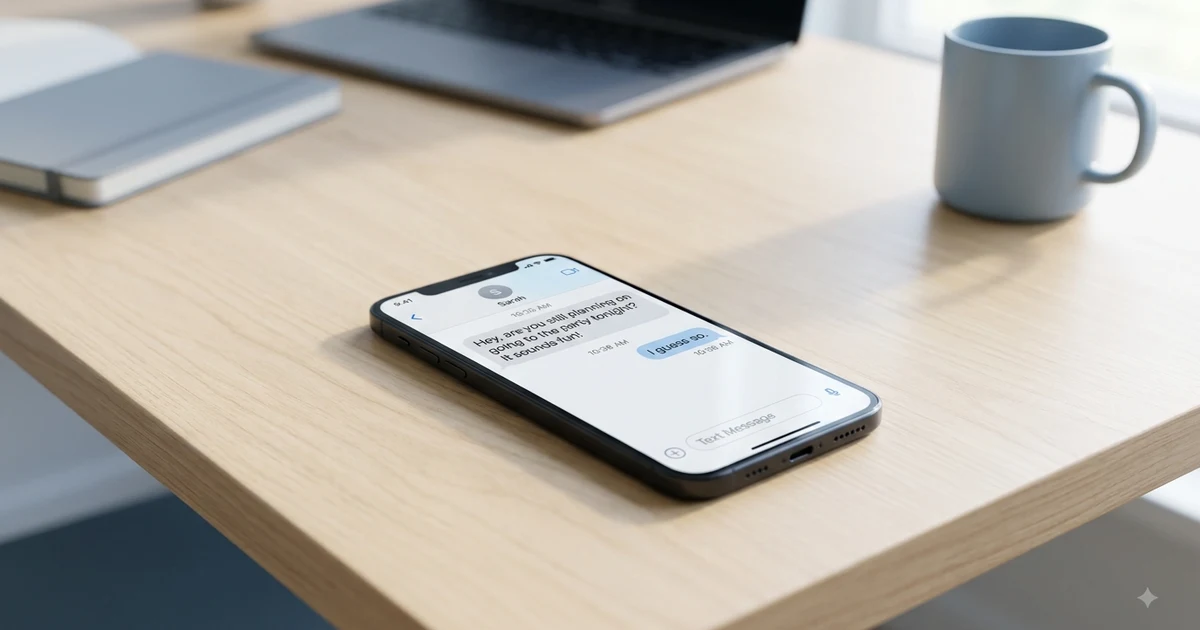
If someone says I guess so, you may wonder what they really mean or how you should respond. The phrase usually means yes, but with some uncertainty, hesitation, or lack of enthusiasm. The right response depends on the situation and the person’s tone.
In casual texting, I guess so can sound neutral, unsure, reluctant, or slightly dismissive. It does not always mean the person strongly agrees. Understanding the context helps you choose a response that feels natural rather than awkward.
Quick Answer
I guess so usually means probably yes, but I am not completely sure or enthusiastic about it. A natural response could be Sounds good, Okay, why are you unsure?, or Fair enough, depending on the conversation. The phrase sounds informal and works best in casual conversations.
TL;DR
- Meaning: Usually yes, but with some uncertainty or hesitation.
- Tone: Casual, unsure, reluctant, neutral, or sometimes dismissive.
- Common use: Texting, chatting, casual conversations, and social media.
- Where it appears: Messages, group chats, comments, and everyday conversations.
- Formal or informal: Mostly informal.
- Best response: Match the tone and ask for clarification if the person seems uncertain.
What I Guess So Means
I guess so is a casual way to express agreement without sounding completely certain.
For example:
Friend: Are you coming with us tonight?
Reply: I guess so.
This usually means the person probably plans to come, but they may not feel fully committed to the plan.
The phrase can carry several meanings depending on context:
- Probably yes
- I think so
- I suppose so
- Most likely
- Yes, but I am unsure
- Yes, although I am not excited about it
- I do not really know, but probably
The words themselves do not tell you exactly why someone feels uncertain. Their previous messages and overall tone provide more information.
Full Form or Basic Explanation
I guess so is not an abbreviation or texting acronym. It is a shortened conversational expression built around the phrase I guess.
Here, guess means that the speaker believes something is probably true without feeling completely certain.
Compare these responses:
| Response | Meaning |
|---|---|
| Yes | Clear agreement |
| I think so | Probably yes |
| I guess so | Probably yes, with more uncertainty |
| Probably | Somewhat uncertain |
| I suppose so | Similar, often slightly reluctant |
| Definitely | Strong certainty |
Because of this difference, I guess so can sound less confident than a direct yes.
How People Use It in Texting or Online Conversation
The phrase appears often in casual digital communication because it is short and conversational.
Someone might use it when:
- They are unsure about a plan
- They do not have enough information
- They agree but feel hesitant
- They do not want to give a strong yes
- They feel indifferent
- They want to avoid a long explanation
For example:
Are you free after school?
I guess so.
The reply suggests that the person is probably available, but they may not know their schedule yet.
In another conversation:
Do you think this is the right choice?
I guess so.
Here, the person agrees somewhat but does not sound confident.
Tone and Emotional Meaning
The message tone matters more than the words alone.
Neutral
Sometimes the phrase simply shows uncertainty.
Are you going to the meeting?
I guess so.
The person may simply need more information before confirming.
Hesitant
The speaker may want to say yes but still have doubts.
Do you think we should wait?
I guess so.
This can signal that they are not completely convinced.
Reluctant
Sometimes I guess so means yes, but I am not particularly happy about it.
Can you come with me?
I guess so.
The person agrees, but the response may sound less enthusiastic than Sure.
Dismissive
In some situations, especially with a short reply, it can sound like the person does not want to discuss the subject.
Do you actually want to go?
I guess so.
The speaker may be avoiding a more direct answer.
Friendly and casual
Among friends, the phrase may have no negative meaning at all. Some people naturally use hesitant language even when they generally agree.
Common Situations Where It Appears
You may see this phrase in many everyday conversations.
- Making plans with friends
- Discussing weekend activities
- Answering a yes-or-no question
- Talking about school or work
- Discussing personal preferences
- Responding to suggestions
- Casual dating conversations
- Group chats
- Social media messages
- Everyday face-to-face conversations
The surrounding conversation usually tells you whether the person sounds uncertain, reluctant, or simply casual.
Examples in Real Conversations
Situation: Making plans
Example:
Are you coming to dinner tonight?
I guess so.
Meaning: The person probably plans to come but has not fully confirmed.
Situation: Asking for an opinion
Example:
Do you think this idea will work?
I guess so.
Meaning: The person thinks it may work but does not feel confident enough to give a strong yes.
Situation: Accepting an invitation
Example:
Want to come to the game with us?
I guess so.
Meaning: They are agreeing, but their response does not show much excitement.
Situation: Confirming information
Example:
So the appointment is at 3 PM?
I guess so.
Meaning: The speaker believes the information is correct but is not completely certain.
Situation: Friendly conversation
Example:
You are still bringing snacks, right?
I guess so.
Meaning: The person probably will, but they may not have made a firm decision.
Situation: Someone sounds uncertain
Example:
Do you want me to book the tickets?
I guess so.
Meaning: The person agrees but may want reassurance or more discussion.
Similar Terms or Related Phrases
Several expressions can communicate a similar idea, but their tone can differ.
| Phrase | Main meaning | Typical tone |
|---|---|---|
| I think so | Probably yes | Neutral |
| I guess so | Probably yes | Casual and uncertain |
| I suppose so | Probably yes | Casual, sometimes reluctant |
| Probably | Likely yes | Brief and neutral |
| Maybe | Uncertain | Open-ended |
| Sure | Yes | More confident |
| Sounds good | Agreement | Positive |
| Definitely | Strong yes | Confident |
| I believe so | Probably yes | More formal |
| I am not sure | Uncertain | Direct |
If someone says I guess so, you should not automatically interpret it as a definite yes.
When You Should Use It
I guess so works well when you genuinely feel uncertain or want to give a soft agreement.
Use it when:
- You are not completely certain.
- You want to avoid sounding overly confident.
- You are having a casual conversation.
- You need more information before committing.
- You agree but want to communicate some hesitation.
If you actually feel confident, a clearer response may work better.
Instead of I guess so, you could say:
- Yes, definitely.
- I think that works.
- Sure, that sounds good.
- Yes, I agree.
- That should be fine.
When You Should Avoid It
The phrase can cause confusion when the other person needs a clear answer.
Avoid it when:
- Confirming an important appointment
- Giving professional instructions
- Answering a serious workplace question
- Confirming a deadline
- Communicating an important decision
- You actually know the answer with certainty
For example, if a manager asks whether a report will be ready by Friday, I guess so may sound unreliable.
A clearer response would be:
Yes, I can have it ready by Friday.
If you are unsure, explain why:
I am not completely sure yet. I should know by tomorrow.
That gives the other person useful information instead of leaving them guessing.
Is It Formal or Informal?
I guess so is generally informal.
It fits naturally in:
- Text messages
- Casual conversations
- Messages between friends
- Family chats
- Informal social media conversations
- Relaxed workplace chats when the topic is not serious
It usually does not work well in formal emails, academic writing, official communication, or situations where you need to sound precise.
For professional communication, alternatives include:
- I believe so.
- I think that is correct.
- That should be correct.
- Yes, based on the information I have.
- I am not completely certain yet.
Common Misunderstandings
It does not always mean no
Some readers interpret hesitation as rejection. However, I guess so generally leans toward yes.
The uncertainty may simply mean the person does not feel completely confident.
It does not always mean annoyance
A short text can look cold because digital messages do not show facial expressions or vocal tone. The person may simply have a naturally hesitant communication style.
It is not always enthusiastic agreement
A person can agree while still sounding reluctant.
That distinction matters when you are making plans or asking someone for a favor.
Context changes the meaning
Consider these two conversations:
Do you know if Sarah is coming?
I guess so.
This sounds like uncertainty.
Want to watch another episode?
I guess so.
This could sound more reluctant or indifferent.
The same phrase can carry a different emotional meaning depending on the question.
USA and Tier 1 Country Usage
I guess so is widely understandable in everyday English across the United States, Canada, the UK, Australia, and other English-speaking settings.
The basic meaning remains similar: the speaker leans toward yes but does not express complete certainty.
The exact emotional tone can vary between individuals. In some conversations, it sounds perfectly normal and relaxed. In others, especially when the person expects an enthusiastic response, it may sound hesitant or uninterested.
For international English learners, the safest approach is to treat it as an informal expression of uncertain agreement rather than a firm yes.
How to Respond to I Guess So
Your response should depend on what you want to find out.
If you are happy with the answer
You can keep things simple:
- Sounds good.
- Okay, that works.
- Great, thanks.
- Alright, that should work.
If you want certainty
Ask a short follow-up:
- Are you sure?
- Do you mean yes?
- Should I count you in?
- Do you want to go or not?
- Would you rather decide later?
If they sound reluctant
You can give them room to explain:
- You sound unsure. What are you thinking?
- No pressure. We can decide later.
- If you are not sure, we can make another plan.
If the conversation is playful
A light response can work:
- That sounds like a very confident yes.
- I will take that as a maybe.
- So that is a yes with a question mark.
These responses work best when you already have a friendly relationship with the person.
Is I Guess So Rude?
No, the phrase is not inherently rude.
However, it can sound rude or dismissive if the situation requires enthusiasm or a clear answer.
For example:
Do you want to come to my birthday party?
I guess so.
The response may hurt the other person’s feelings because it sounds less enthusiastic than expected.
On the other hand:
Do you think the store is still open?
I guess so.
This sounds much more neutral because the question naturally involves uncertainty.
The tone comes from context, not from the phrase alone.
Is It Appropriate in Dating Texts?
It can appear in casual dating conversations, but its meaning depends heavily on the surrounding messages.
If someone asks:
Want to meet for coffee Saturday?
I guess so.
They may simply be uncertain about their schedule. However, they may also sound unenthusiastic.
If you want to avoid misunderstanding, ask a simple follow-up rather than assuming what they mean.
For example:
Are you unsure about Saturday, or would another day work better?
That gives the other person an easy way to clarify.
Is It Funny or Sarcastic?
I guess so can become funny or sarcastic when the context makes the uncertainty exaggerated.
For example:
You have eaten pizza three days in a row. Want pizza again?
I guess so.
Here, the phrase can create a playful effect because the answer is obviously yes.
In text conversations, sarcasm depends heavily on shared humor and context. Without that context, a sarcastic reply can easily sound serious or dismissive.
Quick Reference Table
| Context | What It Means | Tone | Best Use | Avoid If |
|---|---|---|---|---|
| Casual texting | Probably yes | Informal | Friends and family | You need certainty |
| Making plans | Tentative yes | Uncertain | Flexible plans | Tickets or reservations need confirmation |
| Asking an opinion | Probably | Neutral | Casual discussion | A firm decision is required |
| Dating chat | Maybe yes | Hesitant | Relaxed conversation | The other person needs clear interest |
| Workplace chat | Uncertain agreement | Informal | Low-stakes topics | Discussing deadlines or important tasks |
| Social media | Probably yes | Casual | Comments and replies | A precise answer matters |
| Formal email | Uncertain yes | Too casual | Rarely appropriate | Professional communication |
| Serious discussion | Uncertain agreement | Context-dependent | When you genuinely do not know | The situation requires a direct answer |
Conclusion
I guess so usually means yes, but with some uncertainty, hesitation, or limited enthusiasm. It is a casual phrase that appears often in texting, everyday conversation, group chats, and social media.
The best way to understand it is to consider the question, the relationship between the speakers, and the surrounding conversation. If someone gives you this response and you need a definite answer, a simple follow-up question can clear things up.
For casual conversations, the phrase sounds natural. For professional or important situations, a more direct response usually communicates your meaning better.
FAQs
What does I guess so mean in text?
I guess so usually means probably yes. It shows that the person agrees or expects something to be true but does not feel completely certain.
What does I guess so mean in texting?
In texting, I guess so is a casual way to express uncertain agreement. Depending on the conversation, it can sound neutral, hesitant, reluctant, or slightly dismissive.
Is I guess so rude?
No, it is not automatically rude. However, it can sound dismissive when someone expects an enthusiastic or definite answer.
Can I use I guess so in a professional message?
You can use it in a very casual workplace conversation, but it is better to use clearer language in formal or important professional communication.
What is the difference between I guess so and I think so?
Both usually mean probably yes. I guess so often sounds more hesitant or informal, while I think so can sound slightly more confident and neutral.
How should I respond when someone says I guess so?
If you need clarification, ask Are you sure? or Do you mean yes? If the uncertainty does not matter, a simple response such as Sounds good works well.
Does I guess so mean yes or no?
It generally leans toward yes, but it is not a strong or definite yes. The speaker may still have doubts or reservations.