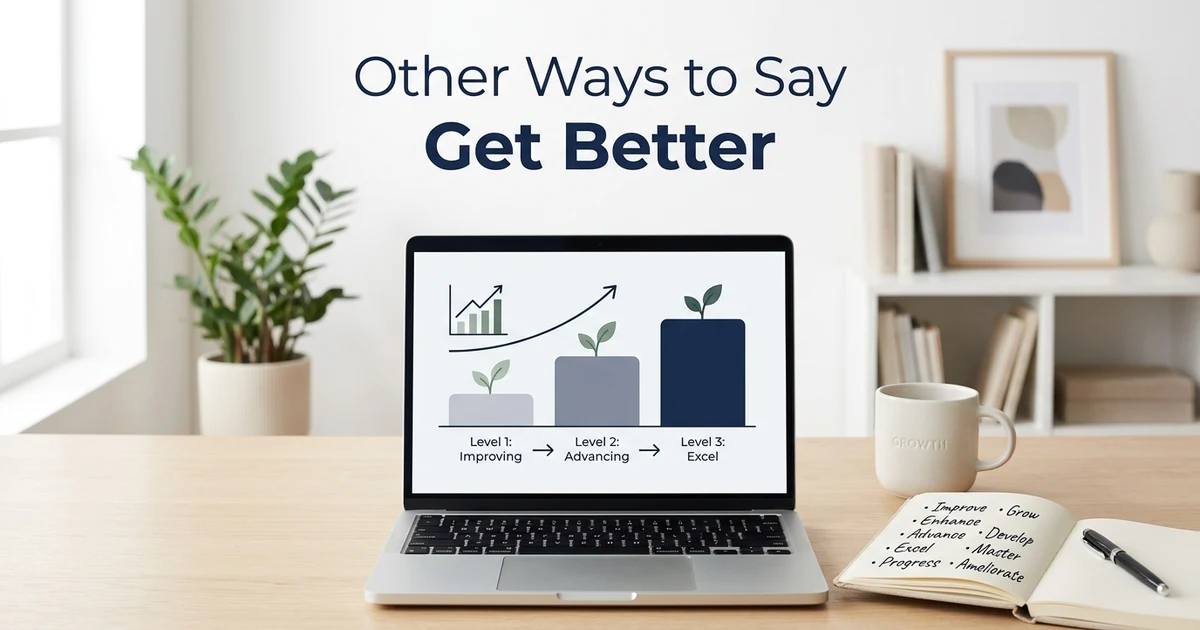
There are many reasons to look for other ways to say get better. You may want to encourage someone who is recovering, describe improvement at work or school, or find a more professional phrase for an email. The best alternative depends on what you mean by get better.
You might say improve, make progress, recover, develop, grow, strengthen, or become more effective. Some choices sound warm and supportive, while others work better in professional or academic writing.
This guide explains the meaning, tone, context, and practical use of these alternatives with simple examples.
Quick Answer
The best alternatives to get better include improve, make progress, recover, develop, grow, strengthen, advance, and become more effective. For health-related situations, recover or feel better usually sounds more natural. For skills, work, or performance, improve or make progress often works best.
TL;DR
- Meaning: Get better means to improve, recover, or become more capable or effective.
- Tone: Usually positive, encouraging, and neutral.
- Common use: Health, skills, school, work, relationships, performance, and personal growth.
- Casual options: Feel better, improve, do better, make progress.
- Professional options: Improve, develop, strengthen, advance, enhance performance.
- Formal writing: Improve, progress, develop, increase effectiveness, or demonstrate growth.
What Other Ways to Say Get Better Means
The phrase get better generally means to improve in quality, condition, ability, performance, or health.
The exact meaning changes according to context.
For example:
- A sick person can get better by recovering from an illness.
- A student can get better at math by practicing.
- An employee can get better at a skill through experience.
- A business can get better by improving its processes.
- A person can get better emotionally by developing healthier habits and receiving appropriate support.
Because the phrase has several meanings, you should choose an alternative that matches the situation.
Common alternatives
Here are some of the most useful choices:
- Improve
- Make progress
- Recover
- Feel better
- Do better
- Develop
- Grow
- Strengthen
- Advance
- Become more effective
- Make improvements
- Show progress
- Build your skills
- Gain experience
- Become stronger
- Refine your abilities
- Reach a higher level
- Perform better
- Get stronger
- Move forward
- Make strides
- Polish your skills
- Enhance your performance
- Increase your effectiveness
- Overcome difficulties
- Regain your strength
- Return to good health
- Make positive changes
- Continue developing
- Reach your potential
- Learn from experience
- Build confidence
- Become more capable
- Show improvement
- Progress steadily

Full Explanation of Get Better
Get better is a flexible everyday phrase. It can describe physical recovery, personal improvement, academic development, professional performance, or general progress.
The phrase often sounds natural because it does not specify exactly how improvement happens.
For example:
- I hope you get better soon.
- You are getting better at writing.
- Her grades are getting better.
- The team needs to get better at communication.
- Things should get better with time.
However, more precise language can make your writing clearer.
Instead of saying a student needs to get better, you could say:
The student needs to improve their writing skills.
Instead of saying someone is getting better after an illness, you could say:
She is recovering well.
The second version gives the reader more information.

How People Use the Phrase in Texting or Online Conversation
Get better appears frequently in casual messages because it is short, familiar, and easy to understand.
Someone might send:
Hope you feel better soon.
A friend might say:
You are getting better at this.
A coach might write:
Keep practicing and you will get better.
In casual online conversation, people often choose shorter alternatives such as:
- Feel better
- Do better
- Keep improving
- Keep going
- You are making progress
- You will improve
The right choice depends on whether you are talking about health, ability, performance, or personal circumstances.
In social media comments
People may use phrases such as:
- Keep improving
- You are making great progress
- You are getting stronger
- Keep working on it
- You have come a long way
These sound more specific than simply saying get better.
Tone and Emotional Meaning
Get better usually has a positive and encouraging tone, but its emotional effect depends on context.
Supportive
When someone is sick or struggling, get better can show care.
Example:
I hope you get better soon.
A softer alternative is:
I hope you feel better soon.
Encouraging
When someone is learning a skill, get better can motivate them.
Example:
Keep practicing and you will get better.
Another option is:
Keep practicing and you will continue to improve.
Professional
In workplace communication, improve often sounds more precise.
Example:
We need to get better at managing customer requests.
More professional:
We need to improve how we manage customer requests.
Potentially critical
The phrase can sometimes sound critical if you tell someone directly that they need to get better.
For example:
You need to get better at your job.
This may sound blunt.
A more constructive version would be:
There are a few areas where you can continue developing your skills.
Common Situations Where You Can Use These Alternatives
Different situations call for different expressions.
When someone is sick
Use:
- Feel better
- Recover
- Get well
- Regain your strength
- Return to good health
Example:
I hope you feel better soon.
When someone is learning
Use:
- Improve
- Develop
- Build your skills
- Make progress
- Gain experience
Example:
You are making good progress with your Spanish.
When discussing work performance
Use:
- Improve performance
- Become more effective
- Strengthen your skills
- Develop professionally
- Increase efficiency
Example:
She has improved her communication skills significantly.
When discussing grades
Use:
- Improve your grades
- Perform better
- Make academic progress
- Strengthen your understanding
- Develop your study skills
Example:
He has made noticeable progress in math this semester.
When discussing personal growth
Use:
- Grow
- Develop
- Make positive changes
- Become stronger
- Move forward
Example:
She has grown a lot through the experience.
Examples in Real Conversations
Situation: A friend is recovering from an illness
Example: I hope you feel better soon.
Meaning: You are expressing concern and wishing the person a quick recovery.
Situation: Someone is learning a new skill
Example: You are making good progress with your photography.
Meaning: You are recognizing improvement without sounding overly critical.
Situation: A student is improving academically
Example: Your writing has improved a lot this semester.
Meaning: You are pointing out clear development.
Situation: A coworker needs to improve a skill
Example: You can strengthen your presentation skills with more practice.
Meaning: You are offering constructive feedback.
Situation: Encouraging someone
Example: Keep working at it. You are getting stronger every day.
Meaning: You are encouraging continued effort.
Situation: Discussing a business
Example: The company has made significant improvements this year.
Meaning: The company has become more effective or successful in certain areas.
Situation: Talking about a difficult period
Example: Things should improve with time.
Meaning: You believe the situation can become better.
Similar Terms and Related Phrases
Not every synonym means exactly the same thing.
Improve vs. Get Better
Improve is more precise and often sounds more professional.
Get better: You need to get better at presentations.
Improve: You need to improve your presentation skills.
Recover vs. Get Better
mainly refers to returning to health or a previous condition.
Recover: He is recovering from the flu.
Get better: He is getting better.
Recover works best when the context involves illness, injury, or another setback.
Make Progress vs. Get Better
progress emphasizes movement toward a goal.
Make progress: She is making progress with her training.
Get better: She is getting better at swimming.
Grow vs. Get Better
often suggests broader personal or professional development.
Grow: She has grown as a leader.
Get better: She has gotten better at managing projects.
When You Should Use These Alternatives
Choose a more specific phrase when you want your message to sound clear and natural.
Use improve when
- You are writing professionally.
- You are discussing skills or performance.
- You want a simple, neutral verb.
- You need a concise alternative.
Example:
We need to improve our customer service.
Use recover when
- Someone is sick.
- Someone is recovering from an injury.
- You are discussing physical health.
Example:
He is recovering well after the procedure.
Use make progress when
- Someone is learning.
- A project is developing.
- You want to recognize gradual improvement.
Example:
The team is making steady progress.
Use develop when
- You are discussing professional skills.
- Someone is gaining experience.
- Improvement happens gradually.
Example:
She is developing strong leadership skills.
Use strengthen when
- A skill or ability needs improvement.
- You want constructive workplace language.
- You are discussing knowledge, relationships, or performance.
Example:
The course helped students strengthen their writing skills.
When You Should Avoid Saying Get Better
The phrase is not wrong, but it can sound too vague in some situations.
Avoid relying on it when:
- You need to explain exactly what should improve.
- You are writing a formal report.
- You are giving detailed workplace feedback.
- You are discussing academic performance.
- The listener may interpret it as criticism.
- The situation requires a specific health-related term.
For example:
You need to get better.
This gives very little useful information.
A clearer alternative would be:
You could improve your time management by setting clearer priorities.
That version explains what needs attention.
Is Get Better Formal or Informal?
Get better is neutral to informal and works well in everyday English.
It is completely natural in casual conversations, texts, chats, and friendly messages.
It can also appear in professional communication, but more precise words often sound better in formal writing.
| Setting | Is get better suitable? |
|---|---|
| Texting a friend | Yes |
| Casual conversation | Yes |
| Social media | Yes |
| Friendly workplace chat | Usually |
| Professional email | Sometimes |
| Academic essay | Usually choose improve |
| Business report | Prefer improve or develop |
| Formal evaluation | Prefer precise language |
For formal writing, consider:
- Improve
- Develop
- Strengthen
- Enhance
- Demonstrate progress
- Increase effectiveness
- Show measurable improvement
Common Misunderstandings
Get better does not always mean recover
If someone says a patient is getting better, the phrase may refer to recovery. But if someone says their writing is getting better, it refers to improvement in ability.
Context determines the meaning.
Improve does not always mean perfect
If someone improves, they simply become better than before. They do not necessarily reach a perfect level.
Feel better is not always interchangeable with get better
Feel better usually describes how someone feels, especially after being sick or upset.
Example:
I hope you feel better soon.
Get better can describe a wider range of changes.
Example:
You will get better at this with practice.
Get stronger has a narrower meaning
Get stronger may describe physical strength, emotional resilience, skills, or performance, but it does not fit every situation.
USA and Tier 1 Country Usage
Get better is widely understood in everyday English across the United States, Canada, the United Kingdom, Australia, and New Zealand.
The phrase does not require special slang knowledge, so it works well for international English learners too.
Small preferences may vary by context. For example, improve often fits formal workplace and academic writing better, while feel better sounds natural when talking about someone who is unwell.
The safest approach is to choose the phrase that describes the specific type of improvement you mean.
35 Alternatives at a Glance
Here are useful alternatives grouped by meaning:
For health
- Feel better
- Recover
- Get well
- Regain your strength
- Return to good health
skills
- Improve
- Develop
- Build your skills
- Refine your abilities
- Gain experience
- Become more capable
work
- Improve performance
- Become more effective
- Strengthen your skills
- Increase efficiency
- Develop professionally
- Enhance performance
personal growth
- Grow
- Move forward
- Become stronger
- Make positive changes
- Reach your potential
- Continue developing
general progress
- Make progress
- Show improvement
- Advance
- Make strides
- Perform better
- Improve steadily
Quick Reference Table
| Context | What It Means | Tone | Best Use | Avoid If |
|---|---|---|---|---|
| Health | Recover physically | Caring | Messages to someone who is sick | You mean skill improvement |
| Feel better | Experience improved health or mood | Warm | Casual messages | Formal reports |
| Improve | Become better at something | Neutral | Work, school, writing | You specifically mean recovery |
| Make progress | Move closer to a goal | Encouraging | Learning and projects | You need to describe health |
| Develop | Build an ability over time | Professional | Skills and careers | Very casual conversations |
| Grow | Experience personal development | Positive | Personal growth | You need a precise technical term |
| Strengthen | Make an ability or quality stronger | Professional | Skills and performance | Simple casual messages |
| Recover | Return toward normal health or condition | Neutral | Illness and setbacks | General skill development |
| Perform better | Produce stronger results | Professional | School and work | Emotional support |
| Become more effective | Work or perform with greater success | Formal | Business writing | Casual texting |
Conclusion
There are plenty of natural other ways to say get better, but the best choice depends on what kind of improvement you mean. Use feel better or recover for health, improve or make progress for skills and performance, and develop or strengthen for professional situations.
Get better remains a perfectly natural phrase in everyday conversation, texting, and casual online communication. However, a more specific alternative can make your message clearer and more helpful.
If you are writing professionally, improve, develop, strengthen, or demonstrate progress usually gives the reader more information than the general phrase get better.
FAQs
What does get better mean in text?
Get better usually means to improve or recover. In a text message, the meaning depends on context. It can describe someone’s health, skills, mood, performance, or general situation.
What are the best alternatives to get better?
The best alternatives include improve, make progress, recover, feel better, develop, grow, strengthen, advance, and become more effective. Choose the option that matches the situation.
Is get better formal or informal?
Get better is neutral and common in everyday English, but it can sound less precise in formal writing. Improve, develop, strengthen, or demonstrate progress often work better in professional and academic contexts.
Is get better rude?
No, get better is not normally rude. However, telling someone they need to get better can sound blunt if you do not explain what they can improve. A specific and constructive phrase usually sounds more considerate.
Can I use get better in a professional message?
Yes, but context matters. For casual workplace communication, it can sound natural. In formal emails, reports, evaluations, or academic writing, improve or develop may sound more professional.
What is the difference between improve and get better?
Both can describe progress. Improve often sounds more precise and professional, while get better feels more conversational. Improve also works especially well when you identify the specific area that needs change.
What is another way to say get better at something?
You can say improve at something, develop your skills, make progress, become more capable, strengthen your abilities, or gain experience. For example, You are improving at public speaking sounds more precise than You are getting better at public speaking.