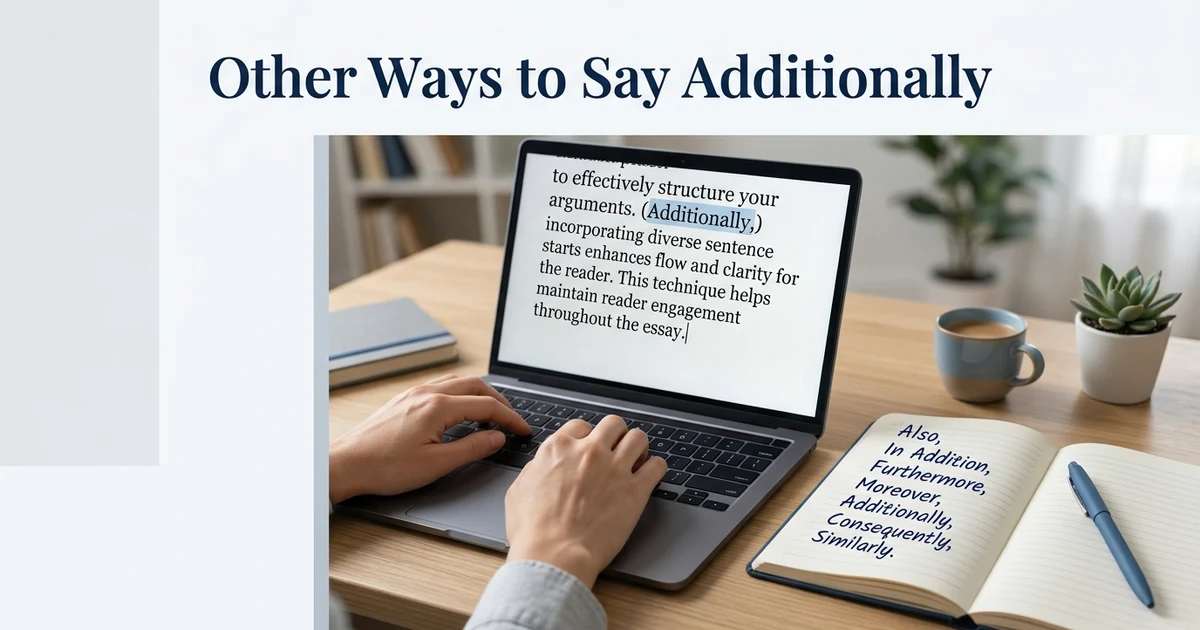
The word additionally helps you add another point, detail, reason, or idea to what you have already said. It works well in essays, reports, emails, business writing, and other formal contexts, but repeating it too often can make your writing feel predictable.
People often search for other ways to say additionally because they want their writing to sound more natural, varied, or appropriate for a specific situation. Depending on the context, you can use words and phrases such as also, in addition, furthermore, moreover, as well, besides, and on top of that. The best choice depends on your tone and how closely the new point connects to the previous one.
Quick Answer
Other ways to say additionally include also, in addition, furthermore, moreover, as well, besides, what is more, and on top of that. Additionally usually introduces another related point, so the replacement should match the tone of your writing. For formal writing, furthermore, moreover, and in addition work well, while also and as well sound more natural in everyday communication.
TL;DR
- Meaning: Additionally means adding another point or piece of information.
- Tone: Neutral to formal, depending on the sentence.
- Common use: Essays, reports, emails, presentations, and professional writing.
- Casual alternatives: Also, as well, plus, and besides.
- Formal alternatives: Furthermore, moreover, in addition, and what is more.
- Best approach: Choose an alternative based on the relationship between your ideas, not just word variety.
What Other Ways to Say Additionally Mean
Additionally means that you are adding information to something you have already mentioned. It often connects two related ideas without changing the main subject.
For example:
The hotel offers free breakfast. Additionally, guests receive complimentary airport transfers.
Here, additionally introduces another benefit offered by the hotel.
You can replace it with several expressions:
- The hotel offers free breakfast. It also provides complimentary airport transfers.
- The hotel offers free breakfast. In addition, guests receive complimentary airport transfers.
- The hotel offers free breakfast. Furthermore, guests receive complimentary airport transfers.
- The hotel offers free breakfast. Guests also receive complimentary airport transfers.
The meaning stays similar, but the tone changes slightly.
Additionally often sounds more formal than simply using also. That makes it useful when you want your writing to sound polished without becoming overly complicated.
Full Form or Basic Explanation
Additionally is not an abbreviation. It is an adverb that signals the addition of another idea, fact, reason, or detail.
In simple words, additionally means another thing is true or another point should be considered.
You might see it at the beginning of a sentence:
Additionally, the company offers flexible working hours.
It can also appear within a sentence:
The course is affordable and additionally provides access to practice materials.
However, the second structure can sound less natural in everyday English. In many cases, moving additionally to the beginning or using also creates smoother writing.
Compare:
Additionally, students receive access to online resources.
Students also receive access to online resources.
Both sentences work, but the second one sounds more conversational.

How People Use It in Writing and Online Conversation
Additionally appears most often in written communication rather than casual speech. Writers use it to connect information and introduce another supporting point.
You may see it in:
- School and university essays
- Business reports
- Professional emails
- Research writing
- News-style writing
- Presentations
- Instructions
- Formal messages
- Website content
- Workplace documents
In casual texting, people usually choose shorter words such as also, plus, or as well.
For example:
Additionally, please bring a copy of your ID.
sounds formal.
Please also bring a copy of your ID.
sounds more natural for a quick message.
On social media, the word can appear in longer posts or informative captions, but it may feel more formal than the surrounding language.

Tone and Meaning
Additionally generally carries a neutral, professional, or formal tone. It does not express a particular emotion by itself.
It simply signals that another piece of information is coming.
Polite
Additionally can make a request or explanation sound organized and professional.
Additionally, please review the attached schedule before Friday.
Formal
It fits naturally into academic and professional writing.
Additionally, the study examined the long-term effects of the treatment.
Neutral
The word does not automatically sound cold or overly formal.
The package includes installation. Additionally, customers receive a one-year warranty.
Casual
Additionally is less common in relaxed conversation. A friend would more likely say also, plus, or on top of that.
Because of this, using it in every casual message can make your writing sound unnecessarily formal.
Common Situations Where It Appears
You can use this type of transition whenever you want to add a related point.
Academic writing
Additionally, the results support the researchers original hypothesis.
Professional emails
Additionally, I have included the revised document for your review.
Business reports
Additionally, the company plans to expand its services next year.
Customer communication
Additionally, you can contact our support team if you need further assistance.
Presentations
Additionally, the survey showed a strong preference for flexible working hours.
Everyday writing
Additionally, the apartment is close to several grocery stores.
For casual communication, however, also or as well may sound more natural.
Examples in Real Conversations
Situation: Professional email
Example:
The meeting has been moved to Thursday. Additionally, the updated agenda is attached.
Meaning:
The writer adds another useful detail about the meeting.
Situation: School essay
Example:
Regular exercise can improve physical health. Furthermore, it may support better sleep.
Meaning:
The second sentence adds another supporting point.
Situation: Workplace message
Example:
The report needs to be submitted by noon. In addition, please send a copy to the finance team.
Meaning:
The sender adds another instruction.
Situation: Casual conversation
Example:
The restaurant has great food. It also has a nice outdoor area.
Meaning:
The speaker adds another positive detail.
Situation: Product description
Example:
The laptop has a lightweight design. Additionally, it offers a long battery life.
Meaning:
The second sentence adds another product feature.
Situation: Formal presentation
Example:
The project reduced operating costs. Moreover, it improved customer satisfaction.
Meaning:
The presenter adds another important result.
Similar Terms and Related Phrases
Several alternatives can replace additionally, but they do not always have exactly the same tone.
| Alternative | Tone | Main Use |
|---|---|---|
| Also | Neutral and natural | Everyday and professional writing |
| In addition | Neutral to formal | Essays, reports, emails |
| Furthermore | Formal | Academic and professional writing |
| Moreover | Formal | Strong supporting points |
| As well | Casual to neutral | Everyday communication |
| Besides | Casual to neutral | Adding another reason or point |
| Plus | Casual | Conversation and informal writing |
| What is more | Neutral to formal | Adding emphasis |
| On top of that | Casual | Adding an extra point, often with emphasis |
| In addition to this | Formal | Connecting related information |
Additionally vs Also
Also is usually more conversational and flexible.
Additionally, the team completed the project early.
The team also completed the project early.
The second version sounds more natural in everyday communication.
Additionally vs Furthermore
Furthermore has a more formal tone and often introduces another point that supports the previous argument.
The proposal would reduce costs. Furthermore, it would improve efficiency.
Additionally vs Moreover
Moreover often adds a point that strengthens or emphasizes the previous statement.
The plan is affordable. Moreover, it requires very little maintenance.
Additionally vs Besides
Besides can introduce another reason or consideration, especially in casual conversation.
Besides being affordable, the course is easy to access.
Besides can also carry a slightly different feeling depending on context, so it does not always work as a direct replacement.
When You Should Use It
Additionally works well when you need a clear transition between related ideas.
Use it when:
- You are adding another fact.
- You want to introduce a supporting detail.
- You are writing a report or essay.
- You need a professional transition.
- You want to avoid repeating also.
- You are listing related benefits or features.
- You want your writing to move logically from one point to another.
A useful rule is to consider the relationship between your sentences first. If the second idea simply adds information, additionally may work well. If the second idea strongly supports or emphasizes the first, moreover or furthermore might fit better.
When You Should Avoid It
Additionally is not wrong in casual communication, but it can sound more formal than necessary.
Avoid relying on it when:
- You are texting a close friend.
- You are writing a very casual social media caption.
- You are having a relaxed conversation.
- The simpler word also would sound more natural.
- You have already used several formal transitions in the same paragraph.
For example:
Additionally, I am going to the store later.
sounds more formal than:
I am also going to the store later.
In a casual message, the second option usually feels more natural.
Is It Formal or Informal?
Additionally is generally formal to neutral.
It works especially well in:
- Academic essays
- Research papers
- Business reports
- Professional emails
- Workplace documents
- Presentations
- Formal explanations
- Technical writing
It can also appear in everyday writing, but it may sound slightly more polished than necessary.
For informal communication, consider:
- Also
- As well
- Plus
- Besides
- On top of that
For professional or academic writing, consider:
- Additionally
- In addition
- Furthermore
- Moreover
- What is more
The right choice depends more on the overall tone than on grammar.
Common Misunderstandings
One common misunderstanding is that additionally and moreover always mean exactly the same thing. They overlap, but they can create slightly different effects.
Additionally usually adds another point.
Moreover often adds a point that gives extra weight to the argument.
For example:
The software is affordable. Additionally, it is easy to install.
This simply adds another benefit.
The software is affordable. Moreover, it has received strong reviews from independent users.
Here, moreover gives the second point more argumentative weight.
Another issue involves sentence placement. Additionally often works naturally at the beginning of a sentence, followed by a comma.
Additionally, the store offers free delivery.
You can also use it in other positions, but forcing it into a sentence can make the writing sound stiff.
USA and Tier 1 Country Usage
Readers in the United States, Canada, the United Kingdom, Australia, and New Zealand generally understand additionally as a standard English transition meaning another point or piece of information.
The word is especially common in formal or structured writing. You may encounter it in workplace documents, educational material, reports, instructions, and professional communication.
Everyday speakers often prefer simpler alternatives such as also or as well. That does not make additionally incorrect in casual communication. It simply means the word may sound more formal than the surrounding language.
For international English writing, also and in addition are often useful choices because they are clear and widely understood.
Quick Reference Table
| Context | What It Means | Tone | Best Use | Avoid If |
|---|---|---|---|---|
| Academic essay | Adds supporting information | Formal | Essays and research | Writing very casually |
| Professional email | Adds another detail | Professional | Workplace communication | Messaging close friends |
| Business report | Introduces another fact | Formal | Reports and proposals | Casual conversation |
| Text message | Adds another thought | Neutral to formal | More polished messages | Very relaxed chats |
| Social media | Adds information | Neutral | Informative posts | Short casual captions |
| Presentation | Adds another point | Professional | Talks and slides | Informal conversation |
| Everyday conversation | Adds information | Formal-leaning | Deliberate speech | Relaxed chatting |
| Customer service | Adds an instruction or detail | Professional | Support messages | Personal messages |
Conclusion
Additionally is a useful transition for adding another fact, reason, detail, or supporting idea. It has a neutral to formal tone and fits especially well in academic writing, professional emails, reports, presentations, and other structured communication.
If you want a simpler option, also and as well usually sound more natural. For a more formal style, in addition, furthermore, and moreover can work well. The best replacement depends on the sentence and the relationship between your ideas.
Using different transitions can make your writing smoother, but you do not need to replace additionally every time it appears. If it clearly connects your ideas and matches the tone, it remains a perfectly natural choice.
FAQs
What does additionally mean in text?
Additionally means that you are adding another piece of information to something already mentioned. In text messages, it can sound slightly formal, so also or as well may feel more natural in casual conversations.
What does additionally mean in texting?
In texting, additionally means another point or detail is being added. The word is grammatically correct, but casual texters often prefer also, plus, or as well because those options sound more conversational.
Is additionally rude?
No. Additionally is not rude. It is a neutral transition word. However, it can sound more formal than necessary in a relaxed conversation, which may make a casual message feel slightly stiff.
Can I use additionally in a professional message?
Yes. Additionally works well in professional emails, workplace messages, reports, and other formal communication. It can help connect related points without sounding overly casual.
What is the difference between additionally and also?
Both words add information, but also usually sounds more natural and conversational. Additionally tends to sound more formal and often works as a sentence transition.
Is additionally formal or informal?
Additionally is generally formal to neutral. It works particularly well in academic, professional, and structured writing. In casual messages, also, as well, or plus may sound more natural.
What are the best alternatives to additionally?
Common alternatives include also, in addition, furthermore, moreover, as well, besides, what is more, and on top of that. Choose the option that matches the tone and meaning of your sentence.