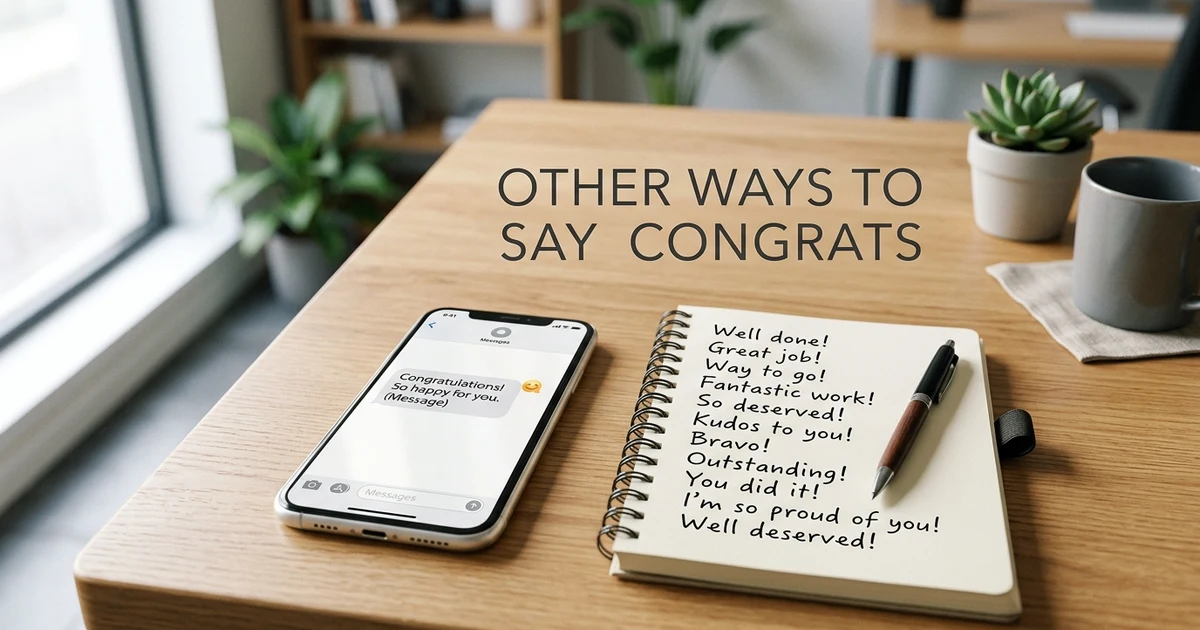
Sometimes Congrats feels too short or casual for the moment. You may want something warmer for a friend, more polished for a coworker, or more thoughtful for someone who reached an important goal. Knowing other ways to say congrats helps you match your message to the person and situation.
Whether you are replying to a promotion, graduation, new job, engagement, award, personal achievement, or good news, the right phrase can make your message feel more genuine.
Quick Answer
Other ways to say congrats include Congratulations, Well done, Great job, You did it, I am so happy for you, and That is fantastic news. The best choice depends on your relationship with the person and how formal or personal you want the message to sound.
TL;DR
- Meaning: Congratulating someone means showing happiness or approval for their achievement or good news.
- Tone: Congrats usually sounds friendly, positive, and casual.
- Common use: Texts, social media comments, cards, conversations, and casual messages.
- Formal option: Congratulations, well deserved, and congratulations on your achievement work better professionally.
- Personal option: I am so happy for you and you should be proud of yourself sound warmer and more emotional.
- Best choice: Match the phrase to the occasion, relationship, and level of formality.
What Other Ways to Say Congrats Means
The phrase other ways to say congrats refers to alternative expressions you can use instead of the short form congrats.
Congrats is a shortened form of congratulations. People commonly use it after someone shares good news or achieves something meaningful.
For example, you might congratulate someone for:
- Getting a new job
- Graduating from school or college
- Getting promoted
- Winning an award
- Buying a home
- Getting engaged
- Reaching a personal goal
- Starting a new business
- Completing a difficult project
- Achieving an academic milestone
The alternative does not always need to be another single word. A complete sentence can sound more natural and personal.

Full Form or Basic Explanation
Congrats is a casual shortened form of congratulations.
Congratulations is the more complete expression and works in a wider range of situations. Congrats feels shorter and more conversational, while congratulations can sound polished without necessarily being formal.
Here are some useful alternatives:
| Phrase | General tone |
|---|---|
| Congratulations | Polite and versatile |
| Well done | Friendly and encouraging |
| Great job | Casual and positive |
| You did it | Warm and personal |
| That is fantastic news | Enthusiastic and friendly |
| I am so happy for you | Warm and personal |
| You should be proud of yourself | Supportive |
| Well deserved | Professional and appreciative |
| What an achievement | Polished and positive |
| I am thrilled for you | Warm and enthusiastic |

How People Use It in Texting or Online Conversation
In texting and online conversation, congrats often appears as a quick response to good news.
Someone might send it after a friend posts about graduating, getting a promotion, passing an exam, or starting a new job.
Short alternatives work especially well in casual messages:
- You did it
- So happy for you
- Well deserved
- Amazing news
- Proud of you
- Great job
- That is awesome
- You earned it
- Good for you
- What an achievement
On Instagram, TikTok, Facebook, or other social platforms, short phrases often fit better than a long message. For a close friend, you can make the comment more personal by mentioning the achievement.
For example:
- So happy for you and this is so well deserved
- You worked hard for this
- What an achievement
- Proud of you for reaching this goal
Tone and Emotional Meaning
The tone of a congratulatory message depends on the words you choose.
Congrats usually sounds casual, friendly, and positive. It works well between friends, classmates, relatives, and coworkers who communicate informally.
Congratulations sounds more complete and polished. You can use it with friends, colleagues, clients, teachers, and acquaintances.
Well deserved focuses on the person earning the achievement.
I am so happy for you adds a personal and emotional touch.
Great job emphasizes the quality of someone’s work or performance.
You should be proud of yourself offers encouragement rather than simply acknowledging the achievement.
A very short response can sometimes feel less personal, especially after major life news. Adding a few words can make the message warmer.
Common Situations Where It Appears
Different achievements call for slightly different expressions.
For a New Job
Try:
- Congratulations on the new job
- That is fantastic news
- Wishing you the best in your new role
- Well deserved
For a Promotion
Try:
- Congratulations on your promotion
- Well deserved
- You earned this
- Great work on reaching this milestone
For Graduation
Try:
- Congratulations on graduating
- You did it
- What an achievement
- You should be proud of yourself
For an Award
Try:
- Congratulations on the award
- What an accomplishment
- Well deserved
- Your hard work paid off
For an Engagement
Try:
- So happy for you both
- Congratulations to you both
- Wishing you both so much happiness
- Such wonderful news
For a Personal Achievement
Try:
- I am really proud of you
- You worked hard for this
- You should be proud of yourself
- That is a huge accomplishment
Examples in Real Conversations
Situation: A Friend Gets a New Job
Example: Congratulations on the new job. I know how hard you worked for it.
Meaning: This sounds warm and personal while recognizing the effort behind the achievement.
Situation: A Coworker Gets Promoted
Example: Congratulations on your promotion. Well deserved.
Meaning: This keeps the message professional, brief, and respectful.
Situation: Someone Graduates
Example: You did it. Congratulations on graduating.
Meaning: The message feels friendly and celebratory without sounding overly formal.
Situation: A Friend Wins an Award
Example: What an achievement. You absolutely earned it.
Meaning: This shows genuine appreciation for the person’s accomplishment.
Situation: Someone Shares Engagement News
Example: I am so happy for you both. Congratulations.
Meaning: The wording feels personal and appropriate for an important life event.
Situation: A Classmate Passes an Exam
Example: Great job. All that studying paid off.
Meaning: This sounds natural in a casual conversation and recognizes the person’s effort.
Situation: A Colleague Completes a Difficult Project
Example: Well done on getting the project across the finish line.
Meaning: This works well in workplace communication and gives credit for completing the task.
Similar Terms or Related Phrases
Not every congratulatory expression carries exactly the same feeling.
| Phrase | Difference |
|---|---|
| Congratulations | The most versatile and widely appropriate option |
| Congrats | Shorter, more casual version of congratulations |
| Well done | Focuses more on effort or performance |
| Great job | Best for work, school, or a specific task |
| Proud of you | More personal and emotional |
| Well deserved | Highlights merit or hard work |
| You did it | Casual and encouraging |
| Good for you | Friendly, but tone depends heavily on context |
| Amazing work | Praises the quality of someone’s work |
| I am happy for you | Focuses on your happiness about their success |
One phrase can also change meaning based on tone. For example, good for you can sound genuinely supportive in a friendly conversation but sarcastic in some contexts.
When You Should Use It
Choose your wording based on the relationship and achievement.
congratulations when:
- You want a safe, versatile option
- You are speaking to someone you do not know well
- You are writing a professional message
- The achievement is significant
- You want a polished tone
well done when:
- Someone completed a task successfully
- You want to recognize effort
- You are speaking to a coworker, student, friend, or family member
I am so happy for you when:
- Someone shares important personal news
- You have a close relationship
- You want your response to sound warm
Use you did it when:
- Someone has worked toward a difficult goal
- You know the person well
- You want a casual and encouraging message
When You Should Avoid It
A short congratulatory phrase does not always fit the situation.
Avoid overly casual wording when:
- You are writing a formal business message
- You are congratulating a senior professional you do not know well
- You are responding to a major professional announcement
- You are writing an official card or letter
- The person may expect a more thoughtful response
For example, Congrats can work perfectly in a workplace chat with a familiar coworker. In a formal email to a client or executive, Congratulations on your achievement may sound more appropriate.
You should also avoid exaggerated wording if the situation calls for a simple acknowledgment. A natural message usually feels better than one that sounds overly dramatic.
Is It Formal or Informal?
Congrats is generally informal to moderately casual.
It works well in:
- Text messages
- Group chats
- Social media comments
- Casual emails
- Messages to friends
- Conversations with familiar coworkers
For professional communication, congratulations is usually the safer choice.
For example:
Casual: Congrats on the promotion. You earned it.
Professional: Congratulations on your promotion. Your hard work and dedication have clearly paid off.
Both express the same basic idea, but the second message has a more polished workplace tone.
Common Misunderstandings
The word congrats itself is rarely confusing, but the surrounding message can affect how it feels.
A one-word response such as congrats may feel perfectly normal after a minor achievement. After major personal news, however, the person may appreciate a more thoughtful response.
Tone can also change depending on punctuation and context. A phrase such as good for you may sound supportive between friends but sarcastic in another conversation.
Another common issue involves using congratulations for something that does not really represent an achievement. If someone simply shares an ordinary update, a supportive response such as that sounds great may fit better.
The safest approach is to consider what happened before choosing your wording.
USA and Tier 1 Country Usage
In American English, congrats is common in casual conversations, text messages, social media comments, and workplace chats. Congratulations remains widely understood and works across both casual and professional settings.
English speakers in Canada, the UK, Australia, and New Zealand also commonly understand congrats as a casual shortened form of congratulations.
Small differences in personal style can matter more than country. Some people naturally prefer short messages, while others use a complete sentence to show more warmth.
For international English communication, congratulations is the safest general option because it works across a broad range of situations.
Quick Reference Table
| Context | What It Means | Tone | Best Use | Avoid If |
|---|---|---|---|---|
| Congrats | Congratulations | Casual | Friends, texts, social media | Formal letters |
| Congratulations | Positive recognition | Polished | Work, school, personal milestones | Almost never inappropriate |
| Well done | Recognition of success | Friendly | Tasks, projects, achievements | Major personal news where warmth matters |
| Great job | Praise for performance | Casual | School, work, activities | Formal announcements |
| Well deserved | Recognition of merit | Professional | Promotions, awards, achievements | You do not know the situation well |
| You did it | Celebration of success | Warm and casual | Friends and family | Very formal settings |
| I am so happy for you | Personal happiness | Warm | Life events and personal news | Brief professional replies |
| What an achievement | Recognition of importance | Polished | Awards, milestones, accomplishments | Very casual one-word replies |
Conclusion
There are plenty of natural alternatives to congrats, and the best one depends on the situation. Congratulations works almost everywhere, while phrases such as well done, great job, well deserved, and you did it give your message a more specific tone.
For friends and family, a personal phrase such as I am so happy for you can make the message feel more sincere. In professional settings, congratulations or well deserved usually creates a more polished impression.
The key is not simply finding a different phrase. Choose words that reflect the achievement, your relationship with the person, and the tone you want your message to carry.
FAQs
What does other ways to say congrats mean?
It means alternative phrases you can use instead of congrats when you want to congratulate someone. Common choices include congratulations, well done, great job, well deserved, and I am so happy for you.
What does congrats mean in text?
Congrats means congratulations. People commonly use it in texts as a short, friendly response to someone’s good news, achievement, promotion, graduation, award, or other milestone.
Is congrats rude?
No, congrats is not normally rude. It sounds casual and friendly. It may feel too informal for certain professional or highly formal situations, where congratulations works better.
Can I use congrats in a professional message?
Yes, especially in an informal workplace chat with a familiar coworker. For formal emails, client communication, or official announcements, congratulations usually sounds more polished.
What is the difference between congrats and congratulations?
Congrats is the shorter, more casual form of congratulations. Both express positive recognition, but congratulations works in more formal and professional situations.
What is another way to say congratulations to a friend?
You can say I am so happy for you, you did it, well deserved, proud of you, or that is fantastic news. The best option depends on the achievement and your relationship.
What is a professional way to say congrats?
Congratulations on your achievement, congratulations on your promotion, well deserved, and congratulations on this well-earned success are polished options for professional communication.