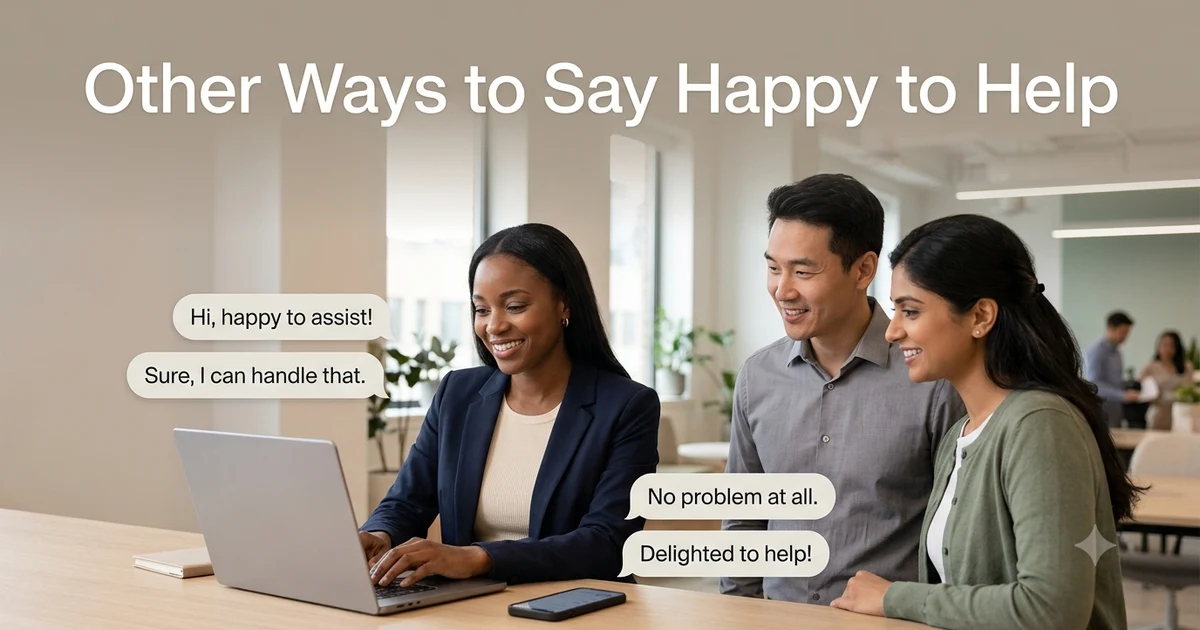
Need a better way to say happy to help without sounding repetitive? The phrase is friendly, polite, and useful in everyday conversations, customer service, workplace messages, and casual chats. However, the best alternative depends on the situation.
You might want something warmer for a friend, more professional for a client, or more natural for a quick text reply. This guide gives you practical alternatives, explains the difference in tone, and shows how to use each phrase naturally.
Quick Answer
Other ways to say happy to help include glad to help, always happy to help, pleased to help, glad I could help, my pleasure, happy to assist, and anytime. The right choice depends on your relationship with the person and how formal the conversation is.
For most everyday situations, glad to help sounds natural and friendly. In professional communication, happy to assist or pleased to help can sound more polished.
TL;DR
- Meaning: You are willing to help and feel good about doing so.
- Tone: Friendly, polite, positive, and supportive.
- Common use: Replies after helping someone or offering assistance.
- Where it appears: Text messages, emails, workplace chats, customer service, and everyday conversation.
- Formal or informal: The original phrase works in both, while alternatives can make the tone more casual or professional.
- Best simple alternative: Glad to help.
What Other Ways to Say Happy to Help Mean
The phrase happy to help means that you are pleased or willing to provide assistance.
It usually communicates more than a simple yes. It tells the other person that helping them was not a burden.
For example:
- A coworker thanks you for fixing a document, and you reply, Glad to help.
- A customer thanks you for answering a question, and you say, Happy to assist.
- A friend appreciates your advice, and you respond, Anytime.
The basic message stays the same: I was glad to be useful, and I do not mind helping you.
Basic Explanation
Happy to help is not an abbreviation or slang term. It is a short conversational phrase made from two ideas:
- Happy: pleased or willing
- To help: to provide assistance
Together, the phrase expresses a positive attitude toward helping someone.
The exact wording can change depending on the relationship. A friend might say Anytime, while a professional might choose Happy to assist.
How People Use It in Texting or Online Conversation
In texting, the phrase often appears as a short response after someone says thank you.
For example:
Thanks for sending me those notes.
Happy to help.
It can also appear after someone acknowledges your assistance:
I really appreciate you helping me with this.
Glad to help.
On social media or in group chats, people usually prefer shorter expressions such as:
- Anytime
- No problem
- Glad to help
- Of course
- You got it
- My pleasure
In professional online conversations, slightly more polished options work better:
- Happy to assist
- Pleased to help
- Glad I could assist
- Always happy to support
The texting meaning usually depends more on the surrounding conversation than on the phrase itself.
Tone and Emotional Meaning
Happy to help generally carries a friendly and positive tone.
It can communicate:
- Willingness
- Politeness
- Friendliness
- Appreciation
- Professional courtesy
- Support
It rarely sounds rude on its own.
However, tone can change through context. A very short reply such as Happy to help can sometimes feel formal or routine if the conversation has been especially personal.
Compare these:
Happy to help.
Polite and neutral.
Glad I could help.
Warm and reassuring.
Always happy to help.
More supportive and generous.
My pleasure.
Polite and courteous.
Anytime.
Casual and friendly.
Happy to assist.
Professional and service-oriented.
Common Situations Where It Appears
You can use this type of phrase in many everyday situations.
After someone says thank you
- Glad to help.
- My pleasure.
- Anytime.
- Of course.
After helping a coworker
- Happy to assist.
- Glad I could help.
- Always happy to help.
- Pleased to help.
In customer service
- Happy to assist.
- Glad I could resolve that for you.
- It was my pleasure.
- I am glad I could help.
With friends
- Anytime.
- No problem.
- Of course.
- Glad to help.
In group chats
- You got it.
- Happy to help.
- No worries.
- Glad I could help.
Examples in Real Conversations
Situation: Helping a coworker
Example
Coworker: Thanks for checking that report.
You: Glad to help.
Meaning: You are acknowledging their thanks in a friendly, professional way.
Situation: Helping a friend
Example
Friend: Thanks for helping me study.
You: Anytime.
Meaning: You are saying that you are happy to help again.
Situation: Customer support
Example
Customer: Thanks for explaining the billing issue.
You: Happy to assist.
Meaning: You are keeping the response polite and professional.
Situation: Giving someone directions
Example
Person: Thanks for showing me where the office is.
You: My pleasure.
Meaning: You are politely saying that helping them was no trouble.
Situation: Finishing a small task
Example
Coworker: I appreciate you sending that file.
You: Glad I could help.
Meaning: You are confirming that you were pleased to assist.
Similar Terms or Related Phrases
Several expressions have a similar meaning, but they do not all carry the same tone.
| Phrase | General Tone | Best For |
|---|---|---|
| Glad to help | Friendly | Everyday and workplace conversations |
| Always happy to help | Warm | Friends, coworkers, customers |
| Happy to assist | Professional | Emails and customer service |
| My pleasure | Polite | Professional and courteous replies |
| Anytime | Casual | Friends and familiar people |
| No problem | Casual | Everyday conversations |
| Of course | Friendly | Quick replies |
| Glad I could help | Warm | After completing a task |
| Pleased to help | Formal | Professional communication |
| You got it | Casual | Friends and coworkers |
Happy to help vs. glad to help
These expressions are almost interchangeable.
Happy to help emphasizes your willingness or positive attitude toward helping.
Glad to help often sounds slightly more natural after the person has already received assistance.
Happy to help vs. my pleasure
My pleasure sounds more courteous and polished. It works particularly well after someone thanks you.
Happy to help feels more direct and conversational.
Happy to help vs. anytime
Anytime sounds more casual. It suggests that the person can ask for your help again.
It works better with friends, family, and familiar coworkers than in a formal business email.
When You Should Use It
Use these alternatives when you want your response to feel positive without becoming overly formal.
Good choices include:
- Glad to help for everyday conversations
- Always happy to help when you want to sound supportive
- Happy to assist for professional communication
- My pleasure when responding politely to thanks
- Anytime for friends or familiar coworkers
- Glad I could help after completing a task
- Pleased to help when a more formal tone fits
Think about the relationship first. The closer you are to someone, the more naturally casual phrases tend to fit.
When You Should Avoid Certain Alternatives
The phrase itself rarely creates a problem, but some alternatives can feel inappropriate in certain situations.
Avoid overly casual wording with clients
Expressions such as Anytime or You got it may sound too relaxed in a formal client relationship.
Choose:
- Happy to assist
- Glad I could help
- Pleased to help
Avoid overly formal wording with close friends
Saying Pleased to help to a close friend can sound stiff or unnatural.
Try:
- Anytime
- Of course
- No problem
- Glad to help
Avoid No problem when you want extra warmth
No problem is perfectly normal, but it can sound less appreciative than My pleasure or Glad to help.
The choice depends on the relationship and conversation.
Is It Formal or Informal?
Happy to help sits comfortably in the middle.
It can work in:
- Casual texting
- Workplace chats
- Emails
- Customer service
- School communication
- Social media conversations
- Everyday face-to-face conversations
For a formal professional email, happy to assist or pleased to help may sound slightly more polished.
For a casual message, glad to help or anytime often feels more natural.
Professional examples
- Happy to assist with any additional questions.
- Glad I could help resolve the issue.
- Pleased to help with the request.
Casual examples
- Glad to help.
- Anytime.
- Of course.
- No worries.
Common Misunderstandings
The phrase can sometimes be misunderstood if the surrounding message is unclear.
It does not necessarily mean you want more work
If you say Happy to help after completing a task, you are usually just being polite. It does not automatically mean you are volunteering for additional responsibilities.
It does not always express strong emotion
The phrase can simply function as a courteous response. Someone may say it because it is a natural conversational habit.
Short replies can feel different in text
In texting, the lack of facial expression and voice tone can make a brief message feel more formal than intended.
For example:
Happy to help.
can sound neutral.
Always happy to help.
can feel warmer.
Happy to help with anything else you need.
can sound more supportive and service-oriented.
USA and Tier 1 Country Usage
Happy to help is widely understandable across English-speaking countries, including the United States, Canada, the United Kingdom, Australia, and New Zealand.
The main difference comes from personal communication style rather than a strict regional rule.
In American workplace communication, happy to help, glad to help, and happy to assist are common and easy to understand.
In British, Canadian, Australian, and New Zealand English, the same expressions are also generally natural. Local preferences can vary between individuals and workplaces, so the relationship and setting matter more than nationality.
For international professional communication, glad to help and happy to assist are particularly clear choices.
Quick Reference Table
| Context | What It Means | Tone | Best Use | Avoid If |
|---|---|---|---|---|
| Glad to help | I am pleased I could assist | Friendly | Work and everyday chat | You need very formal wording |
| Always happy to help | I am willing to help again | Warm | Supportive relationships | You want a very brief reply |
| Happy to assist | I am willing to provide assistance | Professional | Clients and work emails | Talking casually with close friends |
| My pleasure | I was pleased to help | Polite | Thank-you responses | The setting is very casual |
| Anytime | You can ask me again | Casual | Friends and familiar coworkers | Formal business messages |
| No problem | It was not difficult to help | Casual | Everyday conversation | You want extra warmth |
| Glad I could help | I am pleased the help worked | Warm | After completing a task | You have not actually helped yet |
| Pleased to help | I am willing to assist | Formal | Professional settings | Informal texting |
Conclusion
Choosing another way to say happy to help depends mostly on the situation and the relationship. Glad to help works well in everyday and workplace conversations, while happy to assist fits professional messages. My pleasure sounds courteous, and anytime feels more casual and friendly.
The key is to match the phrase with the conversation. A short reply can sound warm, professional, casual, or formal depending on the words around it. If you want a safe option for most situations, glad to help is natural, clear, and easy to use.
FAQs
What does happy to help mean in text?
Happy to help means you are pleased or willing to assist someone. In texting, it usually works as a friendly response after someone thanks you or acknowledges your assistance.
What does happy to help mean in texting?
In texting, the phrase communicates a positive attitude toward helping. It usually means that assisting the other person was not a burden.
Is happy to help rude?
No. Happy to help generally sounds polite, friendly, and supportive. The surrounding conversation can affect how it feels, but the phrase itself is not normally rude.
Can I use happy to help in a professional message?
Yes. It works well in workplace chats, emails, customer service messages, and professional conversations. For a more formal tone, happy to assist or pleased to help may work better.
What is the difference between happy to help and glad to help?
Both phrases communicate a willingness to assist. Glad to help often sounds slightly more natural after you have already helped someone, while happy to help can emphasize your willingness to assist.
Is anytime a good alternative to happy to help?
Anytime is a good alternative in casual conversations. It sounds friendly and suggests that the person can ask for your help again, but it may feel too informal for some professional situations.
What is a professional way to say happy to help?
Happy to assist, pleased to help, and glad I could assist are professional alternatives. The best choice depends on how formal the workplace or conversation needs to be.