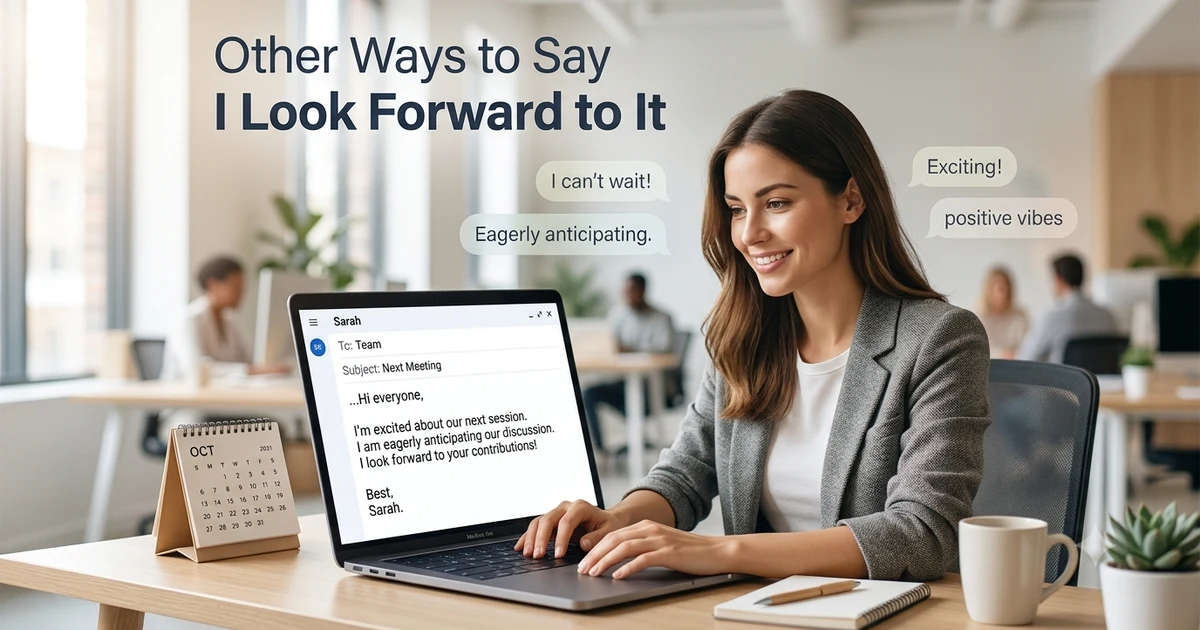
Looking for other ways to say I look forward to it can help you sound more natural, warm, professional, or enthusiastic depending on the situation. The phrase is polite and widely understood, but repeating it in emails, texts, or conversations can feel a little predictable. You might want a softer alternative for a friend, a polished option for work, or a more enthusiastic response when you are genuinely excited about something. Below, you will find practical alternatives, examples, tone differences, and guidance on which expression fits each situation.
Quick Answer
Other ways to say I look forward to it include I am looking forward to it, I am excited about it, I cannot wait, I am really anticipating it, I am eager for it, and I am excited to see what happens. The best choice depends on your relationship with the person and how formal or enthusiastic you want to sound.
TL;DR
- Meaning: You feel positive about something that will happen in the future.
- Tone: Usually polite, positive, and friendly.
- Common use: Meetings, events, plans, trips, conversations, and future opportunities.
- Where it appears: Emails, texts, workplace chats, social media, and everyday conversation.
- Formal or informal: The original phrase works in both professional and casual situations.
- Best alternatives: I am excited about it, I am eager for it, I cannot wait, and I am really looking forward to it.
What Does I Look Forward to It Mean?
The phrase I look forward to it means you feel positive about something that you expect to happen in the future.
For example:
I look forward to our meeting.
This tells the other person that you are pleased about the upcoming meeting and expect it positively.
It can also express anticipation without sounding overly emotional. That makes it useful in both personal and professional communication.
The phrase can refer to almost anything coming up:
- A meeting
- A vacation
- A celebration
- A new project
- A phone call
- Seeing someone again
- Starting a new job
- Receiving an update
- Attending an event
Other Ways to Say I Look Forward to It
Here are some useful alternatives, ranging from professional to casual:
| Alternative | Tone | Best Use |
|---|---|---|
| I am looking forward to it | Neutral | General communication |
| I am excited about it | Warm | Casual or friendly messages |
| I cannot wait | Enthusiastic | Friends, family, informal chats |
| I am eager for it | Polished | Professional or formal situations |
| I am excited for it | Casual | Texting and everyday conversation |
| I am really anticipating it | Formal | Writing and professional contexts |
| I am happy to hear that | Warm | Positive responses |
| I am excited to see what happens | Curious | Future plans or opportunities |
| I am really looking forward to this | Warm | Personal and professional use |
| I am keen to get started | Professional | Projects and work |
| I am eager to get started | Professional | New tasks or opportunities |
| I am excited to be part of it | Positive | Events, teams, and projects |
| I am counting down the days | Playful | Events and special occasions |
| I am ready for it | Confident | Casual or motivational contexts |
| This should be great | Friendly | Informal conversations |
How to Choose the Right Alternative
The best expression depends on what you want your message to communicate.
For professional communication
Try:
- I am eager to get started.
- I am looking forward to our discussion.
- I am pleased about the opportunity.
- I am eager to learn more.
- I look forward to working with you.
These options sound polished without becoming overly formal.
For friends
Try:
- I cannot wait.
- I am so excited about it.
- I am really looking forward to this.
- This is going to be great.
- I am excited for it.
These sound more relaxed and natural in texting.
For a warm personal message
Try:
- I am really looking forward to seeing you.
- I am excited to spend time together.
- I cannot wait for the day.
- I am already excited about it.
- I am really happy this is happening.
The wording can feel more personal while remaining natural.
How People Use the Phrase in Texting or Online Conversation
In texting, I look forward to it usually works as a positive response to a future plan.
For example:
A: We can meet Saturday afternoon.
B: I look forward to it.
The response sounds polite and positive, although slightly more formal than everyday texting.
In casual chat, people often choose shorter or more expressive alternatives:
- Sounds good, I cannot wait.
- I am excited for it.
- Looking forward to it.
- Cannot wait.
- I am really looking forward to this.
The shorter Looking forward to it is especially common in messages because it feels less formal than the complete sentence.
Tone and Emotional Meaning
The phrase usually carries a positive and polite tone.
However, the exact feeling can change depending on the alternative you choose.
I am looking forward to it
Warm, polite, and neutral.
I cannot wait
More excited and casual.
I am eager for it
More polished and slightly formal.
I am excited about it
Friendly and enthusiastic.
I am really looking forward to this
Warm and noticeably more enthusiastic.
I am counting down the days
Playful and highly excited.
The surrounding message also matters. A short response can sometimes sound routine rather than deeply enthusiastic.
Common Situations Where It Appears
You can use these expressions in many everyday situations.
Before a meeting
I am looking forward to our meeting tomorrow.
Before an event
I am really looking forward to the conference.
Before a trip
I cannot wait for the trip.
Starting a new project
I am eager to get started.
Meeting someone
I am looking forward to seeing you again.
Accepting an invitation
Thanks for inviting me. I am excited about it.
Workplace communication
I am looking forward to working with the team.
Waiting for an update
I look forward to hearing from you.
Examples in Real Conversations
Situation: A business meeting
Example:
Thanks for arranging the meeting. I am looking forward to discussing the project.
Meaning:
You are showing professional interest in the upcoming discussion.
Situation: Talking to a friend
Example:
I cannot wait for Saturday. It is going to be so much fun.
Meaning:
You feel strongly excited about the upcoming plan.
Situation: Starting a new job
Example:
I am excited to get started and meet everyone on the team.
Meaning:
You feel positive about joining the workplace.
Situation: Going on vacation
Example:
I am really looking forward to the trip.
Meaning:
You are happily anticipating the vacation.
Situation: Meeting someone again
Example:
I am looking forward to seeing you again.
Meaning:
You are expressing positive anticipation about seeing that person.
Situation: Receiving an invitation
Example:
Thank you for the invitation. I am excited to be there.
Meaning:
You are politely accepting and showing enthusiasm.
Similar Terms and Related Phrases
Several expressions have a similar meaning, but they are not interchangeable in every situation.
I look forward to it vs I cannot wait
I cannot wait sounds more enthusiastic and casual.
Professional:
I look forward to our meeting.
Casual:
I cannot wait to see you.
I look forward to it vs I am excited about it
Both show positive anticipation.
I am excited about it usually sounds warmer and more energetic.
I look forward to it vs I am ready for it
These phrases have different meanings.
I look forward to it focuses on anticipation.
I am ready for it focuses on preparation or willingness.
For example:
I look forward to the presentation.
I am ready for the presentation.
The first expresses anticipation. The second suggests preparation.
When You Should Use These Alternatives
Choose an alternative when you want to:
- Avoid repeating the same phrase.
- Sound more enthusiastic.
- Make a text feel warmer.
- Match a casual conversation.
- Show professional interest.
- Express excitement about an upcoming event.
- Make a response sound more personal.
- Avoid overly formal wording in a friendly message.
For workplace emails, I look forward to it remains a safe choice. For casual messages, I cannot wait or I am excited about it may sound more natural.
When You Should Avoid Them
Some alternatives can create the wrong impression in certain situations.
Avoid very casual expressions such as I cannot wait when writing a highly formal message where a restrained tone works better.
For example, a formal business email may sound better with:
I look forward to our discussion.
rather than:
I cannot wait for our discussion.
Also, avoid using overly enthusiastic wording when the situation does not call for it. Your message should match the relationship and context.
Is I Look Forward to It Formal or Informal?
I look forward to it works in both formal and informal communication.
It can appear in:
- Professional emails
- Workplace messages
- School communication
- Business correspondence
- Personal texts
- Conversations with friends
- Event invitations
- Social media messages
The complete phrase tends to sound more polished than cannot wait, while looking forward to it feels more conversational.
For a professional email, these are safe choices:
- I look forward to our meeting.
- I look forward to discussing this further.
- I am looking forward to working with you.
- I look forward to hearing from you.
For a friend:
- I cannot wait.
- I am really looking forward to it.
- I am so excited about it.
Common Misunderstandings
One common misunderstanding comes from confusing looking forward to something with physically looking ahead.
In this expression, the phrase means anticipating something positively.
Another issue involves tone. Some people may interpret I look forward to it as polite but somewhat formal, especially in casual texting. That does not mean it sounds rude. It simply may feel more polished than everyday chat.
Context also matters. Compare:
I look forward to seeing you.
with:
I cannot wait to see you.
Both are positive, but the second communicates stronger excitement.
USA and Tier 1 Country Usage
The phrase is widely understood in standard English across the United States, Canada, the UK, Australia, and other English-speaking countries.
The main difference comes from communication style rather than meaning. Professional settings often favor restrained expressions such as I look forward to it or I am eager to get started. Friends and family may prefer shorter, more expressive options such as I cannot wait or I am so excited.
Regional preferences can vary between individuals, so the safest approach is to match the tone of the person you are speaking with.
Quick Reference Table
| Context | What It Means | Tone | Best Use | Avoid If |
|---|---|---|---|---|
| I look forward to it | Positive anticipation | Polite | Work or general use | You want very casual wording |
| I am excited about it | Strong positive feeling | Warm | Friends and casual work chats | You need a restrained tone |
| I cannot wait | Strong anticipation | Casual | Friends and family | Formal business emails |
| I am eager for it | Positive expectation | Formal | Professional communication | Casual texting |
| I am really looking forward to this | Strong anticipation | Warm | Personal or professional | You need a very brief reply |
| I am eager to get started | Ready and interested | Professional | New projects or jobs | Talking about leisure plans |
| I am excited to be part of it | Positive involvement | Friendly | Events and teams | The person is not actually participating |
| I am counting down the days | Very excited | Playful | Holidays and events | Formal communication |
| I am ready for it | Prepared or willing | Confident | Tasks and challenges | You only mean anticipation |
Conclusion
There are plenty of natural ways to express the same idea without repeating I look forward to it. For professional communication, options such as I am eager to get started or I look forward to our discussion keep your message polished. In casual texting, I cannot wait and I am excited about it sound warmer and more relaxed. The key is to match the phrase with the situation, your relationship with the reader, and the level of excitement you want to show.
FAQs
What does I look forward to it mean in text?
It means you feel positive about something that will happen in the future. In text messages, it usually shows polite anticipation about a plan, event, meeting, or conversation.
What does I look forward to it mean in texting?
In texting, the phrase means you are happy or excited about something that will happen later. It sounds polite and slightly more formal than casual alternatives such as I cannot wait.
Is I look forward to it rude?
No. I look forward to it is generally polite and positive. Depending on the conversation, it may sound a little formal, but it does not normally sound rude.
Can I use I look forward to it in a professional message?
Yes. It works well in professional emails, workplace messages, business communication, and other formal situations. It can express positive anticipation without sounding overly casual.
What is a more casual way to say I look forward to it?
You can say I cannot wait, I am excited about it, I am really looking forward to this, or simply Looking forward to it.
What is a more professional alternative?
Good professional options include I am eager to get started, I look forward to our discussion, I am pleased about the opportunity, and I look forward to working with you.
Is looking forward to it the same as I cannot wait?
They have a similar meaning, but the tone differs. Looking forward to it sounds more neutral and polite, while I cannot wait usually expresses stronger excitement.