You have probably seen the phrase including but not limited to in contracts, workplace emails, business documents, or website policies. While it works well in legal and formal writing, it can sound repetitive or overly formal in everyday communication. Many people look for simpler or more natural alternatives that fit different situations.
This guide explains what the phrase means, when you should use it, and the best alternatives for business writing, academic work, emails, and casual communication. You will also find practical examples that make each option easy to understand.
Quick Answer
Including but not limited to means the items listed are only examples, not a complete list. It tells the reader that other similar things may also apply. Depending on your audience, you can replace it with phrases such as such as, including, for example, among others, or like, as long as the meaning stays clear.
TL;DR
- Meaning: The list gives examples but does not include every possible item.
- Tone: Usually formal and professional.
- Common use: Contracts, policies, business documents, and formal writing.
- Where it appears: Legal documents, workplace communication, academic writing, and official notices.
- Formal or informal: Mostly formal, though many simpler alternatives work better in everyday writing.
What Including but Not Limited To Means
The phrase tells readers that the examples you mention are only part of a larger group. It prevents people from thinking the list ends with the items you named.
For example:
Employees should follow all company policies, including but not limited to attendance, safety, and data security.
This sentence means employees must follow those policies and any other company policies that also apply.
The phrase helps writers avoid limiting the meaning of a statement to only the examples they provide.
Basic Explanation
Think of the phrase as another way to say:
- These are only examples.
- The list is not complete.
- Other similar items also count.
- More things may apply even if they are not listed.
Many legal documents use this wording because they need to avoid accidental limitations. In everyday writing, however, shorter alternatives often sound more natural.
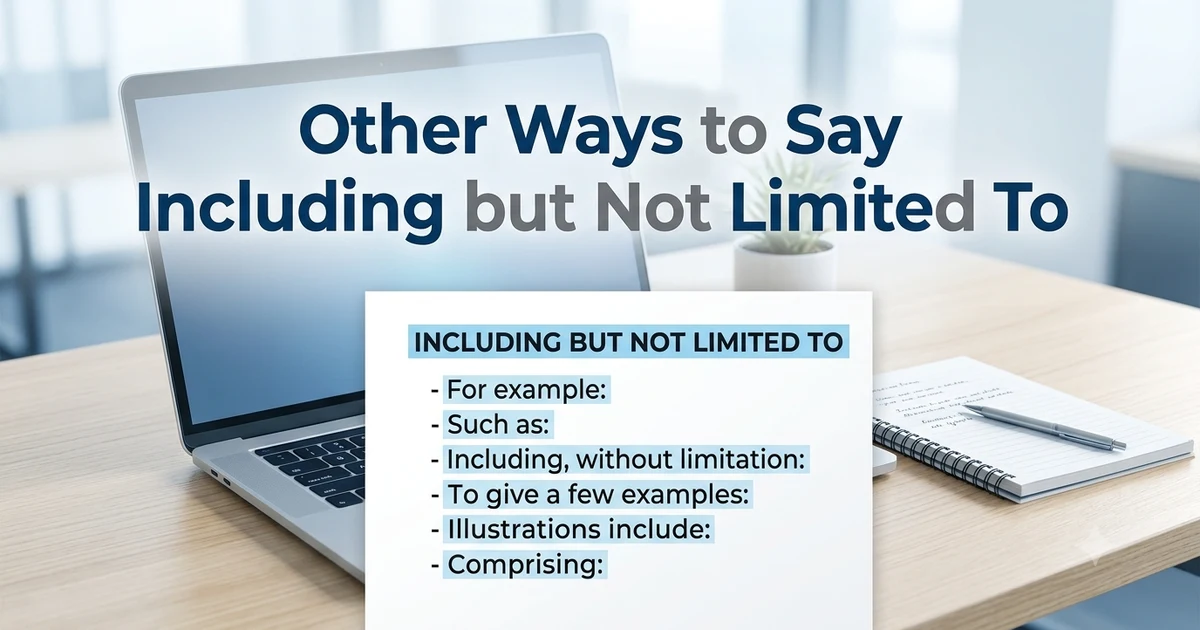
Other Ways to Say Including but Not Limited To
The best alternative depends on your audience and the level of formality you need.
| Alternative | Best For | Tone |
|---|---|---|
| Including | General writing | Neutral |
| Such as | Everyday examples | Friendly |
| For example | Explanations | Neutral |
| Among others | Professional writing | Formal |
| Like | Casual conversation | Informal |
| For instance | Academic writing | Professional |
| Including examples such as | Reports | Professional |
| As well as | General writing | Neutral |
| And more | Marketing or casual writing | Informal |
| Including things like | Conversation | Casual |
1. Including
This is the simplest replacement and often works without changing the meaning.
Example:
Please bring your identification, including your driver’s license or passport.
2. Such as
Use this when you want to introduce examples naturally.
Example:
Outdoor activities such as hiking, camping, and fishing are popular during summer.
3. For Example
This option fits educational content, presentations, and articles.
Example:
Many fruits, for example apples, oranges, and grapes, contain fiber.
4. Among Others
This phrase sounds professional and works well in reports.
Example:
The committee discussed budget planning, staffing, and training, among others.
5. Like
Use this in relaxed conversations or informal writing.
Example:
I enjoy sports like basketball, soccer, and tennis.
How People Use It in Texting or Online Conversation
Most people do not use including but not limited to in text messages because it feels too formal. Instead, they choose shorter expressions that sound more natural.
Common choices include:
- Such as
- Like
- For example
- Things like
- And more
- Plus others
Instead of writing:
The event includes activities including but not limited to games, music, and food.
Someone texting a friend might simply write:
The event has games, music, food, and more.
On social media, shorter wording keeps posts easy to read while still showing that the list is only a few examples.
Tone and Emotional Meaning
This phrase does not express emotion. Instead, it adds clarity and protects the meaning of a sentence.
Its tone usually feels:
- Professional
- Formal
- Precise
- Neutral
- Careful
Because of its legal style, it may sound stiff in everyday conversation. If you are writing an email to friends or posting on social media, a simpler alternative often creates a warmer and more natural tone.
For business agreements, contracts, policies, and official documents, the original phrase remains a strong choice because it reduces confusion.
Common Situations Where It Appears
You will often see this phrase in situations where writers want to avoid limiting a statement.
- Employment contracts
- Terms and conditions
- Privacy policies
- Legal agreements
- Employee handbooks
- School policies
- Government forms
- Business proposals
- Insurance documents
- Official emails
- Company manuals
- Service agreements
Outside of formal documents, people usually replace it with simpler wording that reads more smoothly.
Examples in Real Conversations
Situation
A manager explains workplace responsibilities.
Example
Your duties include customer support, inventory checks, and other related tasks.
Meaning
The employee may receive additional responsibilities beyond those listed.
Situation
A teacher gives assignment guidelines.
Example
Use reliable sources such as books, academic journals, and trusted websites.
Meaning
Students may also use other credible sources that meet the assignment requirements.
Situation
A friend recommends activities.
Example
We could do things like hiking, kayaking, or visit a local museum.
Meaning
These are only suggestions. Other activities are also possible.
Situation
A company announces employee benefits.
Example
Our benefits include health insurance, paid vacation, flexible schedules, and more.
Meaning
The company offers additional benefits that are not listed here.
Situation
A website describes supported payment methods.
Example
We accept major payment options including Visa, Mastercard, PayPal, and others.
Meaning
Customers may have additional payment choices beyond the examples shown.
Situation
A nonprofit shares volunteer opportunities.
Example
You can help by mentoring students, organizing events, supporting fundraising efforts, or helping in other ways.
Meaning
Volunteers are welcome to contribute in many different ways, not only the examples mentioned.
Similar Terms and Related Phrases
Several phrases carry a similar meaning, but each one fits a different situation. Choosing the right option helps your writing sound natural and clear.
| Phrase | Meaning | Best Used For |
|---|---|---|
| Including | Introduces examples | General writing |
| Such as | Gives common examples | Everyday communication |
| For example | Explains an idea with examples | Articles and presentations |
| For instance | Similar to for example | Academic and professional writing |
| Among others | Indicates more items exist | Formal writing |
| Like | Introduces examples casually | Conversations and texts |
| And more | Suggests additional items | Marketing and informal writing |
| Including things like | Gives informal examples | Blogs and casual content |
| As well as | Adds related items | Business and general writing |
| Including examples such as | Emphasizes examples | Reports and guides |
Including vs. Such As
Including often suggests the listed items are part of a larger group.
Example:
The package includes batteries, a charger, and a carrying case.
Such as simply introduces examples.
Example:
Outdoor sports such as skiing and snowboarding require proper equipment.
Including vs. For Example
For example works best when you explain an idea.
Example:
Many pets need regular exercise. For example, dogs benefit from daily walks.
Including fits better when listing items.
Example:
The membership includes fitness classes, pool access, and free parking.
Including vs. Like
Like sounds much more casual.
Example:
I enjoy hobbies like photography and painting.
It works well in conversations but may sound too informal in business documents.
When You Should Use It
The original phrase still has value in certain situations.
Use it when you want to:
- Show that your list is only a sample.
- Avoid limiting the meaning of a statement.
- Write contracts or legal documents.
- Create workplace policies.
- Draft business proposals.
- Write official notices.
- Prepare formal reports.
In many professional settings, this wording helps prevent misunderstandings because readers know the list does not cover every possibility.
When You Should Avoid It
Sometimes the phrase feels heavier than necessary.
Consider a simpler option when you are writing:
- Friendly emails
- Blog posts
- Social media captions
- Text messages
- Marketing copy
- Website content for a general audience
- Classroom assignments that encourage plain language
For example, instead of writing:
Our store sells products including but not limited to clothing, shoes, and accessories.
You could write:
Our store sells clothing, shoes, accessories, and much more.
The second version sounds smoother while keeping the same general idea.
Is It Formal or Informal?
The phrase belongs on the formal end of the language scale.
| Setting | Good Choice? | Why |
|---|---|---|
| Legal documents | Yes | Adds precision |
| Business contracts | Yes | Prevents limiting the list |
| Company policies | Yes | Professional tone |
| Academic writing | Sometimes | Depends on the writing style |
| Professional emails | Sometimes | Works if the message is formal |
| Blog articles | Usually no | Simpler wording reads better |
| Text messages | No | Sounds too formal |
| Social media | Rarely | Shorter phrases feel more natural |
If your goal is plain English, choose a shorter alternative unless you need legal precision.
Common Misunderstandings
Many readers misunderstand this phrase because they assume the list is complete.
Here are a few common mistakes.
Thinking the List Is Complete
The whole purpose of the phrase is to show that more items may exist.
Using It Too Often
Repeating it several times in the same document makes the writing feel repetitive.
Choosing It for Casual Writing
Friends rarely use this wording in everyday conversation because it sounds formal.
Replacing Every List With It
Not every list needs this phrase. If your list is complete, simply list the items without adding extra wording.
USA and Tier 1 Country Usage
Writers in the United States, Canada, the United Kingdom, Australia, and New Zealand commonly recognize this phrase from legal and business writing.
Many organizations use it in:
- Employee handbooks
- Contracts
- Terms of service
- Privacy policies
- Insurance documents
- Government forms
- Business agreements
Outside these settings, plain English has become more popular. Many companies now prefer simpler wording because it improves readability while keeping the message clear.
Quick Reference Table
| Context | What It Means | Tone | Best Use | Avoid If |
|---|---|---|---|---|
| Legal contract | Examples only, not a complete list | Formal | Contracts and agreements | Never if legal precision is required |
| Business policy | Additional items may apply | Professional | Company documents | Casual communication |
| Academic paper | Gives examples without limiting meaning | Professional | Research and reports | Simple assignments |
| Workplace email | Indicates the list is not complete | Professional | Internal communication | Friendly team chats |
| Blog article | Shows examples | Neutral | Only if needed | Plain language works better |
| Text message | Usually sounds too formal | Formal | Rarely appropriate | Everyday conversations |
| Social media | May feel overly technical | Formal | Rarely used | Casual posts and captions |
Conclusion
The phrase other ways to say including but not limited to helps writers find alternatives that match different audiences and situations. While the original expression remains useful in legal documents, contracts, and formal business writing, it often feels too formal for everyday communication.
In most cases, simple options such as including, such as, for example, among others, or and more make your writing easier to read. Choose the phrase that matches your audience, keep your examples clear, and avoid adding unnecessary complexity. Good writing communicates ideas naturally, and the simplest wording often works best.
FAQs
What does including but not limited to mean?
It means the items listed are only examples, not a complete list. Other similar items may also apply even though they are not mentioned.
Can I use including but not limited to in a professional message?
Yes. It works well in professional emails, company policies, contracts, reports, and other formal documents. For everyday workplace emails, a simpler phrase like including or such as often reads better.
Is including but not limited to formal or informal?
It is a formal phrase. Lawyers, businesses, government agencies, and organizations commonly use it in official writing. It is uncommon in casual conversations or text messages.
Is including but not limited to rude?
No. The phrase is neutral and polite. It does not carry a negative tone. Some readers may find it overly formal, but it is not considered rude.
What is the difference between including and including but not limited to?
Including usually introduces examples, but some readers may wonder whether the list is complete. Including but not limited to clearly states that the list is only a sample and that additional items may also be included.
What are the best alternatives to including but not limited to?
Some of the best alternatives include:
- Including
- Such as
- For example
- For instance
- Among others
- Like
- As well as
- And more
- Including things like
Choose the option that matches your audience and the level of formality you need.
Should I use including but not limited to in everyday writing?
Usually not. For blog posts, emails, classroom assignments, and general online content, shorter phrases make your writing easier to read. Reserve the full phrase for situations where legal or formal precision matters.