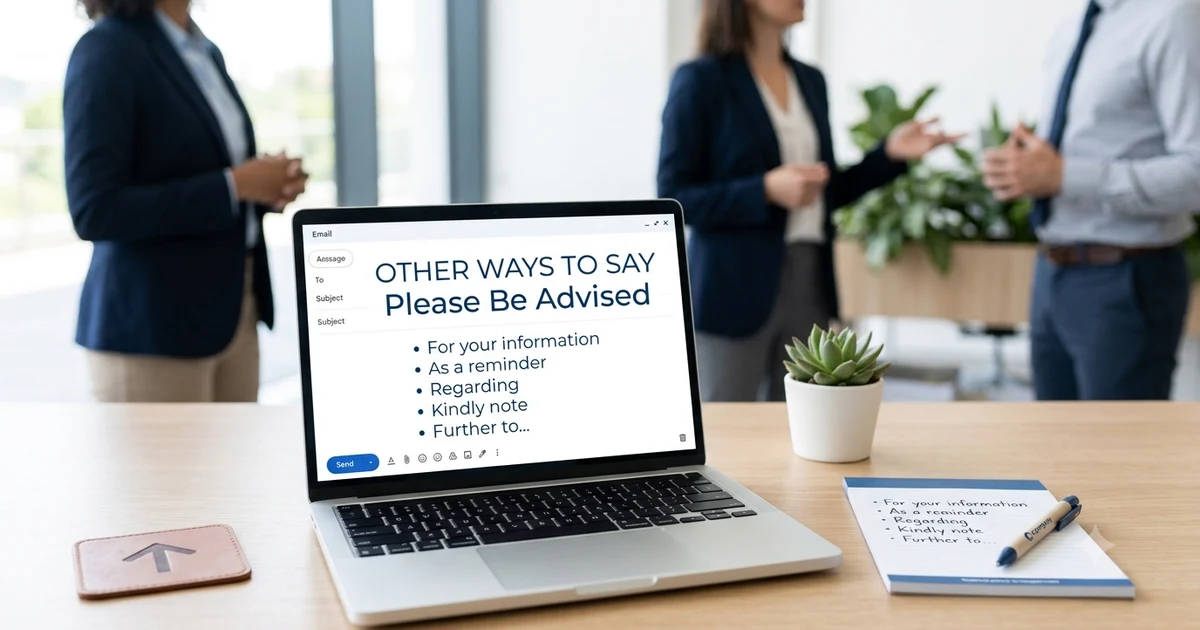
Many people search for other ways to say please be advised because the phrase can sound formal, stiff, or outdated in modern communication. While it still appears in business emails, legal notices, and official announcements, there are often better alternatives that sound clearer and more natural.
Whether you are writing a professional email, a workplace message, or a customer update, choosing the right wording helps your message feel more approachable without losing its meaning. This guide explains what the phrase means, when to use it, and the best alternatives for different situations.
Quick Answer
It asks the reader to pay attention to a notice, update, or instruction. In many modern emails, simpler alternatives such as Please note, Keep in mind, or We would like to inform you often sound friendlier and easier to read.
TL;DR
- Meaning: A formal way to introduce important information.
- Tone: Professional, serious, and official.
- Common use: Business emails, legal notices, and workplace communication.
- Where it appears: Emails, letters, announcements, and policies.
- Formality: Formal, but many workplaces now prefer simpler alternatives.
What Other Ways to Say Please Be Advised Means
It prepares the reader for information that deserves attention. Instead of making a request, it introduces a fact, update, warning, or reminder.
Although it sounds polite because it begins with the word please, it often feels more formal than friendly. Many organizations now choose plain language because it improves readability and creates a warmer tone.
For example, instead of writing:
Please be advised our office will close early on Friday.
You could simply write:
Please note our office will close early on Friday.
The second version sounds more natural while delivering the same message.
Basic Explanation
It has no shortened form or hidden meaning.
It simply means:
- Pay attention to the following information.
- We want to inform you about something important.
- Keep this information in mind.
- This notice may affect you.
- You should know the following details.
You will often see it before announcements, schedule changes, policy updates, or important reminders.
Why many writers replace it
Modern business writing favors clear and direct language. Because of that, many companies encourage employees to avoid overly formal expressions.
Simple alternatives often make communication easier to understand.
For example:
| Instead of | Try |
|---|---|
| Please be advised the meeting has moved. | Please note the meeting has moved. |
| Please be advised your order has shipped. | Your order has shipped. |
| Please be advised that parking is limited. | Keep in mind that parking is limited. |
| Please be advised of the following changes. | Here are the latest changes. |
These alternatives sound more conversational while remaining professional.
How People Use It in Emails, Texting, and Online Conversation
In professional emails
This phrase appears most often in workplace communication. Companies use it when announcing policy changes, deadlines, office closures, maintenance work, or customer updates.
Example:
Please be advised that our support team will respond within two business days.
Many writers now prefer:
Please note that our support team will respond within two business days.
Or even:
Our support team will respond within two business days.
The shorter version feels confident and easier to read.
In workplace communication
Managers and HR teams sometimes use the phrase to introduce important announcements.
Examples include:
- Office schedule changes
- Employee policy updates
- System maintenance notices
- Payroll reminders
- Security announcements
The goal is to highlight information that employees should not miss.
In texting
People rarely use this phrase in personal text messages. It sounds too formal for everyday conversations.
Instead, friends usually say:
- Just so you know
- Heads up
- By the way
- Keep in mind
- Just letting you know
These alternatives match the relaxed tone of texting.
On social media
The phrase occasionally appears in official posts from businesses, schools, government agencies, or public organizations.
For example:
Please be advised that today’s event has been postponed due to weather conditions.
Individual users usually avoid it because it sounds more like an announcement than a casual post.
Tone and Emotional Meaning
The tone of please be advised depends on the situation, but it generally feels:
- Professional
- Formal
- Serious
- Respectful
- Informative
- Official
It does not usually sound warm or conversational.
Some readers even associate it with legal documents because attorneys, government offices, insurance companies, and financial institutions have used the phrase for many years.
Does it sound rude?
Not usually.
However, it can feel distant or overly formal if you use it in a friendly conversation.
For example, imagine receiving this message from a coworker:
It sounds polite, but it also feels more official than necessary.
A simpler message sounds friendlier:
Just letting you know I’ll be working from home tomorrow.
Neither version is wrong. The best choice depends on your audience and the level of formality you need.
Common Situations Where It Appears
You will most often see this phrase in situations where the writer wants readers to pay close attention.
Common examples include:
- Company announcements
- Customer service emails
- Shipping notifications
- Policy updates
- Legal correspondence
- Government notices
- School announcements
- Banking communications
- Insurance documents
- Workplace reminders
- Appointment changes
- Service interruptions
- Website maintenance notices
- Event schedule updates
- Building management notices
In each case, the phrase introduces information that may affect the reader or require action.
Even in these situations, many organizations now prefer plain language because it feels more approachable while keeping the same professional meaning.
Examples in Real Conversations
Seeing a phrase in context makes it much easier to understand. Here are several realistic examples that show how people use it in different situations and how you can replace it with a more natural alternative when appropriate.
Situation: Office meeting update
Example
Please be advised that the weekly meeting will begin at 9:00 a.m. instead of 10:00 a.m.
Meaning
The sender wants everyone to notice an important schedule change.
Situation: School announcement
Example
Please be advised that the school parking lot will be closed on Friday.
Meaning
Parents and students need to know about a temporary change.
Situation: Website maintenance
Example
Please be advised that our website will be unavailable from 11:00 p.m. until 2:00 a.m.
Meaning
Users receive advance notice about planned maintenance.
Situation: Workplace reminder
Example
Please be advised that expense reports are due by the end of the month.
Meaning
Employees receive an important reminder about a deadline.
Situation: Friend sending a text
Instead of writing:
A more natural message would be:
Just letting you know I’ll be a little late.
Meaning
The second version sounds friendlier and better fits everyday conversation.
Other Ways to Say Please Be Advised
If you want your writing to sound more natural, these alternatives often work better. Choose the one that matches your audience and the situation.
| Alternative | Best For | Tone |
|---|---|---|
| Please note | Business emails | Professional |
| Keep in mind | General writing | Friendly |
| Be aware | Instructions | Neutral |
| We would like to inform you | Formal announcements | Professional |
| Kindly note | International business writing | Polite |
| Just so you know | Casual messages | Friendly |
| Heads up | Texting and chat | Informal |
| For your information | Workplace communication | Neutral |
| Please remember | Reminders | Friendly |
| We want to let you know | Customer communication | Warm |
| Here is an update | Project emails | Natural |
| Please take note | Formal notices | Professional |
| This is to inform you | Official communication | Formal |
| Kindly be aware | Notices | Formal |
| Please remember that | Instructions | Friendly |
| We are writing to let you know | Business emails | Professional |
| Keep this in mind | Advice | Friendly |
| You should know | General conversation | Neutral |
| We have updated | Customer notices | Clear |
| Here are the latest changes | Team updates | Natural |
Most modern business writing guides recommend using shorter and more direct alternatives whenever possible.
Similar Phrases and How They Differ
Several expressions have a similar purpose, but each creates a slightly different impression.
Please note
This is probably the closest replacement.
It introduces important information without sounding overly formal.
Example:
Please note that registration closes on Monday.
Kindly note
This version sounds polite and appears frequently in international business communication.
Some readers in North America may find it slightly more formal than Please note.
For your information
Often shortened to FYI, this phrase shares information without necessarily asking the reader to take action.
Heads up
This is a casual expression used among coworkers, friends, and family.
Example:
Heads up. The highway is closed this afternoon.
It works well in conversations but not in legal or official documents.
Just letting you know
This option feels warm and conversational.
Example:
Just letting you know the restaurant changed our reservation time.
It fits emails, chats, and text messages.
When You Should Use It
Although many writers choose simpler wording today, this phrase still has a place in professional communication.
Use it when you need to introduce information that deserves extra attention, especially in formal settings.
It works well for:
- Legal notices
- Contract updates
- Government communication
- Policy changes
- Compliance information
- Official customer notifications
- Workplace announcements
- Safety instructions
- Formal business letters
- Regulatory updates
In these situations, the formal tone often matches the purpose of the message.
When You Should Avoid It
There are also times when this phrase creates unnecessary distance between you and your reader.
Avoid using it in:
- Personal emails
- Friendly workplace chats
- Text messages
- Social media conversations
- Customer emails that aim to sound warm and approachable
- Marketing messages
- Blog posts
- Team collaboration tools like Slack or Microsoft Teams unless the situation is very formal
Instead, choose clear and direct language.
For example:
Instead of:
Please be advised that your appointment has been confirmed.
The second version says exactly the same thing while sounding more natural.
Is It Formal or Informal?
The phrase belongs firmly on the formal side of English.
| Communication Type | Appropriate? |
|---|---|
| Legal documents | Yes |
| Government notices | Yes |
| Business letters | Yes |
| Professional emails | Sometimes |
| Workplace chat | Usually no |
| Text messages | No |
| Social media posts | Rarely |
| Family conversations | No |
Many companies now encourage employees to write in plain English because readers understand it faster.
That does not mean the phrase is wrong. It simply means there are often better choices for everyday communication.
Common Misunderstandings
Some people think this phrase sounds rude because they often see it in legal letters or official warnings.
In reality, the wording itself is polite.
The misunderstanding comes from the situations where it appears.
For example, someone might receive a message about a late payment, a policy violation, or an account update that begins with this phrase. Over time, readers may connect it with negative news even though the words themselves are neutral.
Another common misunderstanding is believing it always requires immediate action.
That is not true.
Sometimes it simply introduces information that the reader should know.
This message only shares information. It does not ask the reader to do anything.
USA and Tier 1 Country Usage
In the United States, Canada, the United Kingdom, Australia, and New Zealand, most professionals understand this phrase immediately.
However, writing styles have changed over the last several years.
Many organizations now encourage employees to write in plain English because it makes communication clearer and easier to read.
- Please note
- We wanted to let you know
- Here is an update
- Keep in mind
- Your order has shipped
For everyday business emails, though, shorter alternatives usually create a friendlier experience without reducing professionalism.
Quick Reference Table
| Context | What It Means | Tone | Best Use | Avoid If |
|---|---|---|---|---|
| Business email | Important information follows | Professional | Company updates | A friendlier tone is better |
| Legal notice | Official notification | Very formal | Contracts and legal documents | Casual communication |
| Customer service | Sharing an update | Professional | Shipping, billing, account notices | Marketing emails with a conversational style |
| Workplace announcement | Drawing attention to key information | Formal | HR notices, policy changes | Team chats or quick messages |
| Text message | Sounds overly formal | Serious | Rarely appropriate | Everyday conversations |
| Social media | Official announcement | Formal | Business or government accounts | Personal posts |
| School notice | Informing students or parents | Professional | Closures, schedule changes | Informal parent groups |
Conclusion
Knowing other ways to say please be advised can help you write messages that sound clear, natural, and appropriate for your audience. While the phrase still works well in legal documents, official notices, and formal business communication, it often feels too formal for everyday emails and conversations.
Simple alternatives like Please note, Keep in mind, Just letting you know, and We wanted to let you know usually make your writing easier to read without changing the meaning. Before choosing an expression, think about who will read your message and how formal the situation is. Matching your tone to your audience creates stronger and more effective communication.
FAQs
What does other ways to say please be advised mean?
These expressions introduce important information in a way that may sound more natural or more suitable for a specific audience.
Is please be advised rude?
No. The phrase is polite and professional. However, it can sound distant or overly formal in casual conversations, which is why many people choose simpler alternatives.
Can I use please be advised in a professional email?
Yes. It is acceptable in formal business emails, especially when sharing important updates or official information. For everyday workplace communication, shorter phrases like Please note often sound more natural.
What is the best alternative to please be advised?
The best alternative depends on the situation. Please note is the most common replacement because it is professional, clear, and easy to understand. Other good options include Keep in mind, We wanted to let you know, and Just so you know.
Is please be advised formal or informal?
It is a formal expression. You will often find it in legal documents, company announcements, government notices, and official correspondence rather than in casual texting or social media conversations.
Should I use please be advised in text messages?
Usually not. The phrase sounds too formal for everyday texting. Casual alternatives such as Heads up, Just letting you know, or Keep in mind fit personal conversations much better.