Finding other ways to say which in English depends on how the word works in the sentence. Sometimes you can replace it with what, that, who, where, or the one that. In other cases, the best option involves rewriting the sentence rather than swapping one word for another.
This guide explains practical alternatives, when to use them, and how each choice changes the tone or meaning. It also covers formal writing, everyday conversation, questions, relative clauses, and common mistakes so you can choose a natural alternative instead of forcing a replacement.
Other Ways to Say Which in English
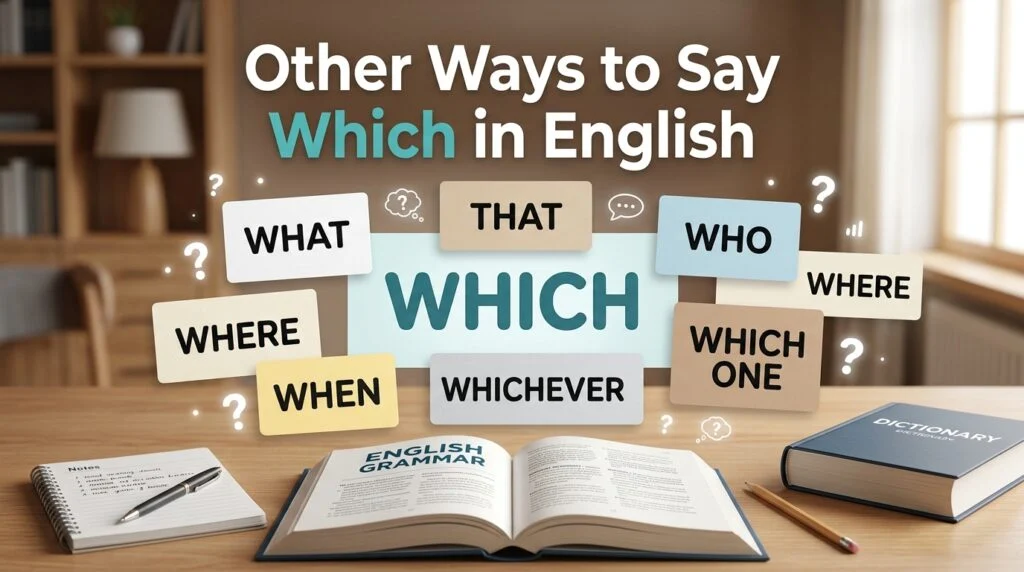
The best alternative depends on the grammatical role of which. A question may need what or which one, while a relative clause may work better with that, who, where, or a sentence restructure.
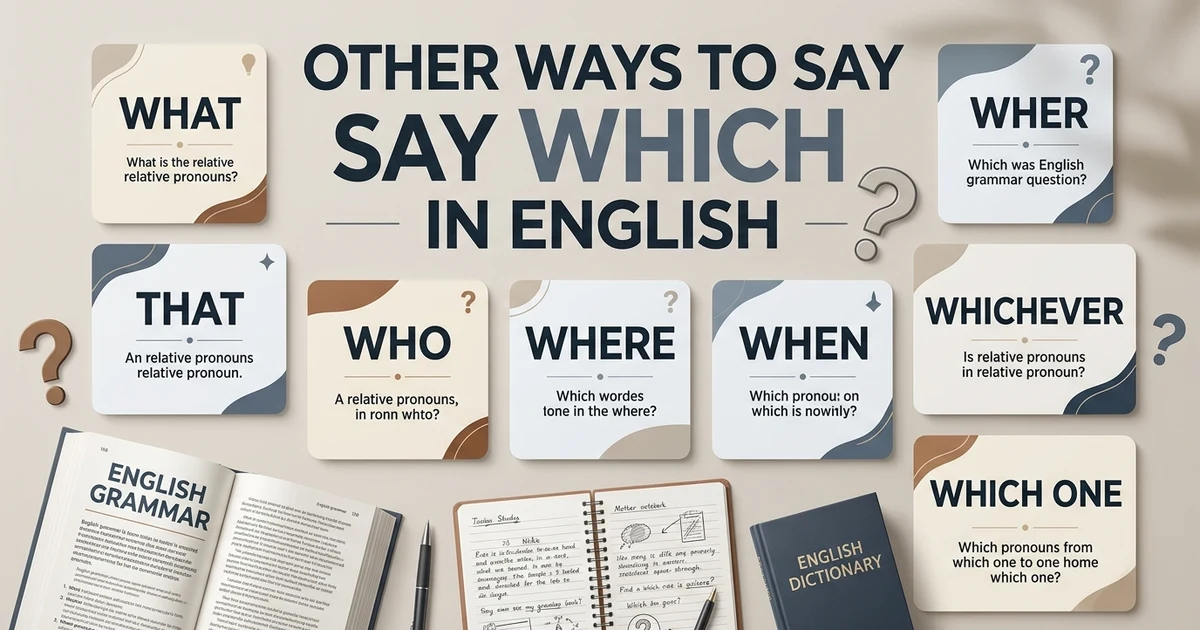
Here are useful alternatives:
- What – for open-ended questions
- That – often used in defining relative clauses
- Who – when referring to a person
- Where – when referring to a place
- When – when referring to a time
- The one that – when identifying a specific choice
- The thing that – when referring to an object or idea
- The option that – when discussing choices
- Whichever – for any choice within a group
- What kind of – when asking about type or category
- The specific one – when emphasizing identification
- The particular one – for a more precise or formal tone
The right choice depends on the meaning, not simply on finding a one-word substitute.
Alternatives to Which in Questions
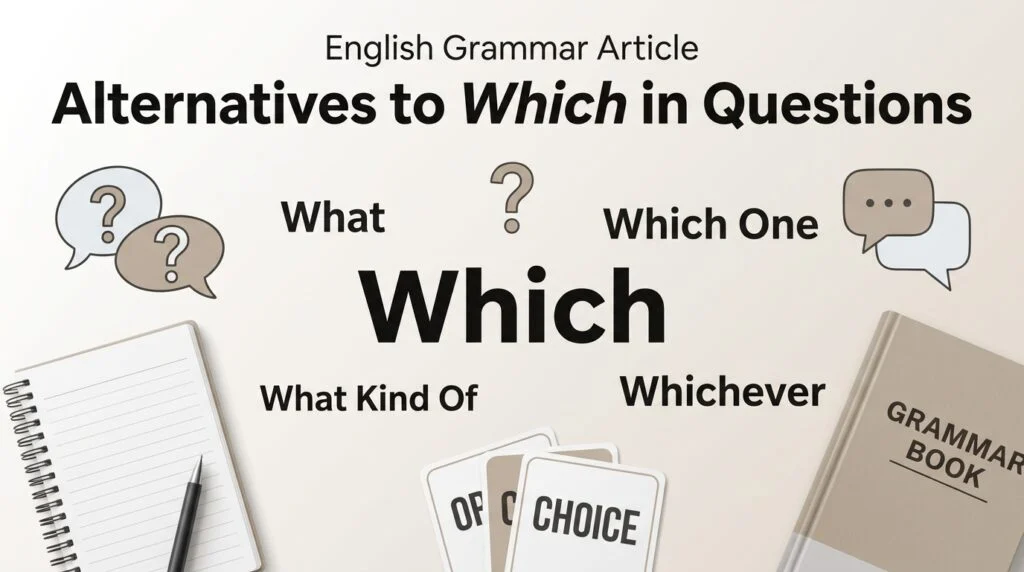
When which introduces a question, the closest replacement often depends on whether the speaker has a limited set of choices in mind.
Use What for Open-Ended Questions
Use what when the possible answers are broad or unlimited.
- Which book do you want to read?
- What book do you want to read?
The second version sounds more open-ended. It doesn’t necessarily suggest a specific list of books.
Other examples:
- Which movie should we watch? → What movie should we watch?
- Which subject do you enjoy? → What subject do you enjoy?
- Which career interests you? → What career interests you?
Use Which One for Clear Identification
Which one works well when several specific choices already exist.
- Which one do you prefer?
- Which one should I choose?
- Which one belongs to you?
- Which one works better?
This expression is especially natural in conversation when the objects are visible or already mentioned.
Use What Kind of for Categories
When you’re asking about a type rather than a specific item, what kind of can sound more natural.
- Which music do you like? → What kind of music do you like?
- Which food do you prefer? → What kind of food do you prefer?
- Which books do you usually read? → What kind of books do you usually read?
The meaning changes slightly because what kind of asks about a category or type.
Formal Alternatives to Which
In formal writing, you don’t always need to replace which. In many cases, which remains the clearest and most grammatically appropriate choice.
However, you can restructure the sentence when repetition makes the writing feel awkward.
Consider:
- The report explains which factors affected the results.
- The report identifies the factors that affected the results.
Or:
- The study examines several methods, which produce different results.
- The study examines several methods, each producing different results.
Useful formal alternatives include:
- the one that
- the option that
- the factor that
- the method that
- the approach that
- the specific item that
- the particular option that
These expressions can add precision, but they should not replace which when the original wording is already clear.
Other Ways to Say Which in Academic Writing
Academic writing often benefits from precise sentence structures rather than forced synonyms.
Instead of repeatedly using which, consider restructuring the sentence.
Original:
- The researchers analyzed several factors, which influenced the outcome.
Possible alternatives:
- The researchers analyzed several factors that influenced the outcome.
- The researchers analyzed several factors influencing the outcome.
- The researchers analyzed the factors responsible for the outcome.
Another example:
Original:
- The study used a method which produced consistent results.
Alternatives:
- The study used a method that produced consistent results.
- The study used a method producing consistent results.
- The study used a method capable of producing consistent results.
The best choice depends on whether you want to emphasize the method, its function, or the result.
Alternatives to Which in Relative Clauses
Relative clauses create some of the most common opportunities to replace which.
That
In many defining relative clauses, that can replace which.
- The book which I bought was expensive.
- The book that I bought was expensive.
- The software which we use is reliable.
- The software that we use is reliable.
However, that does not replace every use of which. In particular, nonrestrictive clauses normally use which after a comma.
Compare:
- The laptop that I bought last week is fast.
- My new laptop, which I bought last week, is fast.
The second sentence adds extra information about an already identified laptop.
Who
Use who when the relative pronoun refers to a person.
- The teacher which helped me → incorrect
- The teacher who helped me → correct
More examples:
- The manager who approved the request
- The student who submitted the assignment
- The writer who created the article
Where
Use where when referring to a place.
- The city in which I grew up
- The city where I grew up
- The office in which she works
- The office where she works
This often makes everyday English sound more natural.
When
Use when for time-related references.
- The year in which they met
- The year when they met
- The day on which we arrived
- The day when we arrived
In formal writing, on which or in which may sometimes be preferable, but when often sounds simpler and more conversational.
Other Ways to Say Which in Everyday English
In casual conversation, native speakers often simplify sentences instead of searching for a direct synonym.
Common alternatives include:
- What
- Which one
- The one that
- The one you mean
- The one you’re talking about
- That one
- Whichever
- What kind of
Examples:
- Which one do you want? → What do you want?
- Which one did you mean? → Which one are you talking about?
- Which option is better? → What option works better?
- Choose which one you like. → Choose the one you like.
The most natural alternative depends heavily on what the listener already knows.
Other Ways to Say Which in a Sentence
Sometimes the easiest solution involves changing the entire sentence.
Instead of Which One
Original:
- Tell me which one you chose.
Alternative:
- Tell me the one you chose.
Instead of Which Option
Original:
- Which option is best for you?
Alternative:
- What option works best for you?
Instead of Which Method
Original:
- We need to decide which method to use.
Alternative:
- We need to decide what method to use.
Instead of Which Person
Original:
- Which person contacted you?
Alternative:
- Who contacted you?
Instead of Which Place
Original:
- Which place did you visit?
Alternative:
- Where did you go?
These changes often produce more natural English than simply replacing which with another word.
Which vs What: What Is the Difference?
Which and what can both appear in questions, but they don’t always mean the same thing.
| Expression | Typical use | Example |
|---|---|---|
| Which | Limited or known choices | Which dress do you want? |
| What | Open-ended choice | What do you want to wear? |
| Which one | Identifying one item | Which one is yours? |
| What kind of | Asking about a category | What kind of music do you like? |
| Whichever | Any choice from available options | Choose whichever you prefer. |
A simple rule is useful:
Use which when the choices are limited or known. Use what when the possibilities are more open.
Context can still make either word possible in some sentences.
Which vs That: When Should You Use Each?
Which and that often appear in relative clauses, but they don’t always function in exactly the same way.
Use that commonly when the information identifies the noun:
- The car that I bought is blue.
- The article that she wrote received attention.
Use which when adding extra information:
- My car, which I bought last year, is blue.
- The article, which she wrote last month, received attention.
The comma matters. Removing which or replacing it with that can change the grammatical structure and sometimes the intended meaning.
Which vs Whichever
Whichever means any one of the available choices.
Compare:
- Which book should I read?
- Read whichever book you prefer.
The first sentence asks the other person to make a choice. The second gives the person freedom to choose any suitable option.
More examples:
- Choose whichever color you like.
- Take whichever seat is available.
- Use whichever method works best.
Whichever is useful when the specific choice doesn’t matter to the speaker.
How to Choose the Best Alternative to Which
Before replacing which, identify what it refers to. That makes the decision much easier.
- Ask whether you’re asking an open question.
Use what when the possible answers aren’t limited. - Check whether you’re choosing from known options.
Use which, which one, or the option that. - Check whether the noun is a person.
Use who rather than which. - Check whether the noun is a place.
Use where when it fits naturally. - Check whether the noun refers to time.
Use when in suitable relative clauses. - Look at the relative clause.
That can often replace which in defining clauses. - Consider rewriting the sentence.
Sometimes removing the relative pronoun creates the cleanest sentence.
The goal isn’t to avoid which at all costs. The goal is to choose the clearest structure.
Common Mistakes When Replacing Which
Replacing which without considering grammar can create awkward or incorrect sentences.
- Using what for every question: What works in many questions, but it doesn’t always preserve the limited-choice meaning of which.
- Using that after a comma: Nonrestrictive relative clauses generally require which, not that.
- Using which for people: Use who when the relative pronoun refers to a person.
- Replacing which with whichever unnecessarily: Whichever means any choice from a group, so it changes the meaning.
- Forcing a synonym: Sometimes which is already the most natural word.
- Ignoring the sentence structure: A replacement should fit grammatically, not just have a similar dictionary meaning.
A good edit improves clarity without changing the original meaning.
How to Make Sentences With Which Sound More Natural
You don’t always need a replacement. Sometimes you can make the sentence smoother by removing unnecessary words.
For example:
- The book which I read yesterday was interesting.
- The book I read yesterday was interesting.
English often allows the relative pronoun to disappear when it functions as the object of the clause.
Another example:
- The product which we ordered arrived today.
- The product we ordered arrived today.
This approach can make writing shorter while preserving the original meaning.
Conclusion
The best alternative depends on how which functions in the sentence. Use what for many open-ended questions, which one for specific choices, that in suitable defining relative clauses, and who, where, or when when the reference calls for them. You can also use phrases such as the option that, the one that, or whichever when they express the intended meaning more clearly.
You don’t need to eliminate which from your writing. Good English comes from choosing the structure that sounds clear, natural, and accurate for the context.
Frequently Asked Questions
What is another word for which?
There isn’t one universal replacement for which. Depending on the sentence, alternatives include what, that, who, where, when, whichever, which one, and the one that. The correct choice depends on whether you’re asking a question or forming a relative clause.
Can I use what instead of which?
Sometimes. What usually works well for open-ended questions, while which often suggests a limited or known set of choices. For example, what book do you like? sounds more open than which book do you like?
Can that replace which?
That can replace which in many defining relative clauses. For example, the book which I bought can become the book that I bought. However, that generally should not replace which in a nonrestrictive clause separated by commas.
What is the difference between which and what?
Which commonly refers to a limited set of choices, while what often asks about a broader range of possibilities. The difference depends on context, so some questions can naturally use either word with a slight change in emphasis.
What can I say instead of which one?
Depending on the sentence, you can use the one, the option, what, or simply restructure the question. For example, which one do you prefer? can become what do you prefer? or which option do you prefer?
What is a formal alternative to which?
There isn’t always a need for a formal alternative. In formal writing, expressions such as the option that, the factor that, the method that, or the particular item that can provide more precision when the context requires it.
Can who replace which?
Use who when the word refers to a person. For example, the employee who called me is correct. Using which for a person is generally inappropriate in standard English.
Can where replace which?
Where can replace phrases such as in which when the reference is a place. For example, the city in which I grew up can become the city where I grew up. This often sounds more natural in everyday English.
When should I use whichever instead of which?
Use whichever when any choice from a group is acceptable. For example, choose whichever seat you want means the specific seat doesn’t matter. Which seat do you want? simply asks the person to identify a choice.
Is it always necessary to replace which?
No. Which is a normal and useful English word, so replacing it just to avoid repetition can make a sentence less natural. First check the meaning and grammar, then decide whether another structure improves clarity.