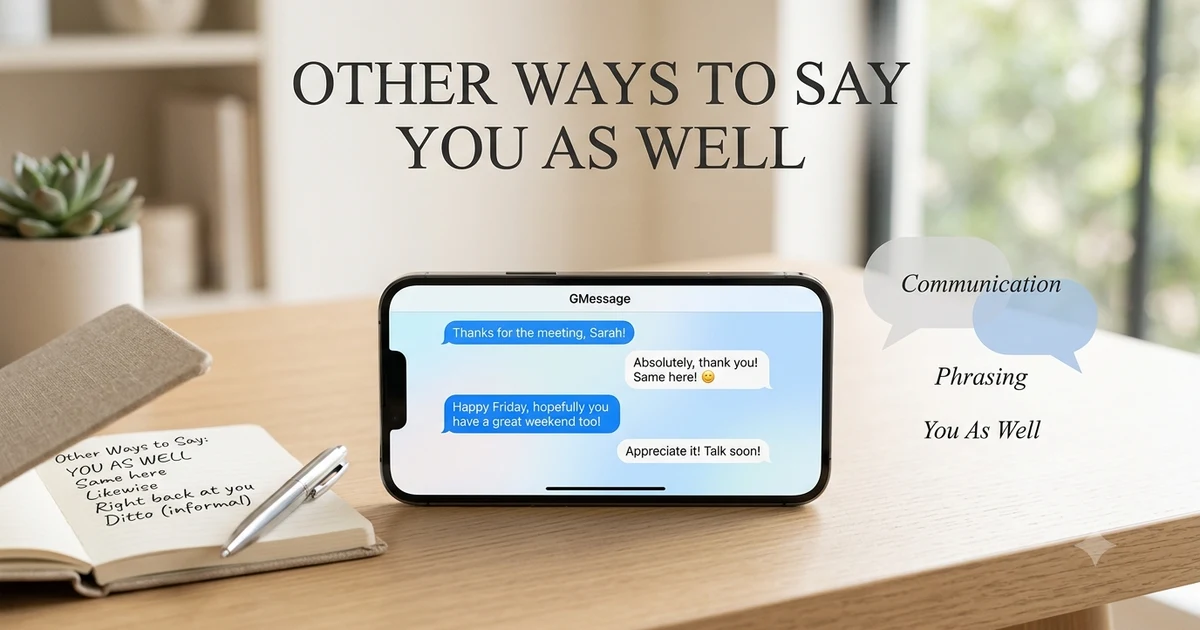
If you are looking for other ways to say you as well, you probably want a reply that sounds more natural, friendly, professional, or personal. The phrase means that you feel or wish the same thing for the other person. For example, if someone says Have a great day, you can respond with You as well.
The best alternative depends on the situation. You might choose you too for casual texting, same to you for a friendly exchange, or likewise for a more polished response. Knowing the difference helps you avoid sounding too formal or too brief.
Quick Answer
You as well means the same to you or I wish the same for you. It works as a polite and friendly response when someone gives you a good wish, compliment, greeting, or positive statement. Common alternatives include you too, same to you, likewise, right back at you, and same here, depending on the context.
TL;DR
- Meaning: I feel or wish the same for you.
- Tone: Polite, friendly, and generally neutral.
- Common use: Replies to greetings, wishes, compliments, and positive comments.
- Where it appears: Texts, chats, social media, conversations, and some professional communication.
- Formal or informal: You as well works in both casual and moderately formal situations.
- Most natural casual option: You too.
What Does You As Well Mean?
You as well is a reciprocal expression. It tells someone that the same thought, feeling, or good wish applies to them.
For example:
Person A: Have a good weekend.
Person B: You as well.
The second person is essentially saying, I hope you have a good weekend too.
The phrase can respond to many positive statements:
- Have a nice day. → You as well.
- Good luck with your exam. → You as well.
- Enjoy your evening. → You as well.
- Take care. → You as well.
- Have a safe trip. → You as well.
The exact meaning comes from the sentence before it. In most cases, it simply returns the same sentiment.
Full Form or Basic Explanation
You as well is not an abbreviation or acronym. It is a complete phrase.
The word as well means also or too. When you say you as well, you are directing the same sentiment back toward the other person.
Compare these expressions:
- You as well = I wish the same for you.
- You too = I wish the same for you.
- Likewise = The same applies to you.
- Same to you = I return the same wish or comment.
- Right back at you = I return the same sentiment, usually in a casual way.
The meaning stays similar, but the tone can change.
Other Ways to Say You As Well
Here are useful alternatives, from casual to more polished:
- You too
- Same to you
- Likewise
- Same here
- Right back at you
- And you
- You also
- The same to you
- Same goes for you
- I wish you the same
- Wishing you the same
- Back at you
- Likewise to you
- I feel the same way
- I hope you do too
- I hope the same for you
- That goes for you too
- The feeling is mutual
- I appreciate that, and you too
- Thank you, same to you
- Absolutely, you too
- Thanks, likewise
- And the same to you
- Same goes your way
- I wish you all the same
Not every alternative works in every situation. For example, same here usually describes a shared feeling or experience, while you too works naturally after a good wish.
How People Use It in Texting or Online Conversation
In texting, you as well often appears as a short response to a positive message.
Someone might write:
Have a relaxing evening.
A natural reply would be:
You as well.
It can also appear in social media comments, group chats, and direct messages.
For casual texting, you too usually feels shorter and more conversational. You as well sounds slightly more polished.
Common texting examples
- Have a great weekend. → You too.
- Good luck tomorrow. → You as well.
- Enjoy the rest of your day. → You as well.
- Sleep well. → You too.
- Have fun tonight. → You too.
- Take care. → You as well.
The phrase does not carry a special slang meaning in texting. Its meaning stays close to the literal sense.
Tone and Emotional Meaning
The tone depends heavily on the surrounding message.
Friendly
You as well can sound warm and courteous.
Have a wonderful weekend.
You as well.
Polite
It works well when you want to return a good wish without adding much detail.
Have a safe journey.
You as well.
Neutral
Sometimes it simply provides a polite response without expressing strong emotion.
Enjoy your evening.
You as well.
Slightly formal
Compared with you too, the phrase can sound a little more polished.
You too is very common in everyday conversation, while you as well can feel more deliberate.
Distant or brief
Context matters. A very short response can sometimes feel less personal if the other person expected a longer conversation.
For example:
I really enjoyed talking with you today.
You as well.
This is polite, but a warmer response might be:
I really enjoyed talking with you too. It was great catching up.
Common Situations Where It Appears
You can use this expression in many ordinary situations.
After a good wish
Have a wonderful day.
You as well.
After a greeting
Good morning. Hope you have a productive day.
You as well.
Before leaving
Take care.
You as well.
During a holiday
Enjoy the holiday.
You as well.
In a workplace conversation
Have a good evening.
You as well.
In a casual message
Have fun tonight.
You too.
After a compliment or positive statement
It was nice meeting you.
You as well.
In this situation, likewise can also work naturally.
Examples in Real Conversations
Situation: Saying goodbye
Example
A: It was great talking with you.
B: You as well.
Meaning
The second person is saying that they also enjoyed the conversation.
Situation: Weekend plans
Example
A: Have a great weekend.
B: You too.
Meaning
The second person is returning the same good wish.
Situation: Work conversation
Example
A: Have a productive afternoon.
B: You as well.
Meaning
The speaker wishes the other person a productive afternoon too.
Situation: Travel
Example
A: Have a safe trip home.
B: Thanks, you as well.
Meaning
The response returns the good wish, assuming the other person is also traveling.
Situation: Meeting someone
Example
A: It was nice meeting you.
B: Likewise.
Meaning
The second person also enjoyed meeting the first person.
Situation: Friendly chat
Example
A: Enjoy your night.
B: Right back at you.
Meaning
The second person is casually returning the same wish.
Situation: Encouragement
Example
A: Good luck with your presentation tomorrow.
B: Thanks, you too.
Meaning
The second person wishes the other person success as well.
Similar Terms or Related Phrases
Several expressions can replace this phrase, but they are not completely interchangeable.
| Expression | General meaning | Typical tone |
|---|---|---|
| You too | Same to you | Casual and natural |
| Likewise | Same applies to you | Polished and neutral |
| Same to you | I return the same wish | Friendly |
| Right back at you | Same sentiment back to you | Casual |
| Same here | I feel the same | Casual |
| And you | The same applies to you | Brief and natural |
| You also | Same applies to you | Neutral |
| I wish you the same | I return your good wish | Polite |
| The feeling is mutual | I share the same feeling | More specific |
| Same goes for you | The same applies to you | Casual |
You as well vs. you too
These phrases have almost the same meaning.
You too sounds more conversational and is probably the most common choice in everyday texting.
You as well vs. likewise
Likewise can sound more formal or refined.
It works especially well after statements such as:
It was a pleasure speaking with you.
Likewise.
For simple good wishes, you too often sounds more natural.
You as well vs. same here
These phrases can overlap, but they do different jobs.
Same here usually means I feel the same or I have the same experience.
For example:
I am tired today.
Same here.
You as well would not normally fit that exchange.
When You Should Use It
Use this phrase when you want to return a positive statement, greeting, wish, or sentiment.
It works particularly well when:
- Someone wishes you a good day.
- Someone tells you to take care.
- Someone wishes you good luck.
- Someone says they enjoyed meeting you.
- Someone gives you a positive farewell.
- You want to remain polite without writing a long response.
- You want something slightly more polished than you too.
It can also help keep a conversation friendly without making the response unnecessarily long.
When You Should Avoid It
The phrase does not fit every type of conversation.
Avoid it when the other person’s statement does not logically apply to you.
For example:
I am having trouble understanding this assignment.
You as well.
That response sounds confusing because the original speaker did not express a wish or sentiment that naturally transfers back.
You should also avoid using it as a default response when someone shares something serious or personal.
For example:
I have been having a difficult week.
You as well.
That could sound dismissive.
A better response would acknowledge what they said:
I am sorry to hear that.
Or:
I hope things get easier for you.
Context matters more than simply finding a replacement phrase.
Is You As Well Formal or Informal?
You as well sits somewhere in the middle. It works in casual and moderately formal situations.
Casual texting
You can use it, although you too often sounds more natural.
Workplace communication
It can work well in short professional exchanges.
Have a good evening.
You as well.
Professional emails
It can work in a friendly closing or response, especially when the conversation already has a conversational tone.
School communication
It is generally appropriate when responding politely to a teacher, classmate, or school staff member.
Social media
It works, although shorter alternatives such as you too or likewise may feel more natural.
Formal writing
It is not something you would normally use in academic writing. Formal written work usually needs complete sentences and more precise wording.
Common Misunderstandings
It does not mean you also in every situation
The phrase depends on context. Usually, it returns a wish or sentiment rather than simply adding information.
It is not slang
You as well is standard English. It does not belong to a special texting vocabulary.
It is not automatically romantic
Someone may use it with a friend, coworker, family member, teacher, or romantic partner.
The surrounding conversation determines the relationship.
It does not necessarily sound cold
A short response can feel brief, but that does not automatically make it rude.
If you want a warmer tone, add a few words:
Thanks, you as well.
Hope you have a great evening too.
It is not always the best response to a compliment
If someone says:
You did a great job.
Responding with you as well may sound odd unless the other person also performed the same task.
A better response might be:
Thank you.
Or:
I appreciate that.
USA and Tier 1 Country Usage
English speakers in the United States, Canada, the United Kingdom, Australia, and New Zealand can generally understand you as well without difficulty.
The main difference comes from conversational style rather than meaning. You too tends to sound especially natural in everyday speech and texting, while you as well can sound slightly more polished.
Likewise is also widely understood, although it can feel a little more formal depending on the conversation.
There is no need to treat one expression as universally correct. Choose the version that matches the setting and the relationship.
Quick Reference Table
| Context | What It Means | Tone | Best Use | Avoid If |
|---|---|---|---|---|
| Casual text | Same to you | Friendly | Friends and family | You want a very warm reply |
| Workplace chat | Same wish for you | Polite | Coworkers and managers | The message needs more detail |
| Social media | Same sentiment | Casual | Comments and DMs | The topic is serious |
| Professional conversation | Same to you | Polished | Short exchanges | You need a formal written response |
| Dating text | Same feeling or wish | Neutral to warm | Positive exchanges | The context needs emotional clarity |
| Goodbye | Take care too | Polite | Ending conversations | The person shared something serious |
| Good wishes | I return your wish | Friendly | Holidays, weekends, trips | The wish does not apply to you |
| Compliment | Same applies to you | Context-dependent | Mutual compliments | Only one person received the compliment |
Conclusion
Other ways to say you as well include you too, likewise, same to you, right back at you, and I wish you the same. The best choice depends on the situation and the tone you want.
For everyday texting, you too usually sounds the most natural. For a slightly more polished response, you as well or likewise works nicely. In a professional setting, keep the context in mind and make sure the phrase actually matches what the other person said.
The key is simple: return the same sentiment when it genuinely applies. A short response can sound perfectly polite when you choose the wording that fits the conversation.
FAQs
What does you as well mean in text?
You as well means the same to you or I wish the same for you. People commonly use it to respond to good wishes, greetings, compliments, or positive statements.
What does you as well mean in texting?
In texting, it usually works as a polite way to return a good wish. For example, if someone says Have a nice evening, you can reply with You as well.
Is you as well rude?
No. You as well is generally polite and neutral. However, a very short response can feel distant in an emotional conversation, so a longer reply may work better when the situation calls for warmth.
Can I use you as well in a professional message?
Yes. It can work in professional emails, workplace chats, and brief conversations. For example, Have a great weekend followed by You as well is perfectly appropriate in many workplace settings.
What is the difference between you as well and you too?
Both expressions usually mean the same thing. You too sounds more casual and conversational, while you as well can sound slightly more polished.
Is likewise the same as you as well?
In many situations, yes. Likewise means the same applies to you. It often sounds a little more formal or polished than you too.
What is the most natural alternative to you as well?
You too is usually the simplest and most natural alternative in everyday conversation and texting. Likewise works well when you want a slightly more polished response.