Finding other ways to say another can make your writing sound more natural, precise, and less repetitive. The word another works in many situations, but the best replacement depends on what you mean. You might need a more formal option for an email, a casual phrase for a conversation, or a more precise expression for academic writing.
This guide explains useful alternatives, their meanings, tones, and practical examples. It also shows which expressions work best in professional communication, everyday conversation, school writing, and online messages.
Quick Answer
Common alternatives include additional, one more, a different one, an extra, another one, a further, a separate, or an alternative. The right choice depends on whether you mean one more item, a different item, or an additional option.
For example, another cup means one more cup, while a different cup means a cup that is not the same one.
TL;DR
- Meaning: Another usually means one more or a different one of the same general type.
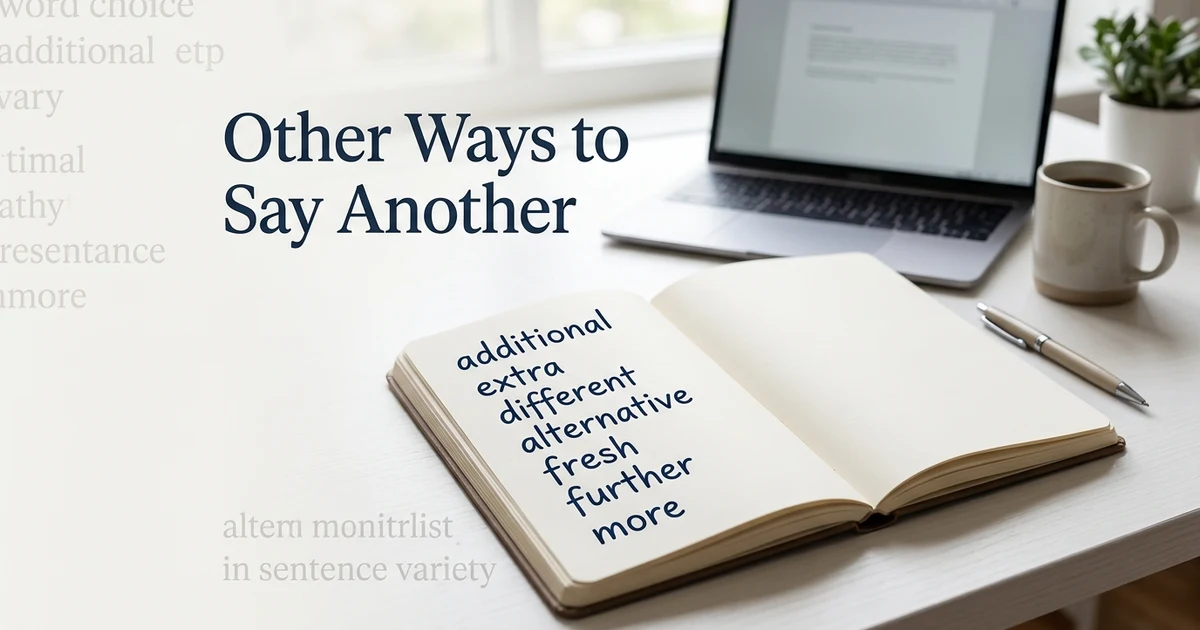
- Common alternatives: Additional, one more, an extra, a different one, a separate, and an alternative.
- Tone: The word itself sounds neutral and natural in everyday English.
- Common use: Conversation, emails, essays, instructions, shopping, and online communication.
- Formal use: Additional, further, and alternative often work better in formal writing.
- Best choice: Pick the replacement based on whether you mean more, different, or separate.
What Other Ways to Say Another Means
The phrase refers to alternative expressions that can replace another without changing the basic idea of a sentence.
Another has two closely related meanings. It can refer to one more item or person, or it can refer to a different item or person.
Consider these examples:
- I would like another coffee.
This means one more coffee. - Can I have another option?
This can mean one more option or a different option. - We need another person for the project.
This usually means one more person.
Because the meaning can change slightly with context, choosing a precise alternative helps your writing communicate exactly what you intend.

Common Alternatives and Their Meanings
Here are some of the most useful choices:
| Alternative | Basic meaning | Tone |
|---|---|---|
| Additional | Added to what already exists | Formal, neutral |
| One more | An extra single item | Casual, natural |
| An extra | Something added beyond the usual amount | Casual, neutral |
| A different one | Not the same item | Neutral |
| A further | Something additional or subsequent | Formal |
| An alternative | Another possible choice | Formal, neutral |
| A separate | Distinct from something else | Neutral, formal |
| One more option | An additional choice | Neutral |
| Another option | A different or additional choice | Neutral |
| A replacement | Something used instead | Neutral |
| A new one | A newly selected or obtained item | Neutral |
| An additional one | One added to the existing number | Formal |
| A second | One following the first | Neutral |
| A spare | An extra kept for future use | Casual, practical |
| A different choice | A choice that is not the current one | Neutral |

25 Natural Alternatives to Another
1. Additional
Additional works especially well in professional and academic writing.
Example:
Please provide additional information if necessary.
It suggests something added to what already exists.
2. One More
One more sounds natural in everyday speech and casual messages.
Example:
Could I have one more minute?
Use it when you specifically mean an extra single item, amount, or opportunity.
3. An Extra
An extra describes something added beyond what someone already has or needs.
Example:
Do you have an extra copy of the worksheet?
This expression works well in casual and practical situations.
4. A Different One
A different one makes the meaning clear when you do not want the same item.
Example:
I do not like this design. Can I choose a different one?
This is often clearer than another because it emphasizes difference rather than addition.
5. Further
Further can replace another in formal contexts when you mean additional or more.
Example:
Please contact us if you require further assistance.
It appears frequently in professional correspondence.
6. An Alternative
An alternative refers to another possibility or choice.
Example:
We need an alternative solution.
It works particularly well when someone needs a different approach.
7. A Separate One
A separate one emphasizes that something should remain distinct.
Example:
Please send me a separate one for each department.
This expression helps avoid confusion between multiple items.
8. An Additional One
An additional one clearly means one more item.
Example:
We may need an additional one for the new employee.
This sounds more formal than one more.
9. A Second
A second can refer to something that comes after the first.
Example:
She requested a second opinion.
It works well when sequence or another viewpoint matters.
10. A Replacement
A replacement means something that takes the place of the original.
Example:
I need a replacement for the damaged charger.
This should not replace another when you simply mean one more.
11. A New One
A new one can describe something selected, bought, created, or introduced recently.
Example:
This version does not work, so I need a new one.
The expression focuses on newness rather than simply adding another item.
12. An Alternative Option
An alternative option means a different choice from the current one.
Example:
Is there an alternative option available?
It fits professional discussions and decision-making.
13. One Additional
One additional is a concise formal expression.
Example:
We need one additional volunteer.
It often appears in workplace, academic, and organizational writing.
14. One More Option
One more option means an extra possibility.
Example:
Can you give me one more option?
It sounds natural in conversations and decision-making situations.
15. A Spare
A spare means an extra item kept in case it becomes necessary.
Example:
I always carry a spare key.
Use this when the extra item serves as backup.
16. A Further Choice
A further choice means an additional possibility.
Example:
Customers have a further choice at checkout.
This expression sounds more formal than another choice.
17. An Extra One
An extra one means an additional item of the same general type.
Example:
Could you print an extra one for me?
It works well in everyday conversation.
18. A Different Choice
A different choice emphasizes that the selected option should not be the same.
Example:
I think we should make a different choice.
This works naturally when discussing decisions.
19. A New Alternative
A new alternative suggests a newly available possibility.
Example:
The team proposed a new alternative.
It works well in professional and academic discussions.
20. A Separate Option
A separate option describes a distinct possibility.
Example:
We can create a separate option for smaller businesses.
This is useful when comparing plans or arrangements.
21. An Additional Choice
An additional choice means one more possibility.
Example:
The updated menu gives customers an additional choice.
It has a neutral to formal tone.
22. A Substitute
A substitute refers to something used instead of another thing.
Example:
We need a substitute for the original ingredient.
It is more specific than another because replacement is involved.
23. A Successive One
A successive one refers to something that follows another in a sequence.
Example:
Each successive one became more difficult.
This is more formal and less common in everyday conversation.
24. A Different Version
A different version works when discussing documents, products, designs, software, or other variations.
Example:
Could you send me a different version of the file?
It gives more information than simply saying another.
25. One More Time
One more time works when another refers to a repeated action rather than an object.
Example:
Could you explain that one more time?
It means the action should happen again.
How to Choose the Right Alternative
The easiest way to choose the right expression is to ask what you mean by another.
If you mean more of the same, use:
- One more
- An additional
- An extra
- Further
you mean something different, use:
- A different one
- An alternative
- A different choice
- A different version
If you mean a replacement, use:
- A replacement
- A substitute
- A new one
you mean a backup, use:
- A spare
- An extra one
If you mean a separate item, use:
- A separate one
- A separate option
This distinction prevents small wording problems and makes your message more precise.
How People Use These Expressions in Texting and Online Conversation
In texting, people usually choose short and familiar expressions rather than formal alternatives.
Common choices include:
- One more
- Another one
- An extra one
- A different one
- One more option
- A new one
Examples:
Situation: Asking for another chance
Example: Can I get one more chance?
Meaning: The person wants an additional opportunity.
Situation: Rejecting an item
Example: Can you show me a different one?
Meaning: The person wants something other than the current item.
Situation: Asking for another copy
Example: Could you send me an extra one?
Meaning: The person wants an additional copy.
On social media, shorter expressions usually sound more natural than formal words such as further or additional.
Tone and Emotional Meaning
The replacement you choose can change the tone of a sentence.
One more sounds friendly and conversational.
An extra sounds casual and practical.
Additional sounds more professional.
Further sounds formal and often appears in business or academic writing.
A different one sounds neutral and makes it clear that the current choice does not work.
An alternative sounds thoughtful and works well when discussing solutions or choices.
A replacement sounds practical and implies that the original item will not be used.
The word another itself usually has a neutral tone. It does not automatically sound rude, formal, romantic, funny, or sarcastic.
Common Situations Where These Expressions Appear
You may need an alternative expression when:
- Writing a professional email
- Avoiding repetition in an essay
- Asking for one more item
- Requesting a different product
- Discussing multiple choices
- Comparing solutions
- Asking someone to repeat something
- Describing backup supplies
- Talking about alternative plans
- Writing product descriptions
- Giving instructions
- Communicating in group chats
The context determines which expression sounds most natural.
Examples in Real Conversations
Asking for more
Situation: At a coffee shop
Example: Could I get one more cup, please?
Meaning: The speaker wants an additional cup.
Requesting a different item
Situation: Shopping
Example: Do you have a different one in a smaller size?
Meaning: The speaker wants an item that differs from the current one.
Asking for more information
Situation: Professional email
Example: Please send any additional information you have.
Meaning: The sender wants more information.
Discussing solutions
Situation: Workplace meeting
Example: We should consider an alternative approach.
Meaning: The speaker wants a different method.
Asking for a backup
Situation: Preparing for a trip
Example: I packed a spare charger.
Meaning: The charger serves as a backup.
Asking someone to repeat something
Situation: Conversation
Example: Could you say that one more time?
Meaning: The speaker wants the person to repeat what they said.
Requesting a replacement
Situation: Customer service
Example: I would like a replacement for the damaged item.
Meaning: The original item needs to be replaced.
Similar Terms and Related Phrases
Several expressions look similar but do not mean exactly the same thing.
| Term | Meaning | Main Difference |
|---|---|---|
| Another | One more or a different one | General expression |
| Additional | Added to an existing amount | More formal |
| Extra | More than what is normally needed | Often casual |
| Alternative | A different possible choice | Focuses on options |
| Different | Not the same | Focuses on difference |
| Replacement | Something used instead | Implies substitution |
| Spare | Extra item kept for backup | Implies future need |
| Further | Additional or subsequent | More formal |
| Substitute | Something used instead of another | Often practical or functional |
Understanding these differences helps you avoid choosing an expression that changes your intended meaning.
When You Should Use These Alternatives
Choose an alternative when it makes your meaning more specific or helps your writing avoid repetition.
Use additional in formal emails, reports, and academic writing.
Use a replacement when something needs to take the place of an existing item.
When You Should Avoid Certain Alternatives
Some replacements can create confusion if they do not match your intended meaning.
Do not use replacement when you simply want one more item. A replacement suggests that the original item will be removed or substituted.
Do not use alternative when you only mean an additional item. Alternative usually suggests a choice between possibilities.
Avoid further in very casual messages if a simpler phrase such as one more or additional sounds more natural.
Do not use spare unless the item will serve as a backup.
Likewise, do not use different if you simply want another item of the same type.
Is It Formal or Informal?
Another is neutral. You can use it in casual conversations, professional emails, academic writing, and everyday communication.
The alternatives have different levels of formality:
| Expression | Formality |
|---|---|
| Another | Neutral |
| One more | Casual to neutral |
| An extra | Casual to neutral |
| A different one | Neutral |
| Additional | Formal to neutral |
| Further | Formal |
| An alternative | Neutral to formal |
| A replacement | Neutral |
| A spare | Casual to neutral |
For a professional email, additional or further may sound more polished. For a text message, one more or an extra usually feels more natural.
Common Misunderstandings
One common problem comes from the difference between more and different.
If someone says I need another copy, they may mean they need one more copy. If they say I need a different copy, they want a copy that differs from the current one.
Another possible misunderstanding involves replacement.
I need another phone could mean the person wants an additional phone or wants a different phone because the current one does not work. I need a replacement phone makes the second meaning much clearer.
Context usually resolves these small differences, but precise wording can prevent confusion.
USA and Tier 1 Country Usage
Another is standard English and appears naturally across the United States, Canada, the UK, Australia, New Zealand, and other English-speaking settings.
The main differences usually come from context rather than country. Everyday speakers commonly use simple expressions such as one more, an extra, or a different one. Professional and academic settings may favor additional, further, or alternative.
Regional spelling differences do not usually affect the use of these expressions. The same basic distinctions between additional, different, alternative, replacement, and spare apply across major English-speaking varieties.
Quick Reference Table
| Context | What It Means | Tone | Best Use | Avoid If |
|---|---|---|---|---|
| One more | An additional single item | Casual | Conversation, texting | You mean a different item |
| An extra | More than currently available or needed | Casual | Everyday situations | You need a replacement |
| Additional | Added to an existing amount | Formal | Emails, reports, essays | Writing very casual texts |
| A different one | Not the same item | Neutral | Shopping, choices | You simply want one more |
| Further | Additional or subsequent | Formal | Business, academic writing | Very casual conversation |
| An alternative | Another possible choice | Neutral, formal | Decisions, solutions | You mean one extra item |
| A replacement | Something used instead | Neutral | Customer service, repairs | You want an additional item |
| A spare | Extra item kept for backup | Casual, neutral | Travel, equipment | No backup meaning exists |
| A separate one | Distinct from another | Neutral | Organization, instructions | You mean a replacement |
| One more time | A repeated action | Casual | Conversation, texting | Referring to a physical object |
Conclusion
There are many useful alternatives depending on what you mean by another. One more and an extra work well in casual conversation, while additional and further suit more formal writing. A different one helps when you want something that is not the same, and an alternative works well for choices or solutions. Replacement and substitute carry a stronger sense of replacing something, while spare usually means a backup.
The key is to focus on the exact meaning you want. Choosing the right expression can make a sentence clearer, more natural, and better suited to its audience.
FAQs
What does other ways to say another mean?
It refers to alternative expressions that can replace another in a sentence. Common choices include additional, one more, an extra, a different one, further, and an alternative.
What is another word for another?
Useful alternatives include additional, extra, one more, different, further, alternative, separate, replacement, and spare. The best option depends on the meaning of the sentence.
What is a formal way to say another?
Additional and further often work well in formal writing. An additional one can also replace another when you specifically mean one extra item.
Is another formal or informal?
Another is neutral rather than strongly formal or informal. You can use it comfortably in everyday conversation, professional communication, academic writing, and online messages.
What is the difference between another and additional?
Another can mean one more or a different one. Additional specifically emphasizes something added to an existing amount, so it often sounds more precise in formal writing.
What is the difference between another and a different one?
Another can mean one more or a different one, depending on context. A different one specifically tells the reader that you want something other than the current item.
Can I use another in a professional message?
Yes. Another is completely acceptable in professional communication. However, additional or further may sound more formal in some sentences, especially in reports and business emails.