
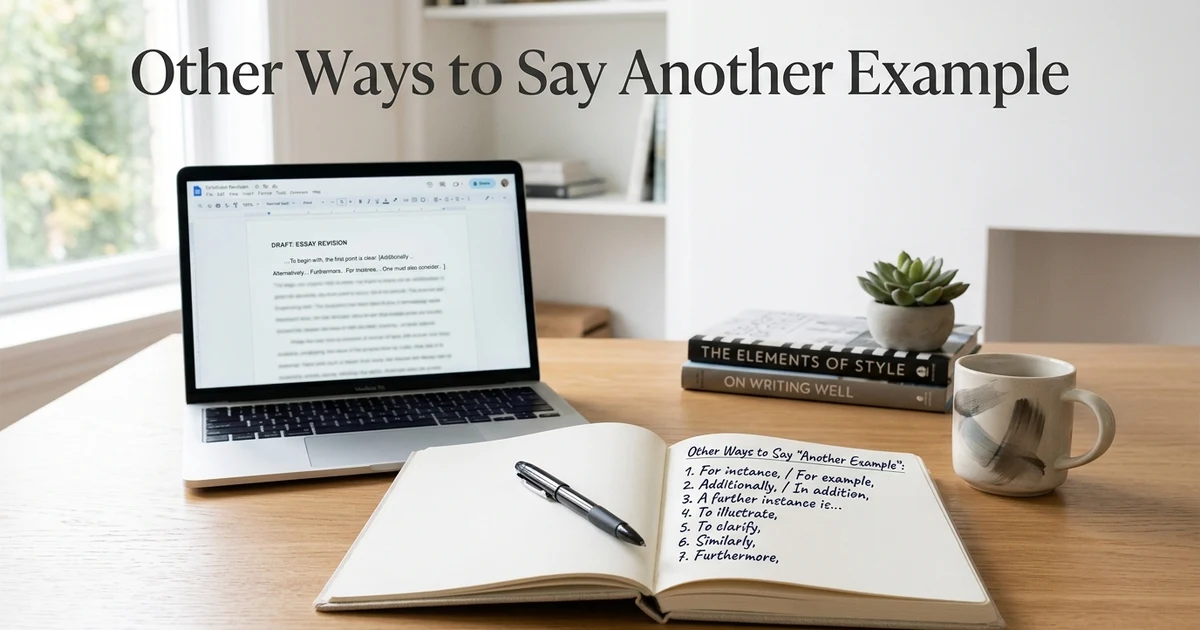
Finding other ways to say another example can help you avoid repetition and make your writing sound more natural. The phrase another example works well in everyday conversation, essays, presentations, reports, and professional communication, but repeating it several times can make your writing feel flat.
Depending on the context, you can use alternatives such as a further example, an additional example, another illustration, a related example, one more example, or a different example. The best choice depends on whether you want a formal, academic, professional, or conversational tone.
Quick Answer
Other ways to say another example include a further example, an additional example, another illustration, one more example, a related example, and a different example. These alternatives help vary your wording while keeping the original meaning clear.
TL;DR
- Meaning: You want to introduce one more example that supports or explains an idea.
- Tone: Usually neutral and flexible.
- Common use: Essays, reports, presentations, emails, conversations, and explanations.
- Where it appears: Academic writing, professional communication, teaching, and casual speech.
- Formal options: A further example, an additional example, or another illustration.
- Informal options: One more example or here is another example.
What Other Ways to Say Another Example Means
The phrase refers to introducing an additional case, situation, fact, or illustration that helps explain a point.
For example, if you have already discussed one situation and want to provide a second one, you might say:
- A further example shows how this works.
- An additional example makes the idea clearer.
- Here is another illustration of the same point.
- One more example may help explain the difference.
The best alternative depends on what you are writing. Academic work usually benefits from precise expressions, while casual conversation allows simpler wording.

Basic Explanation and Useful Alternatives
There is no single replacement that works in every situation. Some alternatives emphasize addition, while others emphasize similarity or difference.
| Alternative | Best for | Tone |
|---|---|---|
| A further example | Essays and reports | Formal |
| An additional example | Academic and professional writing | Formal |
| Another illustration | Explanations and presentations | Neutral |
| One more example | Conversations and casual writing | Casual |
| A related example | Similar situations | Neutral |
| A different example | Contrasting situations | Neutral |
| A second example | Structured explanations | Clear |
| A similar example | Comparable situations | Neutral |
| Another case | Research and analysis | Formal |
| Here is another example | General communication | Natural |

How People Use the Phrase in Writing and Conversation
People usually introduce an additional example after making a statement that needs more support or clarification.
In an essay, you might write:
- A further example can be found in the companys hiring practices.
- An additional example demonstrates the same pattern.
- Another case supports this argument.
In a presentation, a speaker may use simpler language:
- Here is another example.
- Let me give you one more example.
- Consider a second example.
In everyday conversation, the most natural choices tend to be short and direct.
Tone and Meaning
The alternatives have slightly different tones, even though they share the same basic meaning.
A further example sounds polished and works particularly well in academic or professional writing.
An additional example emphasizes that you are adding information to what you have already discussed.
Another illustration works well when the example helps someone understand an abstract idea.
One more example sounds relaxed and conversational.
A related example suggests that the new example connects closely with the previous one.
A different example suggests contrast rather than simple addition.
None of these expressions normally sounds rude. The main difference involves formality and the relationship between the examples.
Common Situations Where These Alternatives Appear
You may need a replacement for another example in many situations:
- Academic essays: Use a further example or an additional example.
- Business reports: Use another case or an additional example.
- Presentations: Use another illustration or a second example.
- Teaching: Use one more example or another illustration.
- Emails: Use an additional example or a related example.
- Casual conversation: Use one more example or here is another example.
- Technical explanations: Use a second example or a related case.
- Comparisons: Use a different example when you want to show contrast.
Examples in Real Conversations
Situation: Academic writing
Example:
A further example appears in the study of workplace communication.
Meaning:
The writer is introducing another piece of evidence or support.
Situation: Classroom explanation
Example:
Here is another example that may make the rule easier to understand.
Meaning:
The speaker wants to clarify an idea with an additional case.
Situation: Professional report
Example:
An additional example can be seen in the companys customer service data.
Meaning:
The writer is adding evidence to support an earlier point.
Situation: Casual conversation
Example:
One more example is the way she handled the meeting.
Meaning:
The speaker is giving another everyday example.
Situation: Showing contrast
Example:
A different example gives us a clearer view of the problem.
Meaning:
The speaker wants to introduce an example that differs from the previous one.
Situation: Explaining a similar situation
Example:
A related example comes from another department.
Meaning:
The new example connects closely with the previous situation.
Similar Terms and Related Phrases
Several expressions can replace another example, but they do not always mean exactly the same thing.
A further example
This phrase means an additional example and often sounds formal. It works especially well in essays, reports, and analytical writing.
An additional example
This option directly emphasizes that you are adding another example to existing information. It fits professional and academic contexts.
Another illustration
Illustration can mean an example used to make an idea easier to understand. This phrase works well in teaching, presentations, and explanations.
One more example
This sounds more conversational. It works naturally in spoken English, informal writing, and friendly explanations.
A different example
This phrase highlights difference rather than simply adding another example. Use it when you want to show another situation with a different feature or outcome.
A related example
This suggests that the new example has a clear connection to the previous one.
A second example
This is useful when presenting examples in a logical order. It makes the structure easy for the reader to follow.
When You Should Use These Alternatives
Choose the replacement according to your audience and purpose.
For formal writing, consider:
- A further example
- An additional example
- Another case
- A second example
- A related case
For everyday communication, consider:
- One more example
- Here is another example
- Another example is
- Consider this example
For explanations, consider:
- Another illustration
- A related example
- A similar case
For contrast, use:
- A different example
- Another contrasting case
- A contrasting example
The goal is not simply to replace words. Choose a phrase that accurately describes the relationship between your examples.
When You Should Avoid Repeating Another Example
Repeating the same phrase several times can make an essay, report, or presentation sound mechanical.
For instance, using another example at the beginning of every paragraph can create a predictable rhythm. Instead, vary your transitions according to the purpose of each paragraph.
You might write:
- A further example demonstrates this pattern.
- Another case supports the same conclusion.
- A related situation shows a similar result.
- A different example reveals the opposite outcome.
Avoid using a formal expression simply because it sounds more sophisticated. A simple phrase such as one more example often works better in a casual conversation.
Is It Formal or Informal?
The phrase another example itself is neutral. You can use it in both formal and informal situations.
For academic writing, alternatives such as a further example and an additional example often fit better.
For workplace communication, an additional example, a related example, or a second example can sound clear and professional.
For casual conversation, one more example and here is another example usually sound more natural.
There is no need to avoid another example in formal writing. It is grammatically correct and widely understandable. Variation simply helps improve style when you use the idea repeatedly.
Common Misunderstandings
One common mistake involves treating every alternative as an exact synonym.
For example, a different example does not necessarily mean another example that supports the same point. It can imply that the new example contrasts with the previous one.
Similarly, a related example suggests a connection, while a further example mainly indicates that you are adding another example.
Another issue involves formality. Words such as illustration or case may sound more formal than necessary in a friendly conversation.
Before choosing an alternative, ask yourself what relationship the new example has with the previous one.
USA and Tier 1 Country Usage
English speakers in the United States, Canada, the United Kingdom, Australia, and New Zealand generally understand another example without difficulty. The phrase is neutral and does not depend on a particular regional form of English.
Differences usually come from the setting rather than the country. Academic and professional writing may favor phrases such as a further example or an additional example, while everyday conversations tend to use simpler expressions.
For international readers, clear wording remains the safest choice. Another example, a further example, and an additional example are all widely understandable.
Quick Reference Table
| Context | What It Means | Tone | Best Use | Avoid If |
|---|---|---|---|---|
| A further example | Adds another supporting example | Formal | Essays, reports | Casual chats where it sounds too formal |
| An additional example | Adds more supporting information | Formal | Business and academic writing | Very informal conversations |
| Another illustration | Gives another explanation or example | Neutral | Teaching, presentations | You need to emphasize contrast |
| One more example | Adds another simple example | Casual | Conversations, messages | Formal research writing |
| A related example | Gives a connected example | Neutral | Explanations, reports | The example has little connection |
| A different example | Gives a contrasting example | Neutral | Comparisons | The new example supports the same case |
| A second example | Clearly identifies another example | Neutral | Structured writing | You are not actually counting examples |
| Another case | Introduces another situation | Formal | Analysis and research | Simple everyday communication |
Conclusion
There are many useful alternatives to another example, and the best choice depends on your audience and purpose. A further example and an additional example work well in formal or academic writing, while one more example and here is another example sound more natural in casual conversation. If the new example connects closely with the previous one, a related example fits well. If it shows contrast, a different example may be more accurate. Choosing the right expression can make your writing clearer, more varied, and easier to follow without making the language unnecessarily complicated.
FAQs
What are other ways to say another example?
Common alternatives include a further example, an additional example, another illustration, one more example, a related example, a second example, and a different example.
What is a formal way to say another example?
A further example and an additional example are two natural formal alternatives. They work well in academic essays, reports, presentations, and professional documents.
Is another example formal or informal?
Another example is neutral. You can use it in casual conversations as well as professional, academic, and educational writing.
What is a casual way to say another example?
One more example and here is another example sound natural in casual conversation. They work well when explaining something to a friend, classmate, or colleague.
What is the difference between a further example and an additional example?
Both introduce more information. A further example often works as a formal transition, while an additional example emphasizes that you are adding information to what you have already presented.
What is a good alternative to another example in an essay?
A further example, an additional example, a second example, and another case can work well in essays. Choose the phrase that best describes the relationship between the examples.
Can I use another example in a professional message?
Yes. Another example is clear and professional enough for most workplace communication. If you want a more formal tone, an additional example may work better.