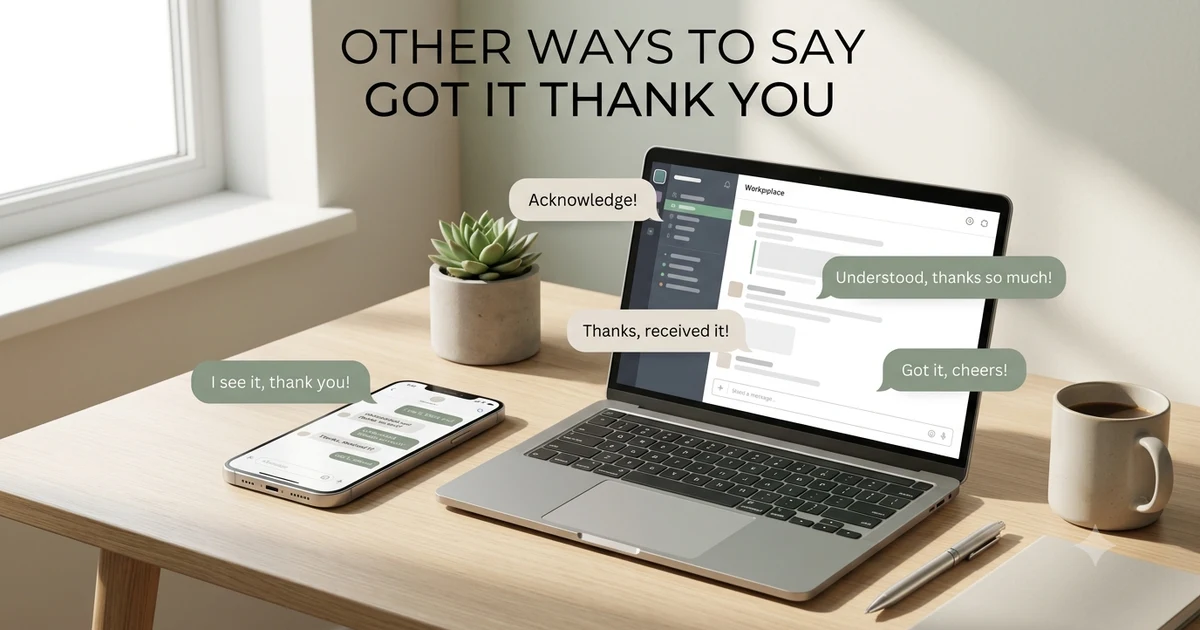
Sometimes got it, thank you is exactly right. It is short, polite, and easy to understand. But if you use the same reply often, you may want other ways to acknowledge information without sounding repetitive.
The best alternative depends on the situation. A workplace message may need a more professional response, while a text to a friend can sound relaxed and friendly. You can also choose wording that shows appreciation, confirms understanding, or simply lets someone know you received their message.
This guide covers natural alternatives, texting examples, tone differences, professional options, and situations where each response works best.
Quick Answer
Other ways to say got it thank you include understood, thanks for letting me know, I understand, thanks for the information, noted, that makes sense, and I appreciate the update. The right choice depends on how formal the conversation is and how much warmth you want to show.
For professional communication, thanks for the clarification or I understand, thank you usually sounds more polished. For casual texting, understood, thanks or gotcha, thanks feels more natural.
TL;DR
- Meaning: You understand and appreciate the information someone shared.
- Tone: Usually polite, neutral, and friendly.
- Common use: Text messages, workplace chats, emails, group conversations, and everyday replies.
- Where it appears: Casual texting, online conversations, professional messages, and social media chats.
- Formal or informal: The original phrase is neutral and conversational. More polished alternatives work better in formal settings.
- Best approach: Match your wording to the relationship and situation.
What Does Got It Thank You Mean?
Got it thank you combines two simple ideas: acknowledgment and appreciation.
Got it tells the other person that you understand or have received the information. Thank you shows that you appreciate them taking the time to provide it.
For example, someone might send:
The meeting has moved to 3 p.m. tomorrow.
A natural response would be:
Got it, thank you.
The reply confirms that you received the update without adding unnecessary detail.
The phrase can also mean I understand what you mean, thanks for explaining. The exact meaning depends on what came before it.
In text messages, it often works as a quick acknowledgment rather than the start of a longer conversation.
Basic Explanation and Meaning in Text
The phrase does not have a special full form because it is not an abbreviation or acronym.
In simple words, it means:
I understand, and I appreciate the information.
The phrase can respond to several types of information, including:
- Instructions
- Directions
- Schedule changes
- Explanations
- Reminders
- Corrections
- Answers to questions
- Workplace updates
- Personal information
The word got makes the response sound conversational. Thank you adds politeness.
That combination makes it useful in everyday communication.
How People Use It in Texting and Online Conversation
People commonly use this type of response when they want to acknowledge a message without continuing the conversation.
For example:
Friend: The movie starts at 8, so meet me outside at 7:45.
You: Got it, thank you.
Or:
Coworker: Please send the updated document before lunch.
You: Got it, thanks.
In group chats, a short acknowledgment can prevent confusion because it shows that you have seen the information.
People may also use variations such as:
- Got it, thanks
- Understood, thanks
- Gotcha, thank you
- I understand, thanks
- That makes sense, thank you
- Thanks, I got it
- Thanks for letting me know
The choice depends on the relationship and the tone of the conversation.
Tone and Emotional Meaning
The phrase usually sounds polite, neutral, and friendly.
However, the surrounding conversation can change how someone interprets it.
Friendly
Thanks, I got it.
This feels warm and natural in a casual conversation.
Neutral
Understood, thank you.
This sounds clear and slightly more formal.
Professional
Thanks for the clarification. I understand now.
This works well when someone has explained a work-related issue.
Very casual
Gotcha, thanks.
This fits relaxed conversations with friends or people you know well.
Potentially dismissive
Noted.
Noted can acknowledge information, but without additional warmth it may sound brief or distant.
The wording itself matters, but context matters just as much. A short reply from someone who normally writes briefly may not indicate annoyance.
Common Situations Where These Replies Appear
You can use an acknowledgment and thank-you response in many everyday situations.
After receiving instructions
Thanks, I understand. I will take care of it.
After receiving an update
Thanks for the update. I understand.
After someone explains something
That makes sense, thank you for explaining.
After receiving directions
Got it, thanks. I know where to go now.
After a schedule change
Thanks for letting me know. I have updated my calendar.
After a correction
Understood, thanks for pointing that out.
In a workplace chat
Thanks for the clarification. I will make the change.
In a casual text
Gotcha, thanks.
The best reply often depends more on the situation than on the words themselves.
Examples in Real Conversations
Situation: A friend gives you plans
Example:
Got it, thanks. I will meet you there at 7.
Meaning:
You understand the plan and appreciate the information.
Situation: A coworker explains a task
Example:
Thanks for explaining. I understand what needs to be done.
Meaning:
You confirm that the instructions are clear.
Situation: Someone changes a meeting time
Example:
Thanks for letting me know. I have the new time noted.
Meaning:
You acknowledge the update and show that you have recorded it.
Situation: A teacher gives clarification
Example:
I understand now. Thank you for clarifying.
Meaning:
You were unsure before, but the explanation helped.
Situation: Someone sends directions
Example:
Thanks, I got it. I should be there around 6.
Meaning:
You understand the directions and are confirming your plan.
Situation: A friend explains a misunderstanding
Example:
That makes sense now, thanks for explaining.
Meaning:
You understand their point after hearing the explanation.
Situation: A workplace email gives a simple update
Example:
Thank you for the update. I understand.
Meaning:
You acknowledge the information in a professional way.
Situation: A casual group chat
Example:
Gotcha, thanks.
Meaning:
You received and understood the message.
Similar Terms and Related Phrases
Several expressions communicate a similar idea, but their tone is not identical.
| Phrase | Tone | Best Use |
|---|---|---|
| Got it, thanks | Casual and polite | Everyday messages |
| Understood, thank you | Polite and professional | Work or formal communication |
| Thanks for letting me know | Friendly and appreciative | Updates and announcements |
| I understand | Neutral | General communication |
| That makes sense | Friendly and conversational | Explanations |
| Thanks for the clarification | Professional | Workplace discussions |
| Gotcha, thanks | Very casual | Friends and relaxed chats |
| Noted, thank you | Brief and formal | Work messages |
| I appreciate the information | More formal | Professional communication |
| Thanks, I have it | Simple and direct | Casual or workplace messages |
The key difference often comes down to warmth and formality.
When You Should Use These Alternatives
Choose an alternative when you want your reply to sound more natural for the situation.
Use thanks for letting me know when someone gives you an update.
Use I appreciate the information when you want a more polished professional tone.
A useful rule is simple: the more formal the relationship, the more carefully you should choose the wording.
When You Should Avoid Certain Alternatives
Not every short acknowledgment fits every situation.
Avoid overly casual wording at work
Gotcha, thanks may sound too relaxed in a formal email or communication with someone you do not know well.
Avoid overly formal wording with close friends
I acknowledge receipt of the information sounds unnatural in a normal text conversation.
Avoid one-word responses when clarification matters
If someone gives complicated instructions, replying with noted may not show that you actually understand them.
Avoid vague replies when action is required
If someone asks you to complete a task, a better response might confirm both understanding and action.
For example:
Thanks for the clarification. I will send the revised file this afternoon.
That gives the other person useful confirmation.
Is Got It Thank You Formal or Informal?
Got it, thank you sits somewhere between casual and professional.
It works in many everyday situations, including workplace chats, school communication, texts, and conversations with acquaintances.
However, formal emails may benefit from slightly more polished wording.
Casual
Got it, thanks.
Neutral
I understand, thank you.
Professional
Thank you for the clarification. I understand the next steps.
More formal
Thank you for the information. I understand what is required.
You do not need to make every professional response complicated. A simple, clear sentence often sounds more natural than a highly formal one.
Professional Alternatives for Work Messages
If you need a polished response at work, consider these options:
- Thanks for the clarification.
- Thank you for the update.
- I understand, thank you.
- Thanks for letting me know.
- Understood. I will take care of it.
- Thank you for explaining.
- I appreciate the information.
- That makes sense. Thank you.
- Thanks for confirming.
- I have noted the update.
The best option depends on what the person actually told you.
If they corrected something, use thanks for the clarification.
If they gave you instructions, use I understand or understood, thank you.
Casual Alternatives for Texting
Friends usually do not need formal wording. Short and natural responses work better.
Try:
- Gotcha, thanks.
- Got it, thanks.
- Okay, thanks.
- I understand, thanks.
- Makes sense, thanks.
- Thanks, I got it.
- Yep, got it.
- Thanks for letting me know.
- All clear, thanks.
- Okay, I understand.
These options sound natural in everyday texting without making the conversation feel stiff.
Common Misunderstandings
A short acknowledgment can sometimes create confusion because the other person cannot hear your voice or see your facial expression.
For example, noted may sound perfectly neutral to one person but slightly cold to another.
Likewise, okay, thanks can mean several things depending on context. It might show understanding, end the conversation, or simply acknowledge receipt.
If you want to avoid ambiguity, add a little context.
Instead of:
Thanks.
Try:
Thanks for explaining. I understand now.
Instead of:
Noted.
Try:
Thanks for the update. I have made a note of it.
A few extra words can make your intention much clearer.
USA and Tier 1 Country Usage
English speakers in the United States, Canada, the UK, Australia, and New Zealand generally understand short acknowledgment phrases such as got it, thanks, understood, and thanks for letting me know.
The main difference usually comes from the individual, relationship, workplace culture, and communication channel rather than a strict country-by-country rule.
In casual texting, shorter expressions are common.
In professional communication, people often choose wording that clearly acknowledges the information while maintaining a polite tone.
For international English communication, simple phrases such as I understand, thank you or thanks for the clarification are especially useful because they are clear and easy to interpret.
Got It Thank You in Professional Emails
A workplace email often benefits from acknowledging the information and, when necessary, stating what you will do next.
For example:
Thank you for the clarification. I understand the changes and will update the document accordingly.
Or:
Thanks for the update. I have noted the new deadline.
These responses sound more useful than simply saying got it because they confirm both understanding and action.
If no action is required, a short response is enough:
Thank you for letting me know. I understand.
Got It Thank You in Dating or Personal Chats
In personal conversations, the phrase can sound neutral and polite.
If someone shares information about their plans, you might reply:
Got it, thanks for letting me know.
If you want the message to feel warmer, you can add a natural follow-up:
Got it, thanks. That helps.
Or:
That makes sense, thanks for explaining.
There is no fixed romantic meaning attached to the phrase. Its meaning depends on the rest of the conversation and the relationship between the people.
Quick Reference Table
| Context | What It Means | Tone | Best Use | Avoid If |
|---|---|---|---|---|
| Friend texting | I understand and appreciate it | Casual | Everyday chats | The situation requires formality |
| Coworker chat | I received and understand the information | Neutral | Workplace messaging | You need to confirm a specific action |
| Professional email | I understand and appreciate the update | Polite | Simple workplace replies | The email requires detailed confirmation |
| Teacher or instructor | I understand the explanation | Respectful | Clarifications | More detail is needed |
| Group chat | I saw and understood the message | Casual | Plans and updates | Someone needs a detailed response |
| Social media chat | I understand | Casual | Short replies | The message needs more context |
| Formal communication | I acknowledge and understand | Formal | Business or official messages | A friend is expecting a relaxed response |
Choosing the Right Alternative
You do not need to memorize dozens of expressions. Think about what you want your reply to communicate.
If you simply received information, try:
Thanks for letting me know.
If you understand an explanation:
That makes sense, thank you.
If someone corrected or clarified something:
Thanks for the clarification.
If you need a short professional response:
Understood, thank you.
If you are texting a friend:
Gotcha, thanks.
If you want to confirm that you will act:
Understood. I will take care of it.
These small differences help your messages sound intentional rather than repetitive.
Conclusion
There are plenty of natural alternatives to got it, thank you, and each one carries a slightly different tone. Thanks for letting me know works well for updates, while thanks for the clarification suits explanations. Understood, thank you sounds concise and professional, while gotcha, thanks fits relaxed conversations.
The best response depends on the person, situation, and communication channel. In casual texting, simple wording usually works best. In professional messages, choose a phrase that clearly acknowledges the information and confirms what you understand or plan to do.
Ultimately, a good acknowledgment should sound natural, polite, and appropriate for the conversation.
FAQs
What does got it thank you mean in text?
It means that you understand or received the information and appreciate the person sharing it. It usually sounds polite, neutral, and conversational.
What does got it thank you mean in texting?
In texting, it usually works as a quick acknowledgment. It tells the other person that you saw the message, understood the information, and appreciate the update or explanation.
Is got it thank you rude?
No. The phrase is generally polite. However, very short replies can sometimes seem distant depending on the conversation, so adding a few words can make your tone warmer.
Can I use got it thank you in a professional message?
Yes. It can work in workplace chats and simple emails. For a more polished tone, use alternatives such as thank you for the clarification, thanks for the update, or I understand, thank you.
What is a more professional way to say got it thank you?
Good professional options include I understand, thank you, understood, thank you, thanks for the clarification, and thank you for the update.
What is a casual way to say got it thank you?
You can say gotcha, thanks, makes sense, thanks, okay, thanks, or thanks, I got it. These options work best in relaxed conversations.
What is the difference between got it and understood?
Both show that you understand something. Got it sounds more conversational, while understood can sound more formal, direct, or professional depending on the context.