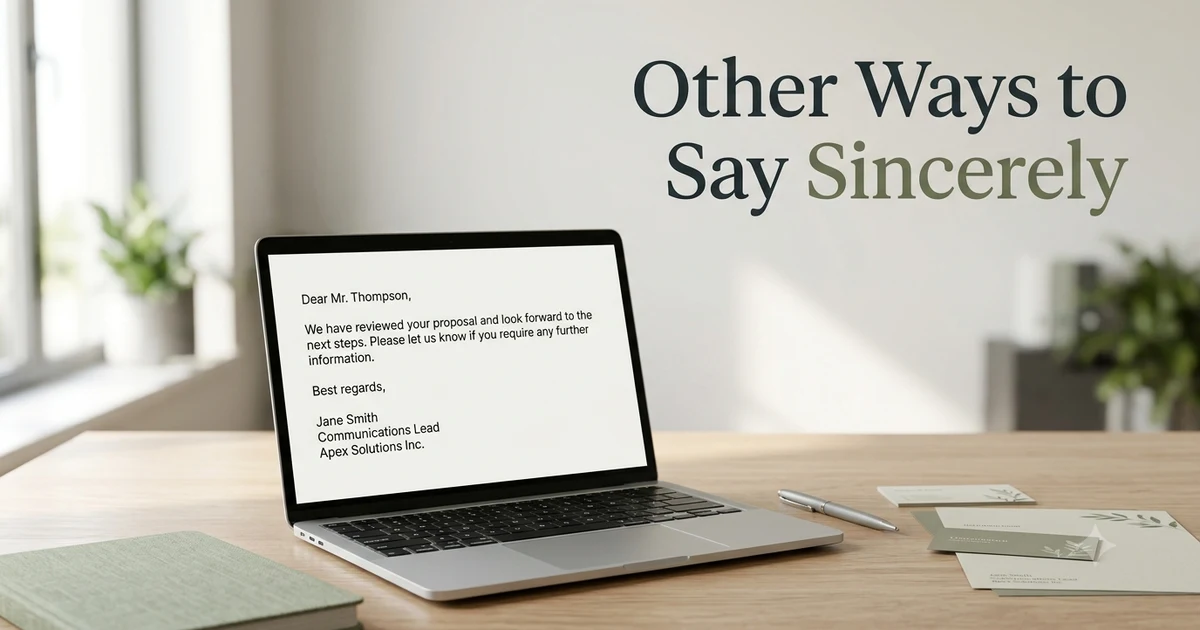
Finding other ways to say sincerely can help you make an email or letter sound warmer, more professional, friendly, or personal. Sincerely is a reliable closing, but it can feel formal or repetitive when you use it in every message.
Depending on the situation, you can choose alternatives such as Best regards, Kind regards, Warm regards, Respectfully, Thank you, All the best, or Best wishes. The right choice depends on who you are writing to and how formal the conversation is.
Quick Answer
Other ways to say sincerely include Best regards, Kind regards, Warm regards, Best wishes, Respectfully, All the best, Yours truly, and With appreciation. For professional emails, Best regards and Kind regards work well in most situations. For a warmer message, Best wishes or Warm regards may sound more natural.
TL;DR
- Meaning: Sincerely is a polite closing used at the end of a letter or email.
- Tone: Respectful, professional, and somewhat formal.
- Common use: Business emails, formal letters, applications, requests, and official communication.
- Where it appears: Emails, cover letters, printed letters, school communication, and professional correspondence.
- Formal or informal: Sincerely is mainly formal or semi-formal rather than casual.
- Good alternatives: Best regards, Kind regards, Warm regards, Best wishes, Respectfully, and All the best.
What Does Sincerely Mean?
Sincerely is a complimentary closing that shows respect and goodwill at the end of a written message.
It commonly appears before the sender’s name:
Sincerely,
Jordan
The word suggests that the message comes from the writer honestly and respectfully. In modern communication, however, most readers simply understand it as a polite way to end a formal letter or email.
It does not usually carry a strong emotional meaning. Instead, it provides a professional ending without sounding overly cold.
For example, you might use it when writing to:
- A hiring manager
- A teacher or school administrator
- A customer service representative
- A business contact
- A government office
- Someone you do not know personally
- A person receiving a formal request
Is Sincerely Formal or Informal?
Sincerely is generally formal or semi-formal.
It works particularly well when you want to sound respectful without becoming overly distant. It can also work in professional situations where you have an established relationship with the recipient.
Here is a simple comparison:
| Closing | Formality | General feeling |
|---|---|---|
| Sincerely | Formal | Respectful and traditional |
| Respectfully | Very formal | Serious and courteous |
| Best regards | Professional | Neutral and polished |
| Kind regards | Professional | Polite and slightly warm |
| Warm regards | Semi-formal | Friendly and warm |
| Best wishes | Semi-formal | Positive and personable |
| All the best | Casual to semi-formal | Friendly |
| Take care | Casual | Personal and warm |
For most everyday professional emails, Best regards or Kind regards can feel more natural than Sincerely.
Other Ways to Say Sincerely in an Email
The best replacement depends on your relationship with the recipient and the purpose of the email.
1. Best regards
Best regards is one of the safest professional alternatives. It works well with coworkers, clients, managers, recruiters, teachers, and business contacts.
Example:
Best regards,
Taylor
2. Kind regards
Kind regards sounds polite and slightly warmer than Sincerely. It works especially well when you want to maintain a respectful but approachable tone.
3. Warm regards
Warm regards adds more personal warmth while remaining appropriate for many professional situations.
Use it when you already have a friendly relationship with the recipient.
4. Best wishes
Best wishes sounds positive and personable. It works well for congratulations, personal updates, farewells, and friendly professional messages.
5. Respectfully
Respectfully creates a more serious and formal tone. It may fit official correspondence, formal requests, or situations involving authority.
6. All the best
All the best sounds natural and friendly. It works well with people you know and often feels less stiff than Sincerely.
7. With appreciation
With appreciation is useful when you want to emphasize gratitude.
Example:
With appreciation,
Morgan
8. With gratitude
With gratitude works when the message expresses genuine thanks, support, or recognition.
9. Yours truly
Yours truly has a traditional formal tone. It can work in formal letters, although it sounds less common in everyday workplace emails.
10. Best
Best is short, modern, and widely used in professional email. It works particularly well when you already have an established relationship with the recipient.
How to Choose the Right Alternative
Think about three things before choosing an email closing:
- Your relationship with the recipient
- The purpose of the message
- How formal the situation is
For example, a job application calls for a more professional closing, while a friendly message to a coworker can use something warmer.
A useful rule is:
- Formal request: Respectfully or Sincerely
- Standard business email: Best regards or Kind regards
- Friendly professional email: Warm regards or Best wishes
- Thank-you message: With appreciation or With gratitude
- Familiar coworker: Best or All the best
- Personal message: Best wishes or Take care
Common Situations Where These Alternatives Appear
Different closings fit different communication situations.
Job applications
Use:
- Sincerely
- Best regards
- Respectfully
A traditional closing can work well when you are contacting an employer for the first time.
Business emails
Use:
- Best regards
- Kind regards
- Best
These options sound professional without being unnecessarily formal.
Thank-you emails
Use:
- With appreciation
- With gratitude
- Best wishes
- Kind regards
The closing can reinforce the thankful tone of the message.
Farewell messages
Use:
- Best wishes
- All the best
- Warm regards
- Take care
These choices feel more personal than Sincerely.
Formal complaints or requests
Use:
- Sincerely
- Respectfully
- Yours truly
Choose the one that matches the seriousness of the situation.
School communication
For teachers, administrators, or other school professionals, Sincerely, Best regards, and Kind regards are generally safe choices.
Examples in Real Conversations
Situation: Applying for a job
Example
Thank you for considering my application. I appreciate your time and look forward to hearing from you.
Sincerely,
Alex
Meaning
The closing keeps the application formal and respectful.
Situation: Writing to a client
Example
Thank you for your patience while we worked through this issue. Please let me know if you need anything else.
Kind regards,
Morgan
Meaning
Kind regards adds professionalism while keeping the email approachable.
Situation: Thanking a coworker
Example
Thanks for helping me prepare the presentation. Your feedback made a big difference.
All the best,
Sam
Meaning
All the best sounds friendly and natural between colleagues.
Situation: Sending appreciation
Example
Thank you for taking the time to explain everything. I really appreciate your help.
With appreciation,
Jordan
Meaning
The closing directly supports the grateful tone of the message.
Situation: Formal request
Example
I would appreciate your consideration of this request and look forward to your response.
Respectfully,
Taylor
Meaning
Respectfully gives the message a serious and courteous ending.
Situation: Friendly professional message
Example
It was great speaking with you today. I hope we have the opportunity to work together again.
Warm regards,
Casey
Meaning
Warm regards creates a friendly tone without becoming too casual.
Similar Terms and Related Phrases
Several alternatives look similar but communicate slightly different levels of warmth and formality.
Sincerely vs. Best regards
Sincerely feels more traditional and formal.
Best regards sounds more modern and flexible, making it a common choice for workplace emails.
Sincerely vs. Kind regards
Both work in professional communication. Kind regards usually feels a little warmer and less formal.
Sincerely vs. Warm regards
Warm regards adds personal warmth. It works better when you already have a positive relationship with the recipient.
Sincerely vs. Best wishes
Best wishes sounds more personal and positive. It fits friendly correspondence, congratulations, farewells, and certain professional messages.
Sincerely vs. Respectfully
Respectfully carries a more serious and formal tone. It can work well for official correspondence or communication involving authority.
Sincerely vs. All the best
All the best feels much more conversational. It usually suits people you already know.
When You Should Use Sincerely
Sincerely works well when you want a dependable formal closing.
Consider using it when:
- You are writing a formal letter.
- You are contacting someone for the first time.
- You are submitting a job application.
- You are making a formal request.
- You are writing to an organization.
- You want to sound respectful and professional.
- The message has a serious or official purpose.
It is especially useful when you do not want your closing to sound overly friendly or personal.
When You Should Avoid Sincerely
Sincerely is not wrong, but it can feel unnecessarily formal in some situations.
Consider another option when:
- You are messaging a close friend.
- You are writing a quick internal chat message.
- You regularly communicate with the recipient.
- The message has a very casual tone.
- You want to emphasize gratitude.
- You are sending a warm farewell.
- The recipient expects a conversational style.
For example, ending a quick message to a coworker with Sincerely can feel stiff if the rest of the conversation sounds relaxed.
Is Sincerely Rude?
No, Sincerely is not normally rude.
It is a polite and respectful closing. However, context can affect how it feels.
If someone normally writes casually and suddenly ends a short message with Sincerely, the closing might feel unusually formal or distant. That does not make it rude, but it may create a different impression than Best or Thanks.
The rest of the message matters more than the closing alone.
Can You Use Sincerely in a Professional Message?
Yes. Sincerely remains appropriate for many professional messages, especially formal letters and first-contact emails.
For everyday workplace communication, though, alternatives such as Best regards, Kind regards, or Best may sound more natural.
Consider the level of formality rather than automatically choosing the most formal option.
Sincerely in American English
In American English, Sincerely remains a familiar formal closing for letters and professional correspondence.
In everyday workplace email, many people use shorter alternatives such as Best, Best regards, or Thanks.
The choice often depends more on the organization, relationship, and communication style than on a strict language rule.
Usage in Other English-Speaking Countries
Readers in the UK, Canada, Australia, and New Zealand will generally recognize Sincerely as a formal or traditional closing.
Regional preferences can vary, especially in business communication. Kind regards, Best regards, Best wishes, and similar closings also appear widely in professional correspondence.
There is no single closing that every English-speaking workplace requires.
Common Misunderstandings
Sincerely does not always mean deep emotion
The word can sound heartfelt in some contexts, but in an email it often functions simply as a conventional closing.
A formal closing does not make an email more professional
Professionalism comes from the entire message, including clarity, respect, accuracy, and appropriate tone.
Sincerely is not automatically better than alternatives
A shorter closing can sometimes fit the situation better.
Warm does not mean unprofessional
Warm regards or Best wishes can still work in professional communication when you have an appropriate relationship with the recipient.
Casual does not always mean careless
Best or All the best can sound polished when the workplace culture supports a relaxed communication style.
Quick Reference Table
| Context | What It Means | Tone | Best Use | Avoid If |
|---|---|---|---|---|
| Sincerely | Respectful closing | Formal | Formal letters and applications | Very casual messages |
| Best regards | Professional goodwill | Neutral | Workplace emails | Highly personal messages |
| Kind regards | Polite goodwill | Warm professional | Clients and coworkers | Extremely formal official letters |
| Warm regards | Friendly goodwill | Warm | Familiar professional contacts | Strictly formal requests |
| Best wishes | Positive closing | Friendly | Farewells and personal updates | Very formal complaints |
| Respectfully | Shows respect | Very formal | Official requests | Casual workplace chats |
| All the best | Positive farewell | Casual to semi-formal | Coworkers and familiar contacts | Formal applications |
| With appreciation | Expresses thanks | Warm | Thank-you messages | Routine emails without gratitude |
| With gratitude | Shows genuine thanks | Warm | Appreciation messages | Neutral business updates |
| Best | Short professional closing | Neutral | Everyday workplace emails | Formal letters requiring a traditional style |
Conclusion
There are plenty of natural alternatives to sincerely, and the best choice depends on the relationship and purpose of your message. Best regards and Kind regards are reliable options for professional emails, while Warm regards and Best wishes create a friendlier tone. Respectfully works better for serious or formal correspondence, and All the best suits familiar professional contacts.
Sincerely itself remains polite, professional, and appropriate for formal communication. You do not need to avoid it, but changing your closing can make your messages feel more natural and better matched to the situation. When choosing an alternative, focus on the tone you want the reader to feel when they reach the end of your message.
FAQs
What does sincerely mean in text?
Sincerely usually means the writer is ending a message politely and respectfully. In text or email, it often functions as a formal closing rather than expressing deep emotion.
What are the best alternatives to sincerely?
Common alternatives include Best regards, Kind regards, Warm regards, Best wishes, Respectfully, All the best, and With appreciation. The right choice depends on the formality and purpose of the message.
Is sincerely rude?
No. Sincerely is generally polite and respectful. It may feel slightly formal or distant in a very casual conversation, but that does not make it rude.
Can I use sincerely in a professional email?
Yes. Sincerely works well in formal emails, job applications, official requests, and first-contact messages. For routine workplace emails, Best regards or Kind regards may sound more conversational.
What is the difference between sincerely and best regards?
Sincerely has a more traditional and formal feel. Best regards sounds modern, professional, and slightly more conversational, making it useful for everyday business emails.
Is sincerely too formal for an email?
It can be, depending on the relationship. For a formal email, it works well. With a close coworker or familiar contact, Best, Thanks, or All the best may sound more natural.
What is a warm alternative to sincerely?
Warm regards and Best wishes are good choices when you want a professional closing with a little more warmth. With appreciation is another option when the message expresses thanks.