
Supporting someone with the right words can make a real difference. If you’re looking for other ways to say I believe in you, you probably want an expression that fits a specific situation, whether you’re encouraging a friend, motivating a coworker, comforting a family member, or cheering on your partner. The good news is that English offers many natural alternatives that can sound more personal, professional, or heartfelt depending on the moment.
This guide explains what these phrases mean, when to use them, and how to choose the one that feels most genuine.
Quick Answer
Other ways to say I believe in you include I have faith in you, You’ve got this, I know you can do it, I trust your judgment, I know you’ll figure it out, and I’m rooting for you. Each phrase shows confidence in someone’s abilities, but the tone can range from casual and friendly to warm, emotional, or professional.
TL;DR
- Meaning: Expresses confidence in someone’s abilities or decisions.
- Tone: Encouraging, supportive, and positive.
- Common use: Conversations with friends, family, coworkers, students, or teammates.
- Where it appears: Everyday conversations, text messages, emails, cards, and social media.
- Formal or informal: Both, depending on the phrase you choose.
- Best tip: Match the wording to your relationship and the situation.
What Other Ways to Say I Believe in You Means
Saying I believe in you tells someone that you trust their ability to succeed, overcome a challenge, or make a good decision. It is one of the most encouraging phrases in everyday English because it offers emotional support without sounding overly dramatic.
Sometimes, repeating the exact same phrase can feel predictable. Choosing a different expression helps your message sound more thoughtful and personal.
For example, instead of saying:
- I believe in you.
You could say:
- I know you can do this.
- I have complete faith in you.
- You’ve worked hard for this.
- I trust you to make the right choice.
- I’m confident you’ll do well.
Although each phrase has a slightly different tone, they all communicate confidence and encouragement.
Basic Explanation
There is no abbreviation or hidden meaning behind this phrase. It simply means that you have confidence in another person’s abilities, character, or potential.
People often use it when someone is:
- Starting a new job
- Taking an important exam
- Preparing for an interview
- Going through a difficult time
- Learning a new skill
- Making a major life decision
- Chasing a personal goal
The message focuses on encouragement rather than guaranteeing success. Even if the outcome is uncertain, you’re telling the other person that you trust their ability to handle whatever happens.
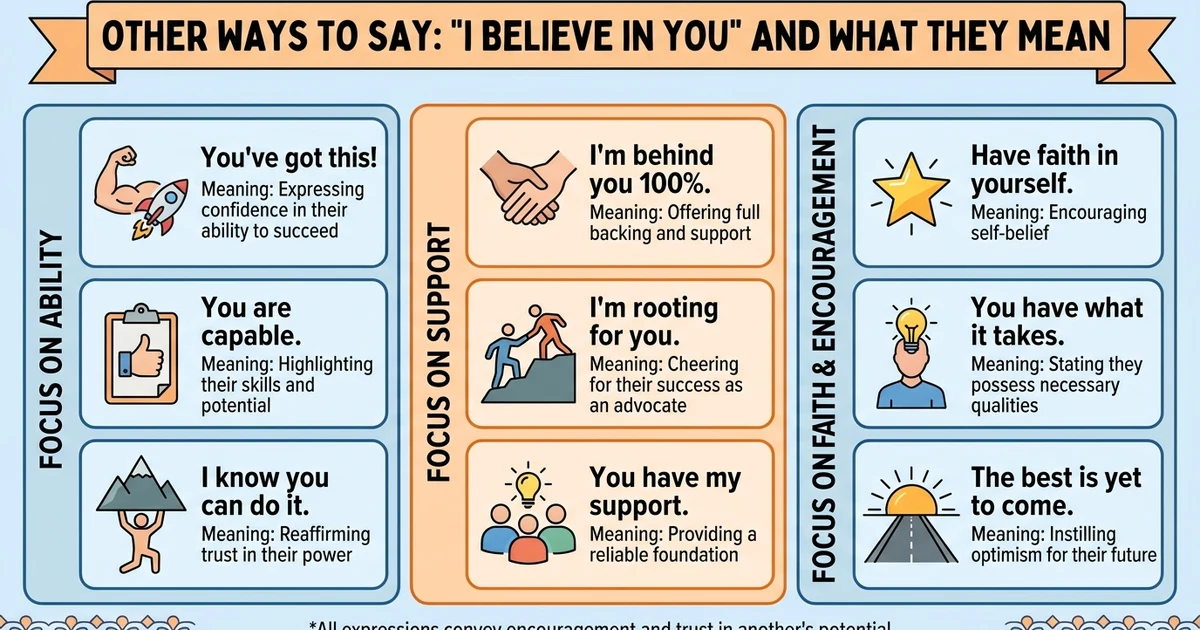
How People Use It in Texting or Online Conversation
Supportive messages are common in text conversations because they’re quick, personal, and easy to understand. Instead of repeating the same sentence every time, many people use different expressions that fit the situation.
Here are some common alternatives in casual texting:
| Alternative | Best Used For | Tone |
|---|---|---|
| You’ve got this | Before a challenge | Casual and motivating |
| I know you can do it | Exams, interviews, competitions | Friendly |
| I’m rooting for you | Showing ongoing support | Warm and encouraging |
| I have faith in you | Emotional conversations | Sincere |
| I trust your judgment | Decision-making | Respectful |
| You’re more capable than you think | Building confidence | Reassuring |
| I know you’ll figure it out | Solving problems | Calm and supportive |
| I know you’ll do great | Before an important event | Positive |
These phrases appear naturally in:
- Text messages between friends
- Family group chats
- Workplace messaging apps
- Social media comments
- Graduation messages
- Birthday cards
- Encouragement posts on Instagram or Facebook
Example text messages
Friend preparing for an interview
A: I’m really nervous about tomorrow.
B: You’ve prepared for weeks. I know you’ll do great.
Student before an exam
A: I don’t think I’m ready.
B: You’ve studied hard. You’ve got this.
Supporting a coworker
A: This presentation feels overwhelming.
B: I trust your judgment. You’re ready for this.
Helping a family member
A: I’m worried about making the wrong choice.
B: I know you’ll figure it out. You’ve handled difficult situations before.
These examples sound natural because they match real conversations rather than using overly formal language.

Tone and Emotional Meaning
Different alternatives carry different emotions. Picking the right one depends on how close you are to the person and what kind of support they need.
Warm and heartfelt
These expressions work well with close friends, family members, or romantic partners.
- I have faith in you.
- I know you’ll get through this.
- I’m always in your corner.
- I’ll be cheering you on.
They show emotional support and reassurance during difficult moments.
Friendly and casual
These are common in everyday conversations.
- You’ve got this.
- I know you can do it.
- You’ll do great.
- Go for it.
They sound upbeat without being overly emotional.
Professional and respectful
In the workplace, encouragement usually sounds more measured.
Examples include:
- I trust your judgment.
- I’m confident in your abilities.
- I know you’re capable of handling this.
- You have the skills to succeed.
These phrases express confidence while maintaining a professional tone.
Calm and reassuring
Sometimes people need quiet reassurance instead of energetic motivation.
Good choices include:
- Take your time. I know you’ll figure it out.
- I trust you.
- You’re capable of handling this.
- I know you’ll make the right decision.
These expressions reduce pressure while still showing confidence.
Common Situations Where It Appears
Encouraging phrases fit many everyday situations. Choosing the right one depends on what the other person is experiencing.
Before an important event
Use phrases such as:
- You’ve got this.
- I know you’ll do great.
- I’m rooting for you.
These work well before interviews, presentations, competitions, or performances.
During a difficult time
Someone facing setbacks often needs reassurance more than motivation.
Helpful expressions include:
- I have faith in you.
- You’ll get through this.
- I know you’re stronger than you think.
When someone doubts themselves
Self-doubt can make even capable people question their abilities.
Good responses include:
- I trust your judgment.
- You’re more capable than you realize.
- I know you can handle this.
Supporting students or children
Simple, encouraging language often works best.
Examples include:
- I know you can do it.
- Keep trying.
- I’m proud of your effort.
- You’re learning every day.
Encouraging coworkers
Professional encouragement should sound confident without being overly personal.
Examples include:
- I’m confident you’ll handle this well.
- I trust your experience.
- You’ve prepared for this.
- I know you’re ready.
Using the right alternative shows that you’ve thought about the person’s situation instead of relying on the same expression every time. A few sincere words can help someone feel more confident, whether you’re sending a quick text, speaking face to face, or writing a thoughtful message.
50 Other Ways to Say I Believe in You
Not every situation calls for the exact words I believe in you. Sometimes you want to sound more encouraging, more professional, or simply more natural. Here are several alternatives that fit different conversations.
| Phrase | Best For | Tone |
|---|---|---|
| You’ve got this | Friends, family | Casual |
| I know you can do it | Everyday encouragement | Friendly |
| I have faith in you | Emotional support | Warm |
| I’m rooting for you | Ongoing support | Cheerful |
| I trust your judgment | Work, personal decisions | Respectful |
| I know you’ll do great | Before an event | Positive |
| You’re capable of this | Motivation | Reassuring |
| I know you’ll figure it out | Problem solving | Calm |
| I believe in your abilities | Professional settings | Formal |
| You’ve prepared well | Exams, presentations | Encouraging |
| You’re ready | Big moments | Confident |
| I know you’ll succeed | Goals and challenges | Optimistic |
| Keep believing in yourself | Personal growth | Inspirational |
| You’re stronger than you think | Difficult times | Supportive |
| I trust you completely | Close relationships | Sincere |
| I know you’ll make the right choice | Decision making | Reassuring |
| I know you’re up to the challenge | Work or school | Motivating |
| You can handle this | Stressful situations | Calm |
| I know you’ll give it your best | Competitions | Positive |
| Your hard work will pay off | Long-term goals | Encouraging |
| I know you’re capable | Workplace or school | Respectful |
| You’ve earned this opportunity | Career milestones | Professional |
| I can’t wait to see what you accomplish | Celebrating progress | Warm |
| You have everything you need | Building confidence | Reassuring |
| You’re on the right track | Ongoing projects | Supportive |
Examples in Real Conversations
Seeing these phrases in context makes it easier to choose the right one.
Situation: A friend has a job interview
Example
Alex: I’m nervous about tomorrow’s interview.
Taylor: You’ve prepared for this all week. I know you’ll do great.
Meaning
Taylor reminds Alex that preparation matters and shows confidence without adding pressure.
Situation: A coworker is leading a meeting
Example
Jordan: I hope this presentation goes well.
Sam: I trust your judgment. You’ll handle it well.
Meaning
This sounds professional while expressing confidence.
Situation: A student before an exam
Example
Emma: I don’t think I’m ready.
Dad: You’ve studied hard. You’ve got this.
Meaning
The response feels supportive and motivating.
Situation: A family member making a big decision
Example
Chris: I’m afraid I’ll make the wrong choice.
Mom: I know you’ll make the right decision. I trust you.
Meaning
The focus shifts from success to confidence in the person’s judgment.
Situation: Encouraging a partner
Example
Jamie: I don’t know if I can finish this project.
Morgan: You’re stronger than you think, and I’ll be cheering you on.
Meaning
The message combines encouragement with emotional support.
Similar Terms and Related Phrases
Several expressions share a similar meaning, but each has a different purpose.
I Believe in You vs You’ve Got This
I believe in you
- Focuses on long-term confidence.
- Feels more personal and heartfelt.
You’ve got this
- Focuses on one specific challenge.
- Sounds casual and energetic.
I Believe in You vs I Trust You
I trust you
- Shows confidence in someone’s decisions or reliability.
- Says you have confidence in the person.
I’m rooting for you
- Says you’re cheering for their success.
Many people use both together because they complement each other.
I Believe in You vs You Can Do It
You can do it
- Motivates someone to take action.
- Often used before a challenge.
I believe in you
- Expresses confidence regardless of the outcome.
When You Should Use These Phrases
Supportive language works best when it feels sincere.
Good situations include:
- Before exams
- Before interviews
- Starting a new job
- Beginning a business
- Learning a new skill
- Recovering from failure
- Playing sports
- Giving a speech
- Preparing for a performance
- Working toward personal goals
These phrases also work well in:
- Birthday cards
- Graduation cards
- Retirement messages
- Encouragement emails
- Team meetings
- Text messages
- Social media comments
A small sentence can boost someone’s confidence when they need it most.
When You Should Avoid Certain Alternatives
Although encouraging language is usually welcome, not every phrase fits every situation.
Avoid overly casual expressions like You’ve got this when:
- Writing formal business emails
- Speaking with senior executives
- Communicating with clients
- Writing recommendation letters
Instead, choose phrases like:
- I’m confident in your abilities.
- I trust your professional judgment.
- I know you’re well prepared.
Also avoid making promises you cannot guarantee.
For example:
- You definitely won’t fail.
This can create unnecessary pressure if things do not go as planned.
A better option is:
- I know you’ll give it your best.
This focuses on effort rather than guaranteeing success.
Is It Formal or Informal?
The answer depends on which alternative you choose.
Informal expressions
These are common among friends and family.
- You’ve got this.
- You can do it.
- I’m rooting for you.
- You’ll do great.
- I know you’ve got this.
Neutral expressions
These work almost anywhere.
- I know you’re capable.
- I trust you.
- I know you’ll handle it.
- You have what it takes.
Formal expressions
These fit professional communication.
- I’m confident in your abilities.
- I trust your judgment.
- You have demonstrated excellent skills.
- I believe you are well prepared.
- I have every confidence in your success.
Choosing the right level of formality makes your encouragement sound more natural and appropriate.
Common Misunderstandings
Although these expressions are simple, people can sometimes interpret them differently.
Some people hear pressure instead of support
If someone already feels anxious, saying You have to succeed may increase stress.
Instead, try:
- I know you’ll do your best.
- Whatever happens, I’m proud of you.
These messages reduce pressure while still offering encouragement.
Confidence is not the same as certainty
Saying I believe in you does not mean you’re predicting success.
It means you trust the person’s abilities, effort, or character.
Tone matters
The same words can sound sincere or sarcastic depending on how they’re delivered.
For example:
- Nice, you’ve got this.
can sound sarcastic if the speaker rolls their eyes or uses a mocking tone.
In normal conversation, however, it is almost always understood as genuine encouragement.
USA and Tier 1 Country Usage
In the United States, Canada, the United Kingdom, Australia, and New Zealand, supportive phrases like I believe in you and its alternatives are part of everyday English.
You’ll hear them in many settings, including:
- Schools
- Sports teams
- Families
- Workplaces
- Churches
- Community groups
- Graduation ceremonies
Among younger speakers, casual expressions such as You’ve got this and I’m rooting for you appear frequently in text messages, social media posts, and group chats.
In professional environments, people often choose more measured phrases like:
- I trust your judgment.
- I’m confident you’ll do a great job.
- You have the experience to handle this.
Across English-speaking countries, the message remains the same: expressing confidence in someone and encouraging them to move forward.
Quick Reference Table
| Context | What It Means | Tone | Best Use | Avoid If |
|---|---|---|---|---|
| Friend before an exam | Showing confidence in their ability | Casual and encouraging | Text messages, face-to-face conversations | You want a more formal tone |
| Job interview | Expressing trust in someone’s preparation | Professional and supportive | Workplace conversations, career advice | You barely know the person |
| Family member facing a challenge | Offering emotional reassurance | Warm and caring | Personal conversations | The person wants practical advice instead |
| Coworker leading a project | Showing confidence in their skills | Respectful | Office chats, emails, meetings | The message sounds too personal |
| Partner during a difficult time | Providing emotional support | Heartfelt | Private conversations | The situation calls for direct problem-solving |
| Student learning something new | Encouraging continued effort | Positive | School, tutoring, coaching | The feedback needs specific guidance |
| Social media comment | Cheering someone on publicly | Friendly | Posts, achievements, milestones | The topic is serious or sensitive |
Conclusion
Finding other ways to say I believe in you helps you make your encouragement feel more personal and meaningful. Whether you’re talking to a friend, family member, coworker, student, or partner, choosing the right words shows that you genuinely care about their success and well-being.
Simple phrases like You’ve got this, I have faith in you, I trust your judgment, and I’m rooting for you all communicate confidence in different ways. The best choice depends on your relationship, the situation, and the tone you want to create.
Most importantly, speak sincerely. Even a short message of encouragement can give someone the confidence they need to take the next step.
FAQs
What are the best other ways to say I believe in you?
Some of the most natural alternatives include You’ve got this, I have faith in you, I know you can do it, I’m rooting for you, I trust your judgment, and You can handle this. Each works best in different situations.
Is saying I believe in you formal or informal?
The phrase itself is neutral and works in both personal and professional conversations. If you need a more formal option, try I’m confident in your abilities or I trust your professional judgment.
Can I use these phrases in a professional message?
Yes. In workplace communication, choose respectful alternatives such as I trust your judgment, I’m confident in your abilities, or You have the skills to succeed. These sound supportive without being too casual.
What is the difference between I believe in you and You’ve got this?
I believe in you expresses confidence in someone’s overall abilities or character. You’ve got this usually refers to a specific challenge, such as an exam, interview, or presentation, and has a more casual tone.
Which phrase is best for encouraging a friend?
For close friends, natural choices include You’ve got this, I know you can do it, I’m rooting for you, and I know you’ll do great. These sound friendly and genuine.
Can I use these phrases in a text message?
Yes. These expressions are common in texting, online chats, and social media. Short messages like You’ve got this or I’m cheering you on feel natural and encouraging.
What should I avoid when encouraging someone?
Avoid making promises you cannot guarantee, such as You definitely won’t fail. Instead, focus on confidence and support with phrases like I know you’ll do your best or I trust that you’ll handle this well.