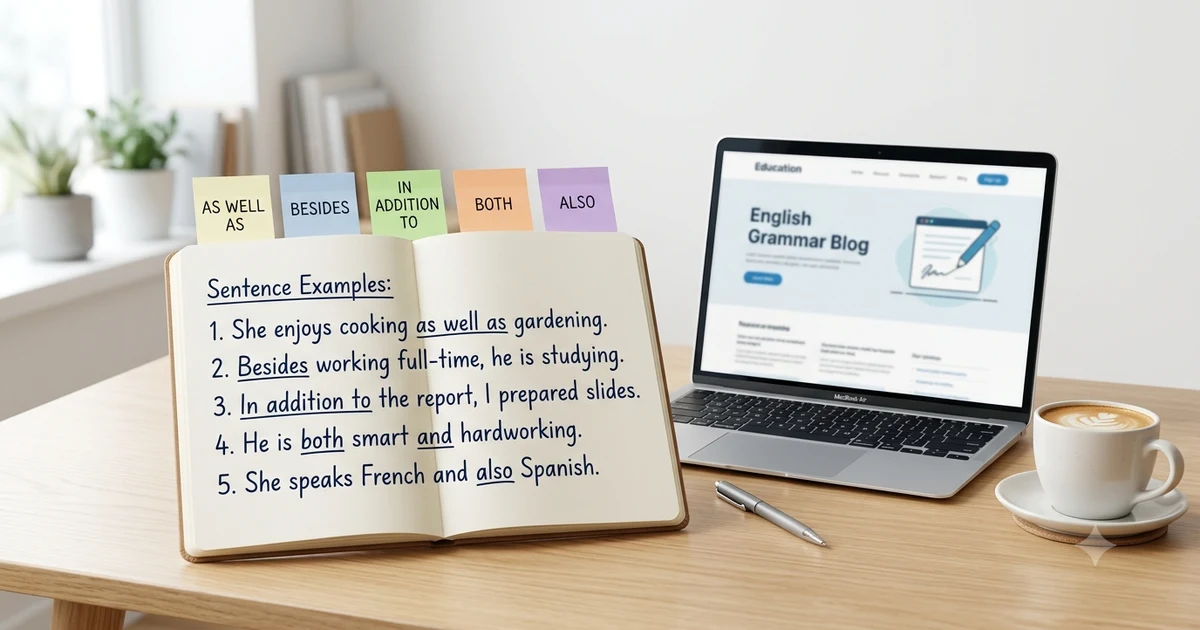
The phrase other ways to say not only with examples is a common search because people want to make their writing sound more natural, varied, or professional. While not only works well in many sentences, repeating it too often can make your writing feel repetitive. Learning suitable alternatives helps you improve essays, emails, business writing, and everyday conversations.
Quick Answer
Not only emphasizes that one thing is true and that another important thing is also true. Depending on the sentence, you can replace it with phrases such as as well as, besides, along with, in addition to, beyond, and both. The best choice depends on the tone and sentence structure.
TL;DR
- Meaning: Adds another important idea or point.
- Tone: Usually neutral and natural.
- Common use: Writing, speaking, presentations, and conversations.
- Where it appears: Essays, emails, blogs, business communication, and casual speech.
- Formal or informal: Works in both formal and informal English.
What Other Ways to Say Not Only Mean
Not only introduces an additional point while giving extra emphasis to what follows. It often appears with but also, but you do not always need to keep the same structure.
For example:
- She is not only talented but also hardworking.
- The movie was not only entertaining but also educational.
In many cases, you can rewrite these sentences using different expressions without changing the meaning.
Basic Explanation
The purpose of not only is to show that there is more than one important quality, action, or fact.
Instead of saying:
- The restaurant serves not only breakfast but also lunch.
You could say:
- The restaurant serves breakfast as well as lunch.
- The restaurant serves both breakfast and lunch.
- Besides breakfast, the restaurant also serves lunch.
Each version sounds slightly different, but they all communicate a similar idea.

Common Alternatives to Not Only
The table below shows some of the best replacements and when to use them.
| Alternative | Best For | Example |
|---|---|---|
| As well as | Formal and everyday writing | She speaks French as well as Spanish. |
| Both | Clear comparisons | He enjoys both hiking and camping. |
| Along with | Casual and professional writing | Coffee comes along with breakfast. |
| In addition to | Formal writing | In addition to experience, she has excellent communication skills. |
| Besides | Everyday conversation | Besides math, he enjoys science. |
| Plus | Informal speech | The hotel was affordable, plus it was close to downtown. |
| Beyond | Formal emphasis | Beyond being affordable, the software is easy to use. |
| Also | Simple replacement | She also volunteered on weekends. |
How People Use These Alternatives in Everyday Conversation
Most native English speakers naturally switch between different expressions instead of repeating not only.
Examples include:
- We visited the museum as well as the aquarium.
- Besides helping with the project, she organized the meeting.
- The package includes free shipping along with a warranty.
- He plays soccer and also coaches a youth team.
These alternatives make conversations sound smoother and less repetitive.
Tone and Meaning
Different alternatives create different tones.
| Expression | Tone |
|---|---|
| As well as | Neutral |
| In addition to | Professional |
| Besides | Friendly and conversational |
| Plus | Very casual |
| Beyond | More formal and descriptive |
| Both | Clear and balanced |
Choose the phrase that matches your audience and purpose.
Common Situations Where They Appear
You can replace not only in many situations, including:
- School essays
- Business emails
- Academic writing
- Job applications
- Blog articles
- Marketing content
- Social media captions
- Everyday conversations
- Presentations
- Reports
Examples in Real Conversations
Situation
Talking about a coworker.
Example
Sarah is organized as well as creative.
Meaning
She has more than one valuable quality.
Situation
Discussing a vacation.
Example
The trip included sightseeing along with local food tours.
Meaning
Several enjoyable activities were included.
Situation
Writing a resume.
Example
In addition to five years of experience, I have project management certification.
Meaning
The speaker highlights another important qualification.
Situation
Talking with friends.
Example
Besides pizza, we ordered salads.
Meaning
The group chose more than one type of food.
Situation
Describing a product.
Example
The laptop is lightweight and also has excellent battery life.
Meaning
The product offers multiple advantages.
Similar Terms and Their Differences
| Phrase | Difference |
|---|---|
| As well as | Smooth replacement in many sentences |
| Also | Adds another idea without strong emphasis |
| Both | Connects two equal items |
| Besides | Adds extra information casually |
| In addition to | More formal than besides |
| Plus | Informal and conversational |
Each option works best in different contexts.
When You Should Use These Alternatives
Choose another expression when you want to:
- Avoid repeating the same phrase.
- Make writing sound more natural.
- Improve sentence variety.
- Match a formal or casual tone.
- Write more smoothly.
Changing your wording helps keep readers engaged.
When You Should Avoid Certain Alternatives
Some replacements do not fit every situation.
For example:
- Avoid plus in academic papers.
- Avoid besides in highly formal legal documents.
- Avoid beyond unless it naturally fits the sentence.
- Do not replace not only if the original emphasis is important.
Always read the sentence aloud to see which option sounds most natural.
Is It Formal or Informal?
Not only itself works well in both formal and informal English.
Here is a quick guide:
| Context | Recommended Choice |
|---|---|
| Academic essay | Not only, in addition to, as well as |
| Business email | As well as, in addition to |
| Resume | In addition to |
| Casual conversation | Besides, plus, also |
| Social media | Also, plus, besides |
Common Misunderstandings
Many learners think every alternative means exactly the same thing.
That is not always true.
For example:
- Both joins two equal items.
- Also simply adds another point.
- Besides can sometimes mean except for, depending on the sentence.
- Plus sounds much more casual than in addition to.
Understanding these small differences helps you choose the right expression.
Usage in the USA and Other English-Speaking Countries
In the United States, Canada, the United Kingdom, Australia, and New Zealand, speakers regularly use many of these alternatives.
You will often hear:
- as well as
- also
- besides
- both
- in addition to
Professional writing usually favors as well as or in addition to, while everyday conversation often uses also or plus.
Quick Reference Table
| Context | What It Means | Tone | Best Use | Avoid If |
|---|---|---|---|---|
| As well as | Adds another item | Neutral | Essays, emails | Rarely |
| Both | Connects two items | Neutral | Comparisons | More than two items |
| Besides | Adds extra information | Casual | Conversation | Formal documents |
| In addition to | Adds another point | Formal | Business writing | Very casual speech |
| Plus | Adds another benefit | Casual | Friendly conversation | Academic writing |
| Also | Adds another fact | Neutral | Almost everywhere | When stronger emphasis is needed |
Conclusion
Learning other ways to say not only with examples helps you write and speak more naturally. While not only remains an excellent expression, alternatives such as as well as, both, besides, along with, and in addition to can improve sentence variety and better match different situations. Choosing the right phrase depends on your audience, writing style, and the level of formality you need.
FAQs
What are the best alternatives to not only?
Some of the best alternatives are as well as, both, besides, along with, in addition to, also, and plus.
Can I replace not only with as well as?
Yes. In many sentences, as well as creates a smoother and more natural structure.
Is not only formal or informal?
It works in both formal and informal English, making it suitable for essays, emails, and everyday conversation.
Which alternative sounds most professional?
In addition to and as well as are usually the best choices for professional and academic writing.
Can I use plus instead of not only?
Yes, but only in casual conversations or informal writing. It is usually too informal for business reports or academic work.
What is the difference between not only and both?
Not only adds emphasis to an additional point, while both simply connects two equal items without extra emphasis.
How can I avoid repeating not only in my writing?
Rotate between expressions like as well as, also, besides, in addition to, along with, and both depending on the sentence and tone.