Have you ever wanted to respond with something more polished than okay in a workplace email or business chat? While okay works in many situations, it can sometimes sound too casual or lack the right level of professionalism. Choosing a better alternative helps you sound clear, respectful, and confident. This guide covers professional ways to say okay, explains when to use each one, and includes practical examples you can apply at work.
Quick Answer
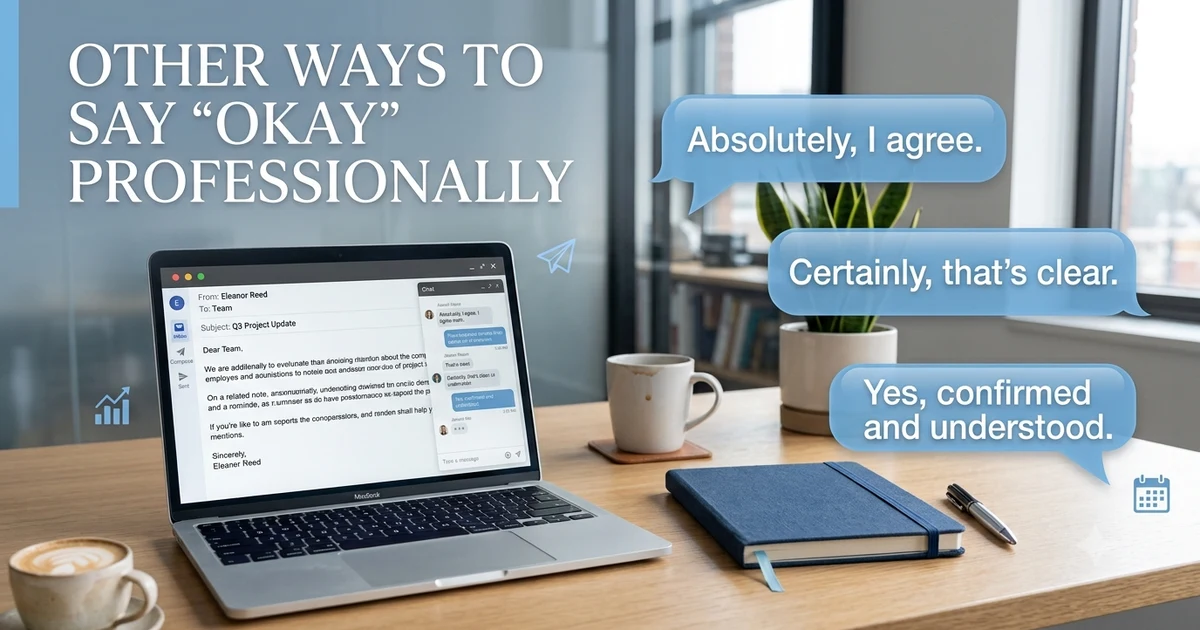
There are many professional alternatives to okay, including understood, certainly, absolutely, noted, sounds good, and I understand. The best choice depends on the situation, your relationship with the other person, and the level of formality you want to maintain.
TL;DR
- Meaning: A professional way to acknowledge, agree, or confirm.
- Tone: Polite, respectful, and clear.
- Common use: Emails, meetings, workplace chats, and customer communication.
- Where it appears: Business emails, Microsoft Teams, Slack, and project management tools.
- Formal or informal: Most alternatives range from neutral to formal.
What Other Ways to Say Okay Professionally Mean
In professional communication, replacing okay with a more specific response helps your message sound thoughtful and intentional.
Instead of giving a one-word reply, you can show that you understand, agree, or will take action. A stronger response also reduces confusion because it tells the other person exactly what you mean.
For example:
- Understood shows you received the information.
- Certainly expresses willingness.
- Sounds good confirms agreement.
- Noted tells someone you have recorded the information.
- Absolutely shows enthusiastic agreement.
The right phrase depends on the message you are answering.
Why Replace Okay in Professional Messages
Okay is not wrong. Most people use it every day. However, in business communication it can sometimes sound:
- Too brief
- Uninterested
- Less professional
- Unclear about your intention
A better alternative can make your response warmer and more helpful without adding unnecessary words.
25 Other Ways to Say Okay Professionally
| Alternative | Best Used For | Tone |
|---|---|---|
| Understood | Instructions | Professional |
| Certainly | Customer service | Formal |
| Absolutely | Strong agreement | Positive |
| Sounds good | Team conversations | Friendly |
| Noted | Confirming information | Professional |
| I understand | Clarifying instructions | Professional |
| That works for me | Scheduling | Friendly |
| Happy to help | Offering assistance | Warm |
| Will do | Accepting a task | Casual professional |
| Consider it done | Completing requests | Confident |
| I can do that | Accepting work | Neutral |
| Agreed | Discussions | Professional |
| I appreciate the update | Status updates | Polite |
| Thanks, I’ll take care of it | Task confirmation | Friendly |
| That makes sense | Discussions | Neutral |
| I’m on it | Quick workplace chats | Casual professional |
| I’ll handle it | Assignments | Confident |
| Confirmed | Confirmations | Formal |
| Received | Document acknowledgments | Professional |
| Acknowledged | Official communication | Formal |
| I agree | Meetings | Professional |
| Thank you, noted | Email replies | Polite |
| No problem | Internal conversations | Friendly |
| Fine by me | Informal workplace chats | Casual |
| Of course | Helpful responses | Warm |
How People Use These Alternatives in Professional Communication
Professional alternatives to okay appear in many workplace situations. Picking the right phrase makes your response sound more natural and shows that you understand the context.
In Emails
Email responses often benefit from clear acknowledgments.
Examples:
- Understood. I will complete the report by Friday.
- Certainly. I will send the updated document this afternoon.
- Noted. Thank you for letting me know.
- Confirmed. I have added the meeting to my calendar.
In Workplace Chat
Quick messaging platforms such as Microsoft Teams or Slack usually allow a slightly more relaxed tone.
Examples:
- Sounds good. I’ll get started.
- I’m on it.
- Will do.
- That works for me.
During Meetings
When speaking in meetings, these phrases help you respond confidently.
Examples:
- I agree.
- That makes sense.
- Understood.
- Absolutely.
In Customer Service
Customer communication should remain polite and reassuring.
Examples:
- Certainly. I’d be happy to help.
- Absolutely. I’ll look into that for you.
- Understood. I’ll provide an update shortly.
Tone and Emotional Meaning
Every alternative carries a slightly different tone. Choosing the right one improves communication.
| Phrase | Tone | Best For |
|---|---|---|
| Understood | Respectful | Following instructions |
| Certainly | Formal | Clients and managers |
| Absolutely | Positive | Strong agreement |
| Sounds good | Friendly | Coworkers |
| Noted | Direct | Confirming information |
| Will do | Casual professional | Team chats |
| Confirmed | Formal | Scheduling and approvals |
| Happy to help | Warm | Customer support |
| I’m on it | Confident | Active tasks |
| Agreed | Neutral | Discussions |
Common Situations Where These Phrases Appear
You can use professional alternatives instead of okay in many everyday situations.
- Replying to an email from your manager.
- Confirming a meeting time.
- Accepting a new assignment.
- Acknowledging project updates.
- Responding to customer requests.
- Confirming receipt of documents.
- Agreeing with a proposal.
- Responding in Microsoft Teams or Slack.
- Following up after a meeting.
- Updating clients on project progress.
Examples in Real Conversations
Situation
A manager assigns a task.
Example
Manager: Please finish the presentation before Thursday.
Employee: Understood. I’ll have it ready by Wednesday afternoon.
Meaning
The employee clearly accepts the task.
Situation
A client requests an update.
Example
Client: Can you send the revised proposal tomorrow?
Employee: Certainly. I’ll email it before noon.
Meaning
The reply sounds polite and professional.
Situation
A coworker confirms a meeting.
Example
Coworker: Let’s meet at 2 p.m.
Employee: That works for me.
Meaning
The meeting time is acceptable.
Situation
A supervisor shares new information.
Example
Supervisor: We’ve changed the project deadline.
Employee: Noted. I’ll adjust my schedule accordingly.
Meaning
The employee acknowledges the update.
Situation
A teammate asks for help.
Example
Teammate: Can you review this report today?
Employee: Happy to help. I’ll review it this afternoon.
Meaning
The response shows willingness to assist.
Similar Terms and Related Phrases
Many people use these expressions for similar purposes, but they are not always interchangeable.
| Phrase | Difference |
|---|---|
| Okay | General acknowledgment, often casual |
| Understood | Shows you received and understood instructions |
| Sounds good | Confirms agreement in a friendly way |
| Certainly | More formal and polite |
| Absolutely | Expresses strong agreement |
| Noted | Confirms information has been received |
| Confirmed | Verifies plans or details |
| Agreed | Shows shared opinion or decision |
When You Should Use These Alternatives
Choose your response based on the situation.
Use Noted when:
- Acknowledging updates.
- Confirming receipt of information.
- Recording important details.
Use Absolutely when:
- You strongly agree.
- You want to sound positive.
- You reassure a customer or colleague.
When You Should Avoid Certain Alternatives
Not every replacement for okay fits every workplace situation. Think about your audience before you reply.
Avoid Will do when:
- Speaking with important clients.
- Responding to formal requests.
- Writing business proposals.
Avoid Absolutely when:
- You are unsure about a request.
- You cannot guarantee the outcome.
- A neutral response would be more appropriate.
Are These Alternatives Formal or Informal?
Some responses work in almost every professional setting, while others suit casual workplace conversations.
| Expression | Formality | Best Setting |
|---|---|---|
| Certainly | Very formal | Clients, executives |
| Understood | Formal | Managers, project updates |
| Confirmed | Formal | Meetings, schedules |
| Acknowledged | Formal | Official communication |
| Noted | Professional | Emails, reports |
| I understand | Professional | General workplace communication |
| Sounds good | Semi-formal | Team chats |
| Will do | Casual professional | Internal conversations |
| I’m on it | Casual professional | Workplace messaging |
| No problem | Casual | Close coworkers |
Common Mistakes People Make
People sometimes choose a response that does not match the situation.
Common mistakes include:
- Replying with Okay to a detailed client request instead of Certainly or Understood.
- Using Will do in highly formal business emails.
- Saying Noted after someone shares good news, which may sound cold.
- Responding with Absolutely when you still need approval.
- Using the same phrase in every email, making your communication feel repetitive.
Usage in the USA and Other Tier 1 Countries
In the United States, Canada, the United Kingdom, Australia, and New Zealand, people often replace okay with more specific responses depending on the situation.
Business professionals commonly use:
- Understood
- Sounds good
- Certainly
- Absolutely
- Noted
- Confirmed
Internal team chats usually have a more relaxed tone, while customer emails and executive communication tend to use more formal language. Choosing the right phrase helps your message sound clear and respectful without feeling overly formal.
Quick Reference Table
| Context | Best Alternative | Tone | Best Use | Avoid If |
|---|---|---|---|---|
| Receiving instructions | Understood | Professional | Following directions | You need to ask questions |
| Client email | Certainly | Formal | Customer communication | Casual team chat |
| Team chat | Sounds good | Friendly | Internal discussions | Formal documents |
| Confirming details | Confirmed | Formal | Meetings and schedules | Casual conversations |
| Acknowledging updates | Noted | Professional | Status updates | Emotional conversations |
| Accepting a task | Will do | Casual professional | Team messaging | Executive emails |
| Showing enthusiasm | Absolutely | Positive | Strong agreement | You are uncertain |
| Offering help | Happy to help | Warm | Customer support | Very formal legal writing |
Conclusion
Finding other ways to say okay professionally can make your communication clearer and more polished. Instead of relying on the same response every time, choose a phrase that matches your purpose. Use Understood for instructions, Certainly for formal requests, Sounds good for friendly workplace conversations, and Confirmed when verifying details. Small changes like these help you sound confident, respectful, and easy to work with in emails, meetings, and business chats.
Frequently Asked Questions
What are the best other ways to say okay professionally?
Some of the best options include Understood, Certainly, Noted, Confirmed, Sounds good, I understand, and Absolutely. Each one fits a different workplace situation.
Is okay professional in an email?
Yes, but it is usually too casual for formal business emails. A more specific response often sounds more polished and helpful.
What can I say instead of okay to my boss?
You can say Understood, Certainly, I understand, Confirmed, or I’ll take care of it. These responses show respect and clarity.
What is a formal way to acknowledge an email?
Good choices include Noted, Received, Acknowledged, Thank you for the update, or Confirmed, depending on the message.
Is sounds good professional?
Yes. It works well in internal workplace chats and conversations with coworkers. For formal client communication, Certainly or Understood is usually a better choice.
What is better than okay in customer service?
Use responses such as Certainly, Absolutely, I’d be happy to help, or I’ll take care of that. These phrases sound polite and customer-focused.
Can I use will do in a professional message?
Yes, but it fits best in casual workplace communication with teammates. For formal emails, choose Understood or Certainly instead.