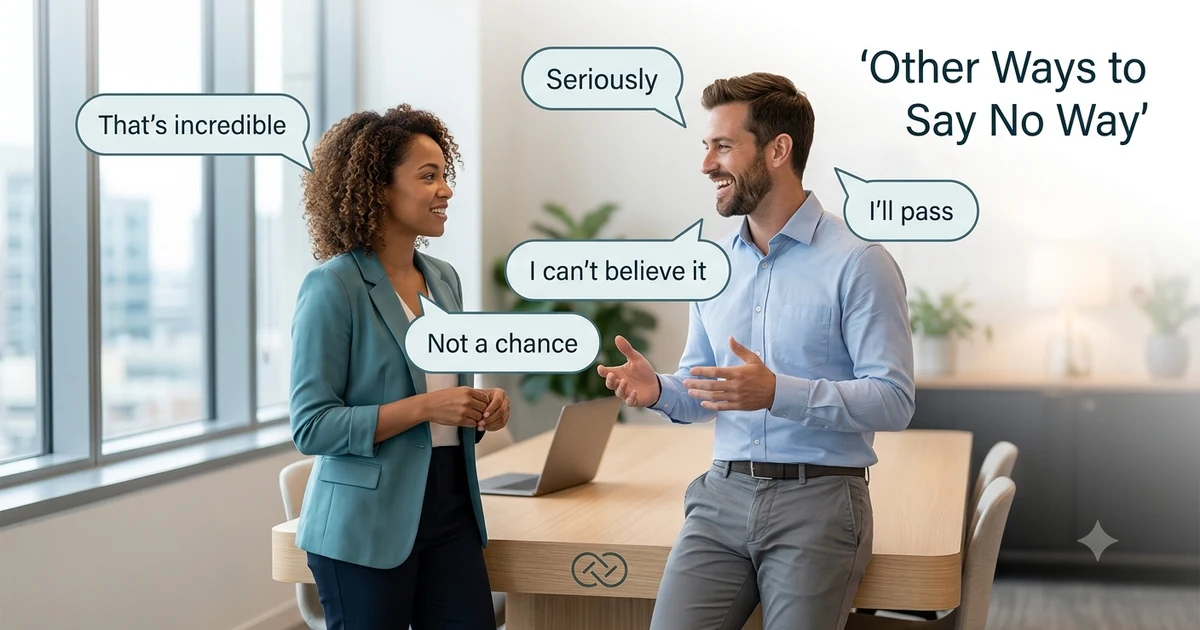
Have you ever wanted to express surprise, disbelief, or excitement without saying no way every time? Maybe you are writing a text message, chatting with friends, posting on social media, or looking for a more professional alternative. Learning other ways to say no way helps you sound more natural and choose the right expression for different situations. Some alternatives feel playful, while others sound polite, dramatic, or formal. The best choice depends on who you are talking to and what emotion you want to show.
Quick Answer
Other ways to say no way include phrases like I can’t believe it, you’re kidding, seriously, unbelievable, that’s incredible, you’ve got to be joking, and absolutely not. Some express surprise or excitement, while others show strong disagreement. Choosing the right phrase depends on the situation and your tone.
TL;DR
- Meaning: An expression of surprise, disbelief, excitement, or refusal.
- Tone: Usually casual, but alternatives range from friendly to formal.
- Common use: Texting, conversations, social media, and everyday speech.
- Where it appears: Chats, online comments, phone calls, and face-to-face conversations.
- Formal or informal: No way is informal, but many alternatives work well in professional settings.
What Other Ways to Say No Way Mean
The phrase no way has more than one meaning. People often use it to react to unexpected news, express disbelief, or refuse something strongly.
For example:
- I won free tickets to the concert.
- No way. That’s amazing.
Here, the speaker feels surprised and excited.
In another conversation:
- Would you like to work this weekend for free?
- No way.
This time, the phrase means a firm no.
Since it carries different meanings, you can replace it with different expressions depending on the context. A phrase that fits excitement may not work when you want to reject an idea politely.
Basic Explanation
No way is an everyday English expression rather than an abbreviation or slang acronym.
People commonly use it to show one of these reactions:
- Genuine surprise
- Shock or disbelief
- Excitement
- Strong disagreement
- A firm refusal
Because it is informal, friends, family members, classmates, and coworkers often use it during casual conversations.
Instead of repeating the same expression, you can choose alternatives that better match your feelings.
Alternatives for Surprise
When something unexpected happens, you could say:
- I can’t believe it
- Seriously
- You’re kidding
- That’s incredible
- Unbelievable
- No kidding
- Really
- Are you serious
- Wow
- That’s wild
Alternatives for Strong Refusal
If you want to say no firmly, consider these options:
- Absolutely not
- Not a chance
- No thanks
- I don’t think so
- That’s not happening
- Count me out
- I’d rather not
- I’ll pass
- Definitely not
- That won’t work for me
More Polite Alternatives
In professional or formal conversations, these choices sound more respectful:
- I’m afraid I can’t
- Unfortunately, no
- I have to decline
- That isn’t possible
- I appreciate the offer, but I’ll pass
- I’m unable to do that
- I don’t think that will work
- Thank you, but no
- I’d prefer not to
- Sorry, I can’t
How People Use It in Texting and Online Conversation
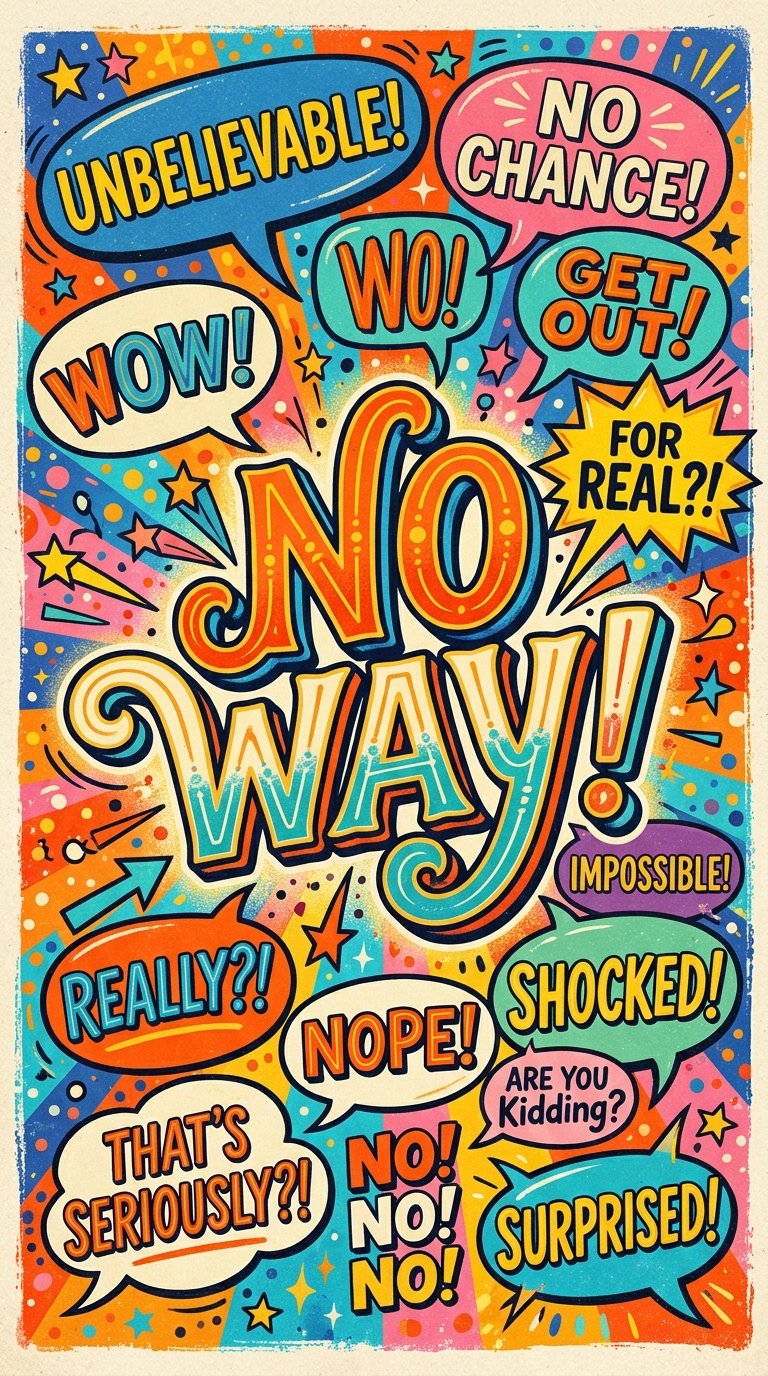
In texting, people often use no way as a quick emotional reaction instead of writing a full sentence.
Examples include:
Friend: I just met my favorite actor.
Reply: No way, that’s awesome.
Or:
Friend: We don’t have homework today.
Reply: Seriously?
Online conversations also use similar reactions because they feel natural and easy to read.
Popular alternatives include:
- Seriously
- For real
- You’re kidding
- That’s crazy
- I can’t believe it
- Wow
- Unreal
- That’s insane
- You’re joking
- No kidding
On platforms like Instagram, TikTok, Snapchat, and Facebook, people often reply with short expressions because they keep conversations fast and engaging.
For example:
- That’s wild
- Crazy
- Stop, really
- I refuse to believe that
- You’re making this up
- Tell me you’re joking
These alternatives help your responses feel fresh instead of repeating the same phrase every time.
Tone and Emotional Meaning
The emotion behind no way changes with the conversation. The same words can sound happy, shocked, doubtful, or even frustrated.
Here are the most common tones.
Excited
Someone shares great news.
Example:
I got tickets for the championship game.
Reply:
I can’t believe it. That’s amazing.
Surprised
You hear something unexpected.
Example:
Seriously? I never saw that coming.
Disbelieving
You think someone is joking or exaggerating.
Example:
You’re kidding. That can’t be real.
Firm Refusal
Someone asks you to do something you do not want to do.
Example:
Not a chance. I already have plans.
Playful
Friends often use humorous reactions.
Example:
Get out of here. You’re joking.
Your voice, facial expression, and the situation help people understand which meaning you intend.
Common Situations Where These Expressions Appear
You can use alternatives to no way in many everyday conversations.
- A friend shares exciting news.
- Someone tells an unbelievable story.
- You react to a surprising sports result.
- A family member announces good news.
- You decline an invitation politely.
- You refuse an unreasonable request.
- You reply to a funny social media post.
- Someone shares a shocking fact.
- You respond during a group chat.
- You react to unexpected workplace news in a respectful way.
Different situations call for different wording. Choosing the right expression helps your message sound natural, respectful, and appropriate for the conversation.
Examples in Real Conversations
Seeing these expressions in context makes it easier to choose the right one.
Situation: A friend shares exciting news
Example
Alex: I finally got the job I wanted.
Taylor: That’s incredible. Congratulations.
Meaning
The response shows excitement and happiness for the other person.
Situation: Someone tells an unbelievable story
Example
Chris: I saw a celebrity at the grocery store this morning.
Jordan: Seriously?
Meaning
The speaker wants to confirm the surprising information.
Situation: You think someone is joking
Example
Emma: I finished the entire project in one hour.
Liam: You’re kidding.
Meaning
The listener finds the claim hard to believe.
Situation: Turning down an invitation
Example
Friend: Want to go hiking at 5 a.m. tomorrow?
You: I’ll pass. Thanks for asking.
Meaning
A polite refusal without sounding rude.
Situation: Rejecting an unreasonable request
Example
Coworker: Can you finish my report too?
You: I’m afraid I can’t.
Meaning
A respectful but clear way to say no.
Situation: Reacting on social media
Example
Comment: You ran your first marathon today?
Reply: That’s amazing.
Meaning
A positive reaction that encourages the other person.
Situation: Family conversation
Example
Dad: We’re taking a vacation next month.
You: I can’t believe it.
Meaning
A happy and surprised response.
Situation: Casual group chat
Example
Friend: School is closed tomorrow.
You: No kidding.
Meaning
You are surprised by the unexpected news.
Similar Terms and Related Phrases
Many expressions carry a meaning similar to no way, but each has its own tone.
| Phrase | Meaning | Best Used When |
|---|---|---|
| I can’t believe it | Strong surprise | Good news or shocking news |
| Seriously | Asking for confirmation | Casual conversations |
| You’re kidding | Doubting something | Friendly chats |
| Unbelievable | Extreme surprise | Big events |
| That’s incredible | Positive excitement | Celebrating achievements |
| Not a chance | Strong refusal | Saying no firmly |
| Absolutely not | Very clear refusal | Serious situations |
| I’ll pass | Polite refusal | Invitations and offers |
| Really | Mild surprise | Everyday conversations |
| No kidding | Surprise or agreement | Casual speech |
Although these phrases share similar meanings, they are not always interchangeable. Think about the situation before choosing one.
More Than 50 Other Ways to Say No Way
Here are useful alternatives grouped by purpose.
For surprise
- I can’t believe it
- Seriously
- Really
- You’re kidding
- No kidding
- That’s unbelievable
- That’s incredible
- Amazing
- Wow
- That’s wild
- Unreal
- That’s crazy
- Are you serious
- For real
- You’ve got to be joking
excitement
- That’s awesome
- That’s fantastic
- How exciting
- Incredible
- That’s wonderful
- Amazing news
- What a surprise
- That’s great
- I never expected that
- This is huge
disbelief
- I don’t believe it
- That can’t be true
- You’re joking
- Tell me you’re joking
- You’re pulling my leg
- Impossible
- I find that hard to believe
- That doesn’t seem real
- Surely not
- You’ve got to be kidding
strong refusal
- Absolutely not
- Not a chance
- No thanks
- Definitely not
- Count me out
- I refuse
- That’s not happening
- I’ll pass
- I don’t think so
- Over my dead body
- Not for me
- I’d rather not
- That’s a hard no
- No, thank you
- I have to decline
polite conversations
- I’m afraid I can’t
- Unfortunately, no
- That won’t work for me
- I appreciate the offer
- Thank you, but I’ll pass
- I’m unable to do that
- Maybe another time
- I must decline
- Sorry, I can’t
- I’d prefer not to
When You Should Use These Expressions
Choosing the right phrase depends on your audience and the situation.
Good times to use them include:
- Texting friends
- Talking with family
- Replying on social media
- Reacting to surprising news
- Celebrating someone’s success
- Politely declining invitations
- Casual workplace conversations
- Group chats
- Video calls
- Everyday conversations
Matching your words to the situation makes your response sound more natural.
When You Should Avoid Them
Some alternatives sound too casual for professional settings.
Avoid informal expressions when you are:
- Writing business emails
- Speaking with a client
- Applying for a job
- Writing academic assignments
- Talking to someone you do not know well
- Responding during formal meetings
For example, saying You’re kidding to your manager may sound too casual. A better choice would be:
- Really?
- I wasn’t expecting that.
- That’s surprising.
- I appreciate the update.
Is It Formal or Informal?
No way is almost always an informal expression.
Here is a simple guide.
Informal
- No way
- Seriously
- You’re kidding
- That’s crazy
- Wow
- No kidding
These work well with friends, family, and casual conversations.
Neutral
- Really
- I can’t believe it
- That’s surprising
- That’s incredible
These fit many everyday situations.
Formal
- I’m afraid I can’t
- Unfortunately, no
- I have to decline
- That isn’t possible
- Thank you, but I’ll pass
These are better for workplaces, professional emails, and respectful conversations.
Common Misunderstandings
People sometimes misunderstand no way because it has two different meanings.
Someone may think you are refusing something when you actually mean you are surprised.
For example:
Friend: I won the lottery.
Reply: No way.
Most people understand this as excitement.
Now compare it with this conversation:
Friend: Can I borrow your car for a week?
Reply: No way.
Here, it clearly means no.
Context, tone of voice, and facial expressions help listeners understand which meaning you intend.
USA and Tier 1 Country Usage
People in the United States, Canada, the United Kingdom, Australia, and New Zealand use no way and its alternatives regularly in everyday conversation.
You will hear expressions such as:
- Seriously
- You’re kidding
- I can’t believe it
- No kidding
- That’s wild
- Not a chance
- Absolutely not
These phrases appear in text messages, phone calls, social media comments, and face-to-face conversations.
While wording varies slightly from region to region, these expressions are widely understood across English-speaking countries.
Quick Reference Table
| Context | Best Expression | Tone | Best Use | Avoid If |
|---|---|---|---|---|
| Friend shares good news | I can’t believe it | Excited | Casual conversations | Formal emails |
| Shocking story | Seriously | Curious | Texting and chat | Business meetings |
| Funny situation | You’re kidding | Playful | Friends | Professional writing |
| Strong refusal | Not a chance | Firm | Casual speech | Workplace communication |
| Polite refusal | I’ll pass | Friendly | Invitations | Serious negotiations |
| Business setting | I’m afraid I can’t | Professional | Emails and meetings | Casual chats |
| Social media | That’s wild | Casual | Comments and posts | Formal documents |
| Everyday conversation | Really | Neutral | Almost any casual setting | None |
Conclusion
Learning other ways to say no way helps you communicate more naturally in different situations. Sometimes you want to show surprise, other times you need to express excitement, disbelief, or a firm refusal. Instead of relying on the same phrase every time, choose an alternative that matches your tone and your audience.
Expressions like I can’t believe it, Seriously, That’s incredible, and You’re kidding work well when reacting to unexpected news. If you need to say no politely, phrases such as I’ll pass, I’m afraid I can’t, or Thank you, but no sound more respectful.
The best choice always depends on the conversation. By using a variety of natural expressions, your speaking and writing will sound more confident, friendly, and fluent.
FAQs
What are other ways to say no way?
Some common alternatives include I can’t believe it, Seriously, You’re kidding, That’s incredible, Unbelievable, Not a chance, Absolutely not, I’ll pass, and Definitely not. The right choice depends on whether you are expressing surprise or refusing something.
What does no way mean in text?
In texting, no way usually expresses surprise, excitement, or disbelief. Depending on the conversation, it can also mean a strong no or refusal.
Is no way considered rude?
Not usually. It is a casual expression that friends and family use every day. However, if you say it with a harsh tone or use it to reject someone abruptly, it may sound impolite.
Can I use no way in a professional message?
It is better to avoid it in professional emails or formal workplace communication. Instead, use polite alternatives such as I’m afraid I can’t, Unfortunately, no, or That won’t be possible.
What is the difference between no way and not a chance?
No way can express either surprise or refusal, while not a chance almost always means a strong and definite refusal.
Which alternatives sound more polite?
Good polite options include:
- I’ll pass
- Thank you, but no
- I’d prefer not to
- I’m afraid I can’t
- I have to decline
- Unfortunately, no
These expressions work well in respectful conversations and professional settings.
Which alternatives are best for texting and social media?
Popular choices include:
- Seriously
- I can’t believe it
- That’s wild
- You’re kidding
- Really
- No kidding
- That’s crazy
- Amazing
These feel natural in chats, comments, and everyday online conversations.